I may not agree with Maj. Gen. Kahinda Otafiire’s words but certianly I agree with his disagreement on restoration of kingdoms without prior assesment on how they would work and what their position in power would be. Read more about Otafiire’s comments here at Daily Monitor.
“Gen. Otafiire is vehemently opposed to the restoration of the monarchy in Ankole; which has never benefited from the 1992 High Command waiver as well as the 1995 constitution which restored traditional institutions.”
And I am glad we never got this Kingdom back, Ankole is a better place in terms of unity and progress.
I woke up this morning to the news of riots and death in Kampala. The Baganda youth protesting the decision by Police to block the prime minister of Buganda to enter Kayunga ahead of the Kabaka’s visit sent Kampala ablaze.
I am not a sympathiser of most of Buganda’s demands and moves but I don’t think the government can keep the Kabaka hostage in his own country. He is free to visit anywhere as long as there are his subjects in that part of the country. The minority Banyala as much as they have a concern for them to ask Kabaka to seek permission from their leader means that cultural institution have power to choose who enters their kingdom or not. The power which I believed the constitution puts in the hand of government through the police and courts. I think it’s hard to see kingdoms in Uganda right now in terms of territories. It’s like the Kabaka for instance can’t meet Baganda in UK without permission from the Queen of England instead of the police of the area. The Police in this case is the institution to allow the Kabaka to visit his subjects in that part of the country. The question that Museveni didn’t forsee was the terriotorial issue of that comes with kingdoms. Should the cultural institutions be observed only in historical territories amidst a modern Uganda where many Ugandans live outside their Kingdom. Is this to say that the Alur King cannot meet the Alurs in Kampala unless he asks permission from the Kabaka? The riots are just a symptom of tribal divisions in Uganda.
Back to the riot why should Ugandans die in a riot that could have been prevented? This reactionary behaviour of the government in Uganda has must be checked. Ugandans must seek explanations for the loss of lives and property in the riot. The government is basically failed to protect citizens from destruction.
But this is not to exonerate those who orchestrated the riots. For the youth to resort to riots which cause losses to traders who are already struggling is not logical. And using violence against the state many times is counter-productive. Burning government cars when you and I are the ones who pay taxes to buy them is like being disappointed and you burn your own house. Anyone behind this movement to oppose government decision regarding the Kabakaship should know that when you fight alone your cause is likely to be lost. I think if you want a certain status you have to do so much to win others who don’t see the self-governance in the same prism as you.
I have covered riots in Kampala and what I know they tend to actually lose grip on what direction they should take. There more about attention and leaders often think causing property loss attracts attention, which it does, but this is just being myopic. I believe if one has a cause worth fighting for they should do a lot of planning and try not to cause loss to those who have nothing to do with the state of things. Often the demonstrations have turned into looting which really blurs the intentions of the demonstration.
But still government could have prevented this by dealing with the situation in a different way. But when you have a government that doesn’t care about the losses of many struggling ordinary Ugandans it will take decisions that incite violence other than resolve matters at hand.
I don’t think the Kabaka poses such a threat to the regime and the Banyala that he has to be made a prisoner of sorts. And if he doess, there are better ways to address this. And no Ugandan life should have been lost in the name of blocking a king from visiting another part of the country.
The recent return of Olara Otunnu, the former UN Under secretary to Uganda politics and his continued claims that genocide was committed in northern Uganda has drawn quite some reactions in the country. Top of it has been the army spokesperson Lt. Col Felix Kulaigye who is defending the institution saying it behaved well and a few incidents of murders got deserved attention and justice from the army system. Otunnu’s claim is backed by some members in the Acholi Parliamentary group like Reagan Okumu.
For anyone especially outsiders (read not direct victims of the conflict) to engage in the debate we must understand what genocide is.
Scholars like Gregory H. Santon, the founder of Genocide Watch have said genocide doesn’t only just describe the killings but it is rather a process that happens over time. There are eight stages of genocide which include classification, symbolisation (using symbols to distinguish the group), dehumanisation (“dehumanization overcomes the normal human revulsion against murder.”), organisation and polarisation, preparation, extermination and then denial.
Whereas all genocides don’t follow this chronology, most of them have most elements of these stages.
With the accusations at hand we must ask ourselves, was there a well planned strategy to exterminate people of the north by President Museveni’s regime? If it happened, how did it happen and what features of dehumanisations can we point out. What about symbolisation? I know many people both in the past and today have referred people from northern Uganda with derogatory terms like Badokoli. In fact in my language ‘we’ even go further to dehumanise them calling them Bakooko
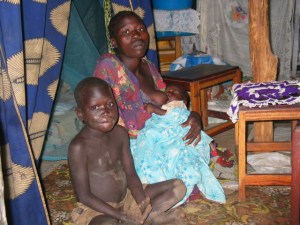
A woman with her kids in hut at Anaka IDP camp. Rosebell Kagumire photo.
(ekikooko is an animal) because of their different black colour.Did such kind of dehumanisation play a major role in how government dealt with the conflict, either its inaction or bad reactions?
If we follow these stages, then Kulaigye’s institution, the army is just a small part in the genocide process because the armies usually move to act on orders from the politicians and this is after the politicians have done enough negative canvassing to justify their moves.
And for a situation to be genocide there has to be a plan to kill a population in part or as a whole. Otunnu’s claims suggest that the government is at the denial stage.
And Kulaigye points out that the ICC investigations cleared the Ugandan army but this doesn’t necessarily take away the debate for it can take long before genocides are acknowledged because of politics.
For instance the genocide of Armenians in 1915 has just been recognised. Also the
Surviving Herero after an escape through the arid desert of Omaheke. Wiki photo
mass killings of the Herero and Namaqua in Southern Africa by Germans from 1904 until 1907 what has come to be called the first genocide of the 20th century, wasn’t recognised as genocide straight away.
(In 1985, the United Nations’ Whitaker Report recognized Germany’s attempt to exterminate the Herero and Nama peoples of South-West Africa as one of the earliest attempts at genocide in the 20th century. The German government apologized for the events in 2004)
I believe we still need to investigate and debate killings in northern Uganda and what happened especially times when there was restricted movement and when the outside world and media in Uganda was not on top of the issue. I am among those who are not quick to say there was a genocide but I will also not be part of the group that believes that government actions in the north were free of any contempt for the population. It’s the truth that will set the country free not the blame games. It’s unfortunate that Kulaigye and the regime want to use use seditous laws to stop the debate. We should be able to disect the claims and deal with them. If you stop debates, it kind of gives the impression you’re scared of debate or its outcomes. Besides that doesn’t end the debate but only postpones it.


 Rosebell Kagumire