Twitter revolt in Uganda?

Today we woke up to the words of the Uganda Security Minister Wilson Muruli Mukasa saying the opposition is using social media to pyschologically prepare youth for armed insurgency. It couldn’t have been better timing looking at what’s coming out of UK government after the riots. Such claims also came out as the opposition was launching new round of walk to work protests.

The first day on Wednesday August 10, the police disperse peaceful opposition supporters in Masaka led by the FDC leader Kizza Besigye. Mukasa’s allegations of a twitter revolt is based on these renewed efforts by opposition to stage protests despite government crackdown. This claim was discussed well among Ugandan tweeps who mostly wondered if the minister really knows how twitter works. Top tweets in Uganda are not even from politicians but rather individual youths looking for forum to discuss issues affecting their country and their lives.

No doubt the Uganda opposition uses social media much better than the government. We have seen top opposition leaders updating their facebook and twitter accounts as they are in running battles with the police. But government’s reaction to social media has been slow ad hence they see the opposition having some good advantage in the race to put out information. I remember in April when the protests were on high, the presidential press secretary told the Guardian that they were not bothered about the impact of social media because “farmers in Uganda don’t know what it is.” Today we see the government waking up to accept the power of social media-in a disguised way- on the youth in the country. Social media use in Uganda has been steadily increasing since end of last year.

In June I was part of an amazing program by the US Mission in Geneva – a Internet Freedom Fellowship. As part of the program I visited the Office of the High Commissioner for Human Rights in Geneva. It’s great to see them follow some issues I highlighted last week. The story of Ester Abeja, a woman from Lira who experience wartime sexual violence and she is in need of a surgery to remove her uterus. The OHCHR highlighted her case here.  Social media is important in putting out stories like that of Abeja, from Lira to Geneva which would otherwise not have been captured by the traditional media.

It’s in the freedom to use the internet that we have seen a certain advance in human rights violations reporting. Therefore moves from people like Mukasa’s and efforts by Cameron in UK shdn’t be just brushed aside. Governments want to use situations like riots to muzzle internet freedom.

They want to attack the means of expression but not the root cause of these riots. We will have to watch in coming days what the government in Uganda will do. Today we see protesters being called terrorists and tomorrow we could see social media users being charged with terrorism for merely expressing themselves.
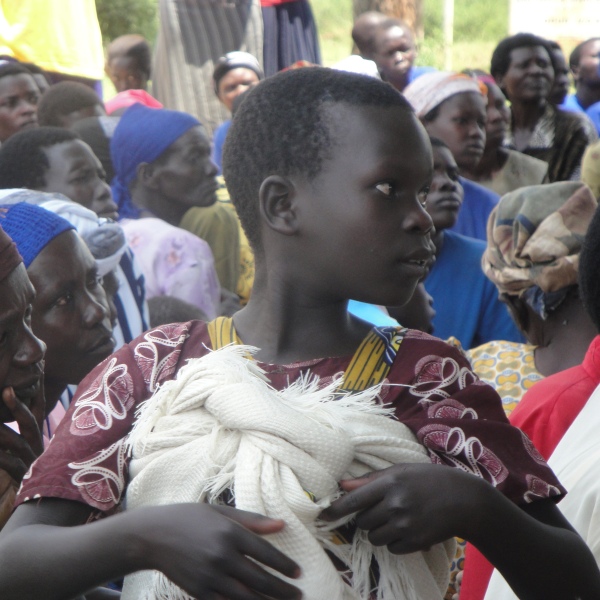
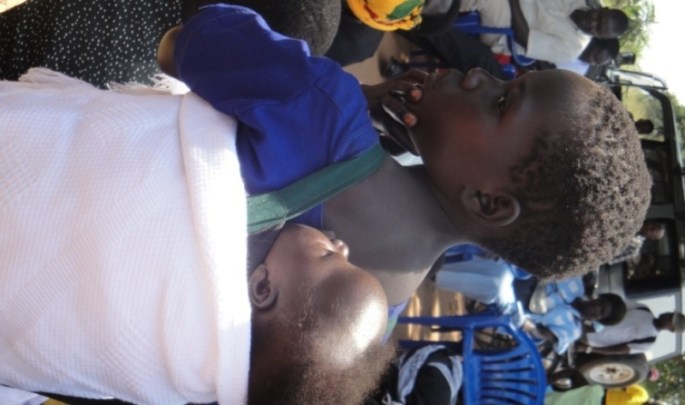
 

Right to Education? I stay out of school for my family.

Last year the Observer reported that in some areas in Uganda the school dropout rate for girls is about 84 percent. Reports have shown that the national primary school dropout rates for girls in Uganda is at 20% annually and about four times more in some districts in the northern and eastern parts of the country (mostly affected by the 23 year war.)

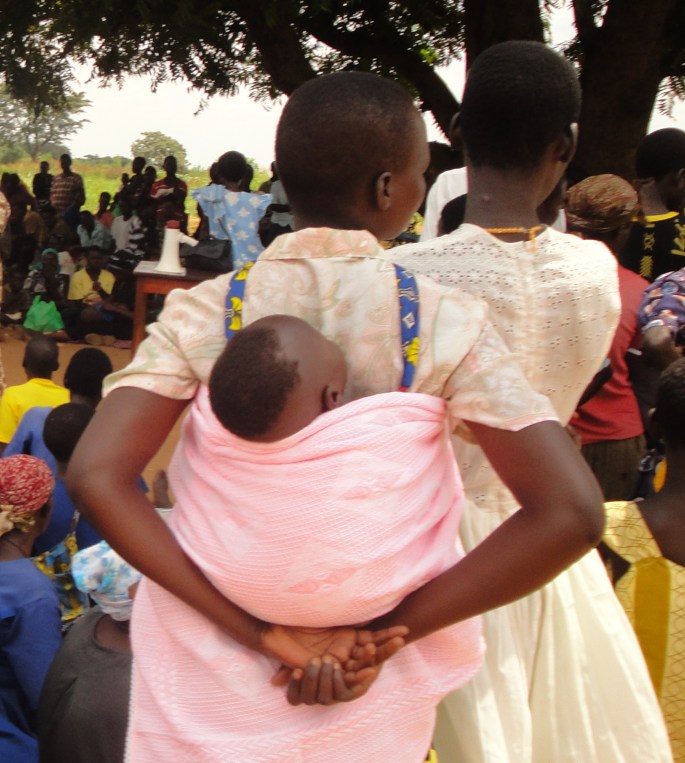
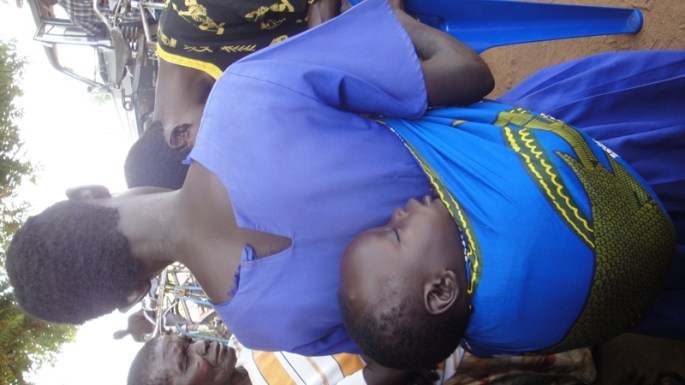
In Lira at one of the OutPatient rooms I watched as girls as young as 10 spent a whole day in queues carrying their young siblings as their either pregnant or sick mothers waited in line. It was a school day and all these girls had missed school. Often when a woman has many children, it’s the girl child who stays back to literally raise her siblings at the expense of her education. Also I met girls about 15 years with children or pregnant at this health center. Catherine Abor, one peace activist told me when i asked why this is going  “the men here have no mercy for these women. They say the war reduced their clans and therefore women must produce as many as possible. This means many don’t support girls to go beyond primary school.” May be its not a mercy thing. But these attitudes keep the girls out of school and so does the lack of coherent policies to back the universal primary education that was introduced more than 10 years ago. The human development issues this country faces cannot be overcome if we can’t keep the girl child in school.

Here are the girls I met.

Last year UNESCO ranked Uganda as country with highest school dropout rate in East Africa. Girls dropout most due to teenage pregnancy and marriage.
A follow-up of every 100 pupils who joined Primary One in 1999, showed that only 25 children in Uganda reached Primary Seven in 2006. Kenya had 84% reaching Primary Seven. Tanzania stood at 81% and Rwanda at 74%--UNESCO.
Most girls that drop out of school are likely to be married off before they are 18 and this means they will have more children and the cycle of poverty never breaks.
Other reports have shown costs of schooling and family responsibilities drive thousands of Ugandan children out of school.

You are my child I shouldn’t be telling you this

This week I was in Lira in northern Uganda at a medical camp for women with reproductive health complications most of them sustained during the 23 year LRA war. Organisers had no idea 400 women would turn just on the the first day.

I was taking interviews from these women most of whom it was the first time they were going to see a gynecologist since the various sexual violations happened. It is always a tough position to be in. Women as old as 60 years narrating how they were raped, how no one wants to hear their story, how the community calls them all sorts of names it is beyond what i can describe.

One of the very first interviews, I was speaking to Akello (not real name) a woman who was abducted together with her co-wife. They reached the bush and were forcibly ‘married’ to one man. They both endured years of sexual violations including gang rapes. They returned 6 years ago, they didn’t know they both had HIV. Akello tells me they passed it on to their husband they had left behind and he died 3 years ago. She hasn’t really dealt with her own trauma and she blames herself for ‘killing’ her husband.

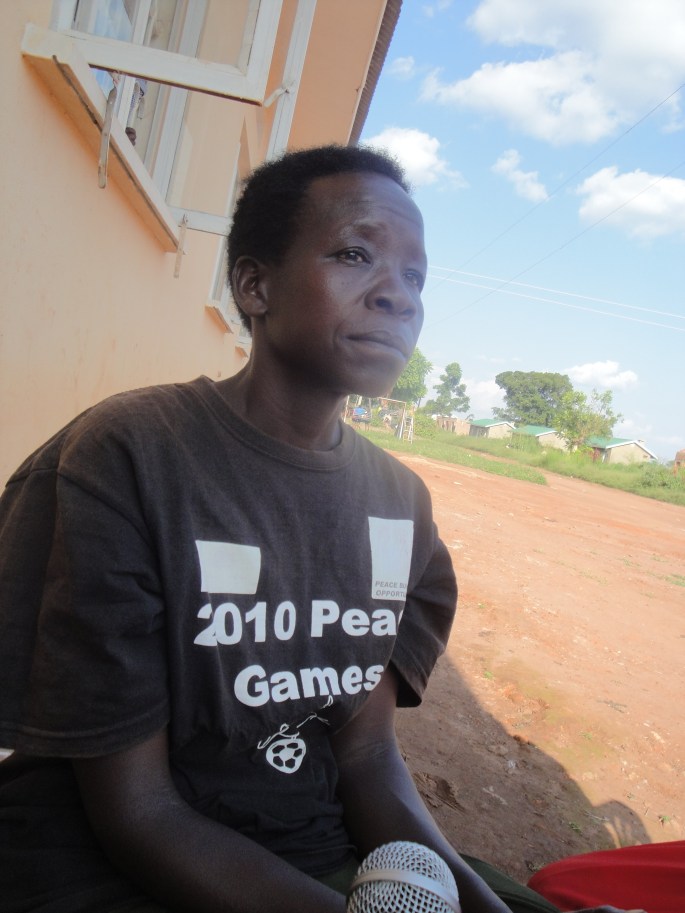
One of the women at the medical camp in Ogur Lira.

Just like in all interviews, we always take time out when the woman needs sometime pull herself together. At the end she calls me back and says “You are my child, I shouldn’t be telling you this.” I had no words to add, I just sat down for some minutes. I felt she wanted to spare me from listening, listening to horrors that many others preferred untold. We had been through it all, her life in the bush, her life after and how she hardly owns anything. How she struggles to feed and educate her 2 grand children. Of the 8 children she had, only one survived. It’s tougher to listen to a woman your mother’s or grandmother’s age talk about how she was raped. You can’t easily cry because you don’t want to derail her further. You can’t help see your mother in the faces of all these women left with almost nothing of their dignity. Yet they tell you these stories that mothers can never tell their children because they think you can help in a way.

I met Ester Abeja, she insisted that I put her face out. She was afraid that covering her face was more like what the community and government have done-ignore their plight. Like most of the women that turned up for the screening, she had complications. She is suffering from what doctors called uterine prolapse (the descent of the uterus into the vagina or beyond). In her case her uterus is hanging out. She was abducted and violated by the LRA rebels for many years.  Ester needs a surgery that would cost about 200 USD. She has had this condition for years and she is raising 5 children whom the husband abandoned. Before I spoke to her she was visibly traumatised and she told me many times she has thought of killing her husband who now has two other wives. We talked about it and she agrees that wouldn’t solve her problems, we have to concentrate on getting her the operation to remove her uterus.

Most of the women i spoke to had been abandoned by their families once they came back from the LRA. They face a high level of stigma. For those who had children with the rebels and came back with them it’s even much more difficult. Their children are called ‘Kony’s children.’

Ester Abeja.

Ester had one child with one of the rebels, she’s now about 6 years. “Do they think I wanted to be raped by these rebels? Do they think i wanted to kill my own child?” Ester wonders. She tells me another chilling story of how rebels forced her to kill her one year old baby gal by smashing her skull on a tree. Another young son was captured with her and she has no idea if he’s still alive.  She tells me she rarely sleeps and you can see it in her eyes.

I left Ester in Ogur. I am hopeful that Isis-WICCE, the organisation i worked with on this medical camp, can get money to get Ester and others the much needed surgery. There’s such lack of attention for survivors of sexual violence who are mostly women all over the LRA affected areas. And if she gets the surgery she will need support and most of these women need a lot of economic empowerment but few reach government programs.

One doctor from Lira told me, “When war ends, there’s a silent war that has to be fought.”

He said the challenge so far has been that “politicians think they will just put structures which they can use to say this is what i did during my time and ignore peoples needs.” And i don’t expect my government to get Ester the much needed help because even the health center we were at didn’t have any drugs to give to those with the simplest of the reproductive health problems.

Hunger; the ultimate failure by East African governments

The main focus has been on the humanitarian needs for the worst affected. The UN estimates that and extra $1.2billion is required to meet immediate needs and of this so far less than $300 million has been provided.

Yet the discussion cannot just be about meeting the needs of today. This crisis was predicted, governments and international community had enough time to respond and had they responded we would not be seing images of children with bare ribs arriving in Dadaab.   I have seen statements slamming international community for its slow response to the crisis but I have not seen many questions put these African governments expect for Kenya over opening a new camp for Somali refugees.

Read more of a blog i wrote for Channel16 published earlier this week.

Uganda radio presenter dissapears

Yesterday the Human Rights Network for Journalists-Uganda (HRNJ-Uganda) sent out a message on the disappearance of Augustine Okello aka Rouks, a radio presenter at Rhino fm based in Lira. Okello was last seen at the office of the District Internal Security officer on Wednesday last week. Since July 13 he has not been seen.

Journalists believe there’s a chance he’s being help incommunicado by authorities. Today over 50 journalist marched to the central police station in Lira to deliver a petition demanding that authorities explain where Okello is being held and why he’s being held.

The the DISO Eryaku Steven shut his office and never met with the journalists. Okello is also a student at UMCAT School of journalism-Lira Study Centre. Eryaku denied Okello’s whereabouts but the presenters motorbike has been parked at the station since he’s disappearance. The police is not talking about the case and they claim to have opened an inquiry.

Detention with charge for anyone is supposed to be illegal the last I checked but may be as many things in this country change day and night that too could have changed.

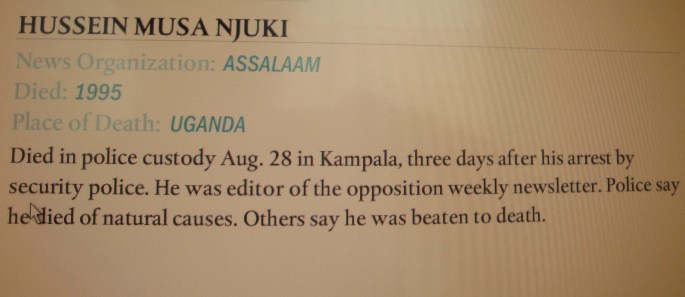
This case just reminded me my recent trip to the Newseum in DC where I found the case of Hussein Musa Njuki a journalist who died in detention on August 28 1995 three days after his arrest. Police said he had died of natural causes but few believe that account. Whatever Okello did police or security forces are violating the 48 hr rule for any detention.

Others on the list of journalist who have been killed in Uganda at the Newseum.

Detention without trail; another slap to Uganda Constitution?

In April, in the heat of walk to work protests that were led by opposition groups, President Museveni suggested he would bring proposals to parliament to change the constitution. He said he would seek to remove constitutional bail for “rioters, economic saboteurs, rapists and murders.” At time many thought the president was merely speaking out of anger as the Uganda was in international headlines everyday thanks to the high-handedness  the security forces used against the protesters who simply wanted to walk to work to highlight the need for concrete interventions in rising food and fuel prices.

To shock of many and those who think still has the vision for this country, Museveni has insisted that that detention without trial for months for anyone under the group he has mentioned is really needed. The proposal is a clear move by Museveni to get to arrest and detain his political opponents or those who question his policies. He just threw in categories like rape and murder to play emotions of Ugandans. He knows even within his own party, many don’t agree with his move to remove a constitutional right and breaching of the law that recognises that one is innocent until proven guilty.

The Uganda Constitution provides that a person arrested in respect of a criminal offence is entitled to apply to the court to be released on bail and the court may grant the same on such conditions as the court considers reasonable.

To bypass those opposed to this change even in his own party, President Museveni has called for a referendum which he is sure he can manipulate to get his desired outcome just like many elections we have had since he came to power.

Daily Monitor quoted Livingstone Ssewanyana, a human rights activist saying such A change would be contested in court but also said.

“The referendum would be a good idea” as it would “let Ugandans decide if they want to be enslaved by such an unconstitutional move”.

In the past,President Museveni has used trumped up rape charges against his opponents. As a person who has worked with survivors of sexual violence in war affected areas in Uganda (some of it carried out by government forces), I don’t think Museveni’s inclusion of rape in this category is an attempt to address the issue. Denial of bail cannot  stop the rape or provide the much needed services for those who have been rape victims and can’t easily access justice.

To entertain an idea of holding such a referendum at a time when the economy is not doing well, when many are unemployed shows how out of touch the president is. We will watch and see if the president will achieve his mission and this might not be impossible if you know how the constitution was changed to deal away with presidential term limits.

Arms Trade Trade negotiations on

This week the third arms trade treaty preparatory committee  for the UN Conference on an Arms Trade Treaty (ATT)  is seating in New York.  The purpose of the PrepCom is to make recommendations on the elements that would be needed to attain an effective and balanced legally-binding instrument on international standards for the transfer of conventional arms. The ATT is to be negotiated in July 2012.

Armtreaty.org has developed a map showing states and where they stand on the different aspects of the treaty that are to be negotiated on.

I looked through to see how African states are doing on a few issues. You can follow the map to track down countries, their positions and voting patterns on the issue.

Armed Violence:

Most of African countries have made expressions of support for considering ‘prevention of armed conflicts/violence’ as a criteria in the Arms Trade Treaty but they are not actively advocating that violations of the criteria should lead to a denial of the transfer, or suggesting their inclusion requires consideration.

Munitions:

Under Munitions:  ‘Ammunition’, ‘munitions’ and ‘explosives’ refer to large caliber munitions (e.g. missiles) and small caliber ammunition (e.g. bullets for firearms).

Most of African states have expressed strong support for including ‘ammunition’ or ‘munitions’ in the scope of the Arms Trade Treaty. Apart from Ethiopia and Egypt.

Maritania has not made any statement is publicly about its position on munitions.

Brokering:

Brokering generally refers to arranging or mediating arms deals and buying or selling arms on one’s own account or for others, as well as organizing services such as transportation, insurance or financing related to arms transfers, and the actual provision of such services.

Here most of African countries have no known stand. Most ECOWAS countries have expressed support for the inclusion of ‘brokering’, ‘brokerage’, ‘brokers’ or ‘dealers’ in the scope of the treaty. South Africa, Egypt and DRC only mentioned of brokering and dealing without expressing support. South Africa and Egypt are top of the list of arms production on the continent.

Corruption:

This category maps States’ positions on including as a parameter of the Arms Trade Treaty provisions to restrict transfers that could exacerbate or institutionalize ‘corruption’ or ‘corrupt practices’. In the context of arms transfers, corrupt practices include bribing of state officials with commissions and kickbacks provided by arms producers and traders to facilitate a transfer agreement.

Only Niger, Mali, Burkina Faso, Cote d’Ivoire, Togo and Zambia have given this corruption inclusion a strong backing. Most of the states on the continent have no known stand on corruption in the arms trade and transfer under the treaty.

U.S and China remain one of the few countries strongly opposed to the corruption clause while many countries have remained silent. Many African states lose a lot of money in covert arms trade deals by corrupt state officials which are never known by the citizens.


But also countries are tied in talks on implementation of the treaty.

The major weapon producing and exporting states articulated a vision of a simple treaty that above all ensures that “commerce”— the sale of weapons—is unhindered by stringent transfer criteria or robust treaty implementation measures. To this end, the five permanent members of the UN Security Council (P5: China, France, Russian Federation, United Kingdom, and United States), along with Canada and India, stipulated that the implementation provisions should be “simple, short and easy to implement.” Arguing against the inclusion of any specific implementation measures, the P5 said, “Domestic implementation in accordance with national legislation and regulations in line with the obligations that would arise from any possible ATT would be the most practical way to address implementation.”

According to the Arms Trade Treaty Monitor.

But for many states, and most of civil society, setting standard criteria for arms transfer decisions is the point of the ATT—they see the treaty as a gauge that all states must use before authorizing an arms transfer, and they argue that this will help improve equitably, as well as human security.

Spirit not shaken; Ugandans remember July 11 bomb victims

It was supposed for be a joyful day.  Uganda, a football loving country just like many in different corners of the world was waiting to see who would lift the first World Cup trophy on the African soil. Hosting the World Cup, even when it was thousands of miles away at the Soccer City, was something the filled the hearts of many Africans with pride. On this day I was in Johannesburg, in Soweto watching the great performances of the likes of Yvonne Chaka Chaka, Angelique Kidjo, Eric Wainaina and Oliver Mutukudzi as they wrapped up the World Cup with great African rythms.

In the later hours of the day shortly before Spain lifted the trophy, Uganda witnessed horror as twin bomb blasts ripped through bodies of young men and women. 76 lives most of them young Ugandans were taken in just a few minutes at Kyandondo and Ethiopian restaurant. Al Shabab, the al-Qaida linked Somali militant group had been warning the country over our troops that have been deployed in Mogadishu since 2007 and they later claimed the responsibility.

The last one month, the Ugandan media especially Daily Monitor  has done a great job covering the lives of those who survived the 7/11 and those whose loved ones were taken by the bombings.

However we have not comprehensively covered what happened in regard to the bombers and how the 7/11 bombings happened. Our government did carry out arrests even cross the border in Kenya and Tanzania but not much has come out of this. There has not been any proper trial. We have seen reports of Kenyan human rights defenders locked in our jails, many people locked without charge and it seems Uganda has emulated tactics from the American war on terror that saw thousands of innocent people jailed without trail.

Daily Monitor today carried a story of how terrorists lived in close proximity with top defense officials in the country and yet our intelligence failed to unearth the bombing plans.

“It was apparently planned in Mogadishu, the explosives assembled in Kenya’s Eastleigh, a Nairobi suburb, while the funding was allegedly wired from Pakistan and execution carried – to devastating effect – in Kampala by among others, ordinary-looking Ugandans some of who fraternised even with the senior army officers.

In the story the Army spokesperson Felix Kulaigye informs us that terrorism is impossible to stop.

“Terrorism is impossible to stop since it has no face or religion. You can only minimise their chances,” he said, pointing to the September 11, 2001 Al Qaeda attacks on the US, despite the world super-power’s sophisticated security arrangement.

Ugandan photojournalist Edward Echwalu captured the memorial service held today to mark the one year 711 bombimg anniversary in Kampala. One message from caught my eye ‎” 7/11 bomb blast, we remember one year later, our spirit is not shaken…”

It’s important to support families of those who lost loved ones not just by throwing money at them but give them psychosocial support. But above all we need to ensure that no more bombings take away another Ugandan life.

While it’s difficult to stop a man willing to take his own life in order to kill others, its’ possible to be truthful about our engagement in Somalia which is the main link to why the attacks took place our soil in the first place.

After the bombings most Ugandans started asking what we were doing in Somalia, before not many ever cared that we had troops there. Terrorism can inflict pain on anyone but our spirit to seek a genuine engagement and understanding our foreign policies and their impact should not wither.

Many believe we are fighting someone else’s war in Somalia and we will no doubt pay the price. After fighting the Taliban for 10 years, the US is leaving Afghanistan with not much to show in terms of stability. Last month US drones wounded militants  in Somalia. My worry and the worry of many Ugandans is that our country as well as Burundi have embroiled themselves in war on terror when they have the least capacity to protect their own citizens from the retaliation that is always assured.  Despite our troops being in Mogadishu as peacekeepers, this is very much a war and years have shown that we are still looked at as a representation of foreign interests in Somalia by Somalis. This argument has its own basis. Ugandans need to question our involvement in Mogadishu and whether our leaders have any plan to leave.

South Sudan Independence; A new journey begins

Flag of the Sudan People's Liberation Army/Mov...
Image via Wikipedia

Tonight at midnight, South Sudan will be covered with jubilations, from Juba to Warab, Torit to Yambio, Wau to Raga and all other corners of the new republic. Several dignitaries from around the world will be there to give their blessing to the divorce and for the new nation on Saturday.

And the dream of many like John Garang de Mabior the great South Sudanese fallen leader will come to pass. He once said:

“It is not my intention to change the Comprehensive Peace Agreement but I must say South Sudan needs its own independence. I see it coming even when am not the leader of SPLA/M.”

South Sudanese reporter, Anthony Kamba wrote a piece capturing what the mood in Juba was like ahead of the historic day.

The UN Secretary General Ban Ki-moon wrong an opinion and called it Standing by South Sudan and in there, he captured the countries challenges but most important the opportunities.

‎”…South Sudan has remarkable potential. With substantial oil reserves, huge amounts of arable land and the Nile flowing through its center, South Sudan could grow into a prosperous, self-sustaining nation capable of providing security, services and employment for its population.”

It’s this optimism that I carry a few hours from the independence declaration. I was chatting with a South Sudanese friend and he said to me to understand the feeling I would need to talk to people who lived in places like Kenya where colonial struggles claimed many and lived long to see the Union Jack come down.

South Sudan has been born at time when Africa has made substantial steps in development unlike the 60s. With a population that is not even half that of my country Uganda, South Sudan will need its neighbours who are already a step ahead in all sectors and am optimistic they will be a good asset. Women in Sudan are more than 60 percent of the population, yet 80 percent of them are illiterate. Empowerment of women of South Sudan will be key to the country improving the gloomy development indicators faster. I remember I met one woman on one of the trips to Sudan who said they didn’t want to be like women of Eritrea “who fought but in the end they were pushed out of the system and told their place was only in the kitchen once independence was declared.”

In April I was in Juba working with grassroots women leaders. Juba is a melting pot. It’s where East, Central Africa meets the north and horn of Africa. It’s one of the most diverse African capitals I have visited. My Boda Boda rider was a young man about 20 years old. He was born in Torit, he lived in Masindi in western Uganda then Kenya before finally coming back to Sudan. He speaks about ten languages. Language is important for integration and most Sudanese have spent many years living in Uganda, Kenya and Ethiopia. These experiences can be harnessed to bring about changes in the new republic. South Sudan can take advantage of the booming sectors like education in Uganda where graduates spend years with no job.

It can get professionals from regional capitals who are not being put to use by their countries. These young people can be good for South Sudan as it starts from scratch. The new rich country where production is almost none existent will put pressure on its neighbours for some time because it is a great market for almost everything from food to industrial products to human resource. This can make South Sudan prosperous some years down the road.

But the all this optimism can only mean much if South Sudan can tame its ethnic divisions, corruption and the culture of hero worship. I know dangers of this culture because I am Ugandan. Twenty years after people fought to take power, we are still told if you didn’t fight for the five years in the bush, you are probably useless and you shouldn’t demand for good governance and a your share of the national cake. So Sudan must keep those heroes and heroines accountable. All Sudanese paid the price in this liberation and the country’s ruling party must start embracing alternative views.

I remember at one of the meetings a woman told me that in South Sudan if you don’t support SPLM you are equated to Bashir’s spy or the enemy. This stifling of people’s right to choose a party and oppose policies the way they see fit must be abandoned. And then the tribalism! You don’t want to see another Kenya of tribal politics and high inequality in the new country.

SPLM government must ensure they work for the good of all South Sudanese and shouldn’t hold the country at ransom and its oil revenues. The optimism rests on whether Salva Kiir and his government can deliver that country that many desired and fought for and died for. A country where they could be free and be free indeed.  When the midnight bells rings today, it will be a celebration of many thankful souls. Thankful that after all the loss and despair they went through they have lived to see this historic day. A day I pray will have even greater meaning when people of South Sudan look back some years from now.

A strong UN force on North-South border needed to realise South Sudan independence

Tomorrow, the UN Security Council will vote on a new Mission to South Sudan. The current Mission (UNMIS) has to leave the country (North Sudan) by  Saturday  July 9 when the Republic of South Sudan finally comes into being. Different agencies working in Sudan have to the last few days try to put up a case for a new revitalized force which would have a mandate to enforce peace given the current security situation in border states as well as Abyei and South Kordofan.

The situation is tense as the inevitable divorce approaches. The northern army has bee accused of ethnic cleasing in Abyei by many human rights campaigners. Such charges are not baseless. According to OCHA, in 2009 over 350,000 people were displaced by violence and 2,500 killed in southern Sudan.

By mid-June 2011 alone, over 300 conflict incidents had taken place, with over 1,800 people killed and 264,000 people displaced in southern Sudan. This means more people in South Sudan have been killed in the first months of 2011 (over 1800) than in the whole of 2010 (less than 1000) most of them  through violence in the North-South border areas, deadly cattle raids, inter-communal violence and clashes between southern rebels and  the SPLA – South Sudan national army.

Violence in recent weeks in Abyei, Southern Kordofan and across southern Sudan has also forced over 180,000 people to flee their homes, according to UN reports.  The UN has called on the Security Council to send a strengthened Mission to the border as the situation is very tense and the country needs all the support it can to protect its population.  The UN asked for 7.000 troops but reports indicate talks are going very badly as the UK, US and France are trying to trim the size of the Mission, its budget and its staff.

Kirsten Hagon, Head of Oxfam’s New York Office yesterday said:

“Hundreds of billions of dollars has been spent in Afghanistan and more recently over US$ 1 billion was spent in three months in Libya. That is the cost of the current UN mission in Sudan for a whole year. Southern Sudanese deserve to get the full backing of the UN Security
Council.”

Oxfam warned that taking the cheap option would cost lives and risks destabilizing the region. The agency said inadequate numbers of peacekeepers for the next mission in South Sudan risk endangering thousands of lives and future stability.

While the UN peacekepers alone cannot bring the much needed peace to people living in the border states and regions like Abyei and South Kordofan, failure to fully fund and resource the Mission – including by slashing troop or civilian staffing numbers due to cost concerns – would undermine the progress that has been made over the past six years.

“If there was ever a time for the Security Council and countries that contribute to peace keeping to support the people of Sudan, it is now. Violence is rising and this isn’t the time to go cheap by cutting on the budget of the future UN mission, on the number of boots on the ground or the number of civilian staff. They must walk the talk and provide their strong backing in a time of optimism but also extreme tension for the people of South Sudan,” said Hagon.

As the budget for the Sudan Mission is to be slashed we see realized that the five permanent members of the UN Security Council, who will decide the future of this mission,  spent in 2010 alone a staggering US$ 996 billion on military expenditure while the annual UN Peacekeeping budget is roughly $9 billion.
Beyond the funding, the issues that have marred the UNMIS1 should be avoided.

Like Tendai Marima is a Zimbabwean blogger noted there have been issues with the intervention of the peacekeepers.

In Abyei, Zambian peacekeepers preferred to hide out in their rooms for two days rather than go on patrol and protect civilians caught up in the conflict. Similarly in South Kordofan, Egyptian troops are reportedly occasionally reluctant to carry out their duties.”

Such conduct must be checked if the UNMIS2 is to make any impact but for now the UN Security Council must deliver a well sized and well budgeted force to protect civilians in Sudan.