Part three: Museveni’s statement criticizes bombing Libya

On current operations against Gaddafi by coalition of western countries:

1: distinguish between demonstrations and insurrections. leave it to internal forces

2: What will you do for China?

3: West has double standards take a look at Bahrain, other pro-Western regimes and wat about Somalia?

4: Using technological superiority to spread war on poor countries, warns of arms race

5: Gaddafi should sit down with opposition under AU mediation

6: calls ‘extra-ordinary’ Summit of the AU in Addis Ababa to discuss this grave situation.

7: West intervention never really helped Middle East and Africa. remember killing of Lumumba!

Statement continues:


Coming to the present crisis, therefore, we need to point out some issues:

  1. The first issue is to distinguish between demonstrations and insurrections.  Peaceful demonstrations should not be fired on with live bullets.  Of course, even peaceful demonstrations should coordinate with the Police to ensure that they do not interfere with the rights of other citizens.  When rioters are, however, attacking Police stations and Army barracks with the aim of taking power, then, they are no longer demonstrators; they are insurrectionists. They will have to be treated as such.  A responsible Government would have to use reasonable force to neutralize them.  Of course, the ideal responsible Government should also be an elected one by the people at periodic intervals.  If there is a doubt about the legitimacy of a Government and the people decide to launch an insurrection, that should be the decision of the internal forces.  It should not be for external forces to arrogate themselves that role, often, they do not have enough knowledge to decide rightly.  Excessive external involvement always brings terrible distortions.  Why should external forces involve themselves?  That is a vote of no confidence in the people themselves.  A legitimate internal insurrection, if that is the strategy chosen by the leaders of that effort, can succeed.  The Shah of Iran was defeated by an internal insurrection; the Russian Revolution in 1917 was an internal insurrection; the Revolution in Zanzibar in 1964 was an internal insurrection; the changes in Ukraine, Georgia, etc., all were internal insurrections.  It should be for the leaders of the Resistance in that country to decide their strategy, not for foreigners to sponsor insurrection groups in sovereign countries.  I am totally allergic to foreign, political and military involvement in sovereign countries, especially the African countries.  If foreign intervention is good, then, African countries should be the most prosperous countries in the world because we have had the greatest dosages of that: slave trade, colonialism, neo-colonialism, imperialism, etc.  All those foreign imposed phenomena have, however, been disastrous.  It is only recently that Africa is beginning to come up partly because of rejecting external meddling.  External meddling and the acquiescence by Africans into that meddling have been responsible for the stagnation in Africa.  The wrong definition of priorities in many of the African countries is, in many cases, imposed by external groups.  Failure to prioritize infrastructure, for instance, especially energy, is, in part, due to some of these pressures.  Instead, consumption is promoted.  I have witnessed this wrong definition of priorities even here in Uganda.  External interests linked up, for instance, with internal bogus groups to oppose energy projects for false reasons.  How will an economy develop without energy?  Quislings and their external backers do not care about all this.
  2. If you promote foreign backed insurrections in small countries like Libya, what will you do with the big ones like China which has got a different system from the Western systems?  Are you going to impose a no-fly-zone over China in case of some internal insurrections as happened in Tiananmen Square, in Tibet or in Urumuqi
  3. The Western countries always use double standards.  In Libya, they are very eager to impose a no-fly-zone.  In Bahrain and other areas where there are pro-Western regimes, they turn a blind eye to the very same conditions or even worse conditions.  We have been appealing to the UN to impose a no-fly-zone over Somalia so as to impede the free movement of terrorists, linked to Al-Qaeda, that killed Americans on September 11th, killed Ugandans last July and have caused so much damage to the Somalis, without success.  Why?  Are there no human beings in Somalia similar to the ones in Benghazi?  Or is it because Somalia does not have oil which is not fully controlled by the western oil companies on account of Gaddafi’s nationalist posture?
  4. The Western countries are always very prompt in commenting on every problem in the Third World – Egypt, Tunisia, Libya, etc.  Yet, some of these very countries were the ones impeding growth in those countries.  There was a military coup d’état that slowly became a Revolution in backward Egypt in 1952.  The new leader, Nasser, had ambition to cause transformation in Egypt.  He wanted to build a dam not only to generate electricity but also to help with the ancient irrigation system of Egypt.  He was denied money by the West because they did not believe that Egyptians needed electricity.  Nasser decided to raise that money by nationalizing the Suez Canal.  He was attacked by Israel, France and Britain.  To be fair to the USA, President Eisenhower opposed that aggression that time.  Of course, there was also the firm stand of the Soviet Union at that time.  How much electricity was this dam supposed to produce?  Just 2000 mgws for a country like Egypt!!  What moral right, then, do such people have to comment on the affairs of these countries?
  5. Another negative point is going to arise out of the by now habit of the Western countries over-using their superiority in technology to impose war on less developed societies without impeachable logic.  This will be the igniting of an arms race in the world.  The actions of the Western countries in Iraq and now Libya are emphasizing that might is “right.”  I am quite sure that many countries that are able will scale up their military research and in a few decades we may have a more armed world.  This weapons science is not magic.  A small country like Israel is now a super power in terms of military technology.  Yet 60 years ago, Israel had to buy second-hand fouga magister planes from France.  There are many countries that can become small Israels if this trend of overusing military means by the Western countries continues.
  6. All this notwithstanding, Col. Gaddafi should be ready to sit down with the opposition, through the mediation of the AU, with the opposition cluster of groups which now includes individuals well known to us – Ambassador Abdalla, Dr. Zubeda, etc.  I know Gaddafi has his system of elected committees that end up in a National People’s Conference.  Actually Gaddafi thinks this is superior to our multi-party systems.  Of course, I have never had time to know how truly competitive this system is.  Anyway, even if it is competitive, there is now, apparently, a significant number of Libyans that think that there is a problem in Libya in terms of governance.  Since there has not been internationally observed elections in Libya, not even by the AU, we cannot know what is correct and what is wrong.  Therefore, a dialogue is the correct way forward.
  7. The AU mission could not get to Libya because the Western countries started bombing Libya the day before they were supposed to arrive.  However, the mission will continue.  My opinion is that, in addition, to what the AU mission is doing, it may be important to call an extra-ordinary Summit of the AU in Addis Ababa to discuss this grave situation.
  8. Regarding the Libyan opposition, I would feel embarrassed to be backed by Western war planes because quislings of foreign interests have never helped Africa.  We have had a copious supply of them in the last 50 years – Mobutu, Houphout Boigny, Kamuzu Banda, etc.  The West made a lot of mistakes in Africa and in the Middle East in the past.  Apart from the slave trade and colonialism, they participated in the killing of Lumumba, until recently, the only elected leader of Congo, the killing of Felix Moummie of Cameroon, Bartholomew Boganda of Central African Republic, the support for UNITA in Angola, the support for Idi Amin at the beginning of his regime, the counter-revolution in Iran in 1953, etc.  Recently, there has been some improvement in the arrogant attitudes of some of these Western countries.  Certainly, with Black Africa and, particularly, Uganda, the relations are good following their fair stand on the Black people of Southern Sudan.  With the democratization of South Africa and the freedom of the Black people in Southern Sudan, the difference between the patriots of Uganda and the Western Governments had disappeared.  Unfortunately, these rush actions on Libya are beginning to raise new problems.  They should be resolved quickly. Therefore, if the Libyan opposition groups are patriots, they should fight their war by themselves and conduct their affairs by themselves.  After all, they easily captured so much equipment from the Libyan Army, why do they need foreign military support?  I only had 27 rifles.  To be puppets is not good.
  9. The African members of the Security Council voted for this Resolution of the Security Council.  This was contrary to what the Africa Peace and Security Council had decided in Addis Ababa recently.  This is something that only the extra-ordinary summit can resolve.
  10. It was good that certain big countries in the Security Council abstained on this Resolution.  These were: Russia, China, Brazil, India, etc.  This shows that there are balanced forces in the world that will, with more consultations, evolve more correct positions.
  11. Being members of the UN, we are bound by the Resolution that was passed, however rush the process.  Nevertheless, there is a mechanism for review.  The Western countries, which are most active in these rush actions, should look at that route.  It may be one way of extricating all of us from possible nasty complications.  What if the Libyans loyal to Gaddafi decide to fight on?  Using tanks and planes that are easily targeted by Mr. Sarkozy’s planes is not the only way of fighting.  Who will be responsible for such a protracted war?  It is high time we did more careful thinking.

Yoweri K. Museveni

PRESIDENT

20th March 2011


Part two: President Museveni cites positives for Gaddafi

President Museveni point out positive changes that Col. Gaddafi has brought to Libya, Africa and the Third World. Because the statment was long I am the one who divided it into three parts and I have extracted the points below from the statement.

1: Gaddafi has had an independent foreign policy. “Muammar Gaddafi, whatever his faults, is a true nationalist.”

2: Pursued Fair oil prices

3: Growth, infrastructure and employment creation. “Is the conflict in Libya economic or purely political?”

4: Gaddafi’s secularism and women’s rights


Stament continues..


Nevertheless, Gaddafi has also had many positive points objectively speaking.  These positive points have been in favour of Africa, Libya and the Third World.  I will deal with them point by point:


1.  Col. Gaddafi has been having an independent foreign policy and, of course, also independent internal policies.  I am not able to understand the position of Western countries which appear to resent independent-minded leaders and seem to prefer puppets.  Puppets are not good for any country.  Most of the countries that have transitioned from Third World to First World status since 1945 have had independent-minded leaders: South Korea (Park Chung-hee), Singapore (Lee Kuan Yew), China People’s Republic (Mao Tse Tung, Chou Enlai, Deng Xiaoping, Marshal Yang Shangkun, Li Peng, Jiang Zemin, Hu Jing Tao, etc), Malaysia (Dr. Mahthir Mohamad), Brazil (Lula Da Silva), Iran (the Ayatollahs), etc.  Between the First World War and the Second World War, the Soviet Union transitioned into an Industrial country propelled by the dictatorial but independent-minded Joseph Stalin.  In Africa we have benefited from a number of independent-minded leaders: Col. Nasser of Egypt, Mwalimu Nyerere of Tanzania, Samora Machel of Mozambique, etc.  That is how Southern Africa was liberated.  That is how we got rid of Idi Amin.  The stopping of genocide in Rwanda and the overthrow of Mobutu, etc., were as a result of efforts of independent-minded African leaders.  Muammar Gaddafi, whatever his faults, is a true nationalist.  I prefer nationalists to puppets of foreign interests.  Where have the puppets caused the transformation of countries?  I need some assistance with information on this from those who are familiar with puppetry.  Therefore, the independent-minded Gaddafi had some positive contribution to Libya, I believe, as well as Africa and the Third World.  I will take one little example.  At the time we were fighting the criminal dictatorships here in Uganda, we had a problem arising of a complication caused by our failure to capture enough guns at Kabamba on the 6th of February, 1981.  Gaddafi gave us a small consignment of 96 rifles, 100 anti-tank mines, etc., that was very useful.  He did not consult Washington or Moscow before he did this. This was good for Libya, for Africa and for the Middle East.  We should also remember as part of that independent-mindedness he expelled British and American military bases from Libya, etc.

2.  Before Gaddafi came to power in 1969, a barrel of oil was 40 American cents.  He launched a campaign to withhold Arab oil unless the West paid more for it.  I think the price went up to US$ 20 per barrel.  When the Arab-Israel war of 1973 broke out, the barrel of oil went to US$ 40.  I am, therefore, surprised to hear that many oil producers in the world, including the Gulf countries, do not appreciate the historical role played by Gaddafi on this issue.  The huge wealth many of these oil producers are enjoying was, at least in part, due to Gaddafi’s efforts.  The Western countries have continued to develop in spite of paying more for oil.  It, therefore, means that the pre-Gaddafi oil situation was characterized by super exploitation in favour of the Western countries.

3.  I have never taken time to investigate socio-economic conditions within Libya.  When I was last there, I could see good roads even from the air.  From the TV pictures, you can even see the rebels zooming up and down in pick-up vehicles on very good roads accompanied by Western journalists.  Who built these good roads?  Who built the oil refineries in Brega and those other places where the fighting has been taking place recently?  Were these facilities built during the time of the king and his American as well as British allies or were they built by Gaddafi?  In Tunisia and Egypt, some youths immolated (burnt) themselves because they had failed to get jobs.  Are the Libyans without jobs also?  If so, why, then, are there hundreds of thousands of foreign workers?  Is Libya’s policy of providing so many jobs to Third World workers bad?  Are all the children going to school in Libya?  Was that the case in the past – before Gaddafi?  Is the conflict in Libya economic or purely political?  Possibly Libya could have transitioned more if they encouraged the private sector more.  However, this is something the Libyans are better placed to judge.  As it is, Libya is a middle income country with GDP standing at US$ 89.03 billion.  This is about the same as the GDP of South Africa at the time Mandela took over leadership in 1994 and it about the current size of GDP of Spain.

4.  Gaddafi is one of the few secular leaders in the Arab world.  He does not believe in Islamic fundamentalism that is why women have been able to go to school, to join the Army, etc.  This is a positive point on Gaddafi’s side.


Part one: President Yoweri Museveni’s statement on Libya

President Museveni’s statement on Libya first puts forward Col. Muammar Gaddafi’s mistakes as the following:

1: His support for Idi Amin in Uganda from 1972-79

2: His African political integration project since 1999 against AU position

3: ‘Interference’ in internal matters of African states through his Cultural leaders project

4: Gaddafi’s support (with other Arab leaders) for marginalisation of South Sudan

5: Failed to distance himself enough from Terrorists

Below is the first part of the statement

Article On the Libyan crisis By H.E. Yoweri K. Museveni

President of the Republic of Uganda

20th March  2011

By the time Muammar Gaddaffi came to power in 1969, I was a third year university student at Dar-es-Salaam.  We welcomed him because he was in the tradition of Col. Gamal Abdul Nasser of Egypt who had a nationalist and pan-Arabist position.

Soon, however, problems cropped up with Col. Gaddafi as far as Uganda and Black Africa were concerned:

  1. Idi Amin came to power with the support of Britain and Israel because they thought he was uneducated enough to be used by them.  Amin, however, turned against his sponsors when they refused to sell him guns to fight Tanzania.  Unfortunately, Col. Muammar Gaddafi, without getting enough information about Uganda, jumped in to support Idi Amin.  This was because Amin was a ‘Moslem’ and Uganda was a ‘Moslem country’ where Moslems were being ‘oppressed’ by Christians.  Amin killed a lot of people extra-judiciary and Gaddafi was identified with these mistakes.  In 1972 and 1979, Gaddafi sent Libyan troops to defend Idi Amin when we attacked him.  I remember a Libyan Tupolev 22 bomber trying to bomb us in Mbarara in 1979.  The bomb ended up in Nyarubanga because the pilots were scared.  They could not come close to bomb properly.  We had already shot-down many Amin MIGs using surface-to-air missiles.  The Tanzanian brothers and sisters were doing much of this fighting.  Many Libyan militias were captured and repatriated to Libya by Tanzania.  This was a big mistake by Gaddafi and a direct aggression against the people of Uganda and East Africa.
  2. The second big mistake by Gaddafi was his position vis-à-vis the African Union (AU) Continental Government “now”.  Since 1999, he has been pushing this position.  Black people are always polite.  They, normally, do not want to offend other people.  This is called: ‘obufura’ in Runyankore, mwolo in Luo – handling, especially strangers, with care and respect.  It seems some of the non-African cultures do not have ‘obufura’.  You can witness a person talking to a mature person as if he/she is talking to a kindergarten child.  “You should do this; you should do that; etc.”  We tried to politely point out to Col. Gaddafi that this was difficult in the short and medium term.  We should, instead, aim at the Economic Community of Africa and, where possible, also aim at Regional Federations.  Col. Gaddafi would not relent.  He would not respect the rules of the AU.  Something that has been covered by previous meetings would be resurrected by Gaddafi.  He would ‘overrule’ a decision taken by all other African Heads of State.  Some of us were forced to come out and oppose his wrong position and, working with others, we repeatedly defeated his illogical position.
  3. The third mistake has been the tendency by Col. Gaddafi to interfere in the internal affairs of many African countries using the little money Libya has compared to those countries.  One blatant example was his involvement with cultural leaders of Black Africa – kings, chiefs, etc.  Since the political leaders of Africa had refused to back his project of an African Government, Gaddafi, incredibly, thought that he could by-pass them and work with these kings to implement his wishes.  I warned Gaddafi in Addis Ababa that action would be taken against any Ugandan king that involved himself in politics because it was against our Constitution.  I moved a motion in Addis Ababa to expunge from the records of the AU all references to kings (cultural leaders) who had made speeches in our forum because they had been invited there illegally by Col. Gaddafi.
  4. The fourth big mistake was by most of the Arab leaders, including Gaddafi to some extent.  This was in connection with the long suffering people of Southern Sudan.  Many of the Arab leaders either supported or ignored the suffering of the Black people in that country.  This unfairness always created tension and friction between us and the Arabs, including Gaddafi to some extent.  However, I must salute H.E. Gaddafi and H.E. Hosni Mubarak for travelling to Khartoum just before the Referendum in Sudan and advised H.E. Bashir to respect the results of that exercise.
  5. Sometimes Gaddafi and other Middle Eastern radicals do not distance themselves sufficiently from terrorism even when they are fighting for a just cause.  Terrorism is the use of indiscriminate violence – not distinguishing between military and non-military targets.  The Middle Eastern radicals, quite different from the revolutionaries of Black Africa, seem to say that any means is acceptable as long as you are fighting the enemy.  That is why they hijack planes, use assassinations, plant bombs in bars, etc.  Why bomb bars?  People who go to bars are normally merry-makers, not politically minded people.  We were together with the Arabs in the anti-colonial struggle.  The Black African liberation movements, however, developed differently from the Arab ones.  Where we used arms, we fought soldiers or sabotaged infrastructure but never targeted non-combatants. These indiscriminate methods tend to isolate the struggles of the Middle East and the Arab world.  It would be good if the radicals in these areas could streamline their work methods in this area of using violence indiscriminately.

These five points above are some of the negative points in connection to Col. Gaddafi as far as Uganda’s patriots have been concerned over the years.  These positions of Col. Gaddafi have been unfortunate and unnecessary.


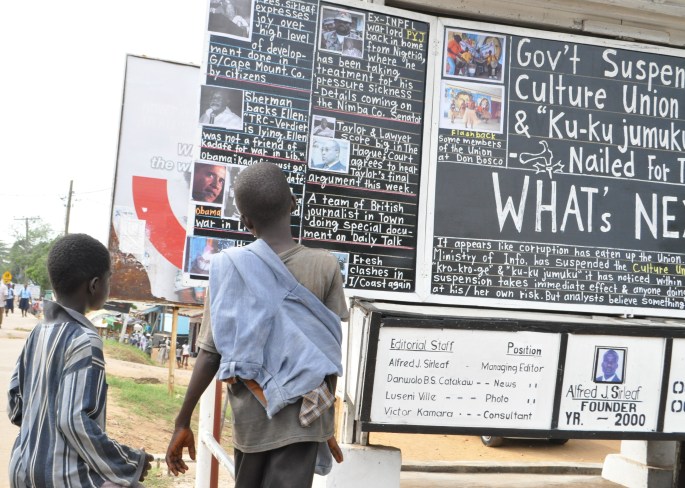
Daily Talk keeps Liberians informed about revolt against Gaddafi

As Col Muammar Gaddafi continues his grip on power, the African continent continues to follow the story. In countries like Liberia where years of civil war which Gaddafi had a hand in, many are following the fight for Libya in hope that Gaddafi can finally be brought to justice.

In Monrovia, Daily Talk, a street news blackboard offers Liberians news about Gaddafi. The people on the street pay much attention here because of Gaddafi’s role in the Liberian civil war.  Cllr. Jerome J. Verdier , the former chairman of the Truth and Reconciliation Commission (TRC) in Liberia issued a statement a few days  ago saying  the massacre of protesters  in Libya reminded the people of Liberia of the  killings that Gaddafi had much hand in as he supported President Charles Taylor during the civil war.

Verdier accused President Ellen Johnson-Sirleaf of being a key ally of Col. Gaddafi citing that she had consulted Libya throughout her six-year tenure. So today’s Daily Talk had another political figure Sherman defending President Sirleaf on her ties with Gaddafi. President Sirleaf recently on BBC warned against military intervention to oust Gaddafi saying that “it’s easier to destroy than rebuild”, citing Liberia’s experience. However the President condemned the violence that is taking place in Libya.

In a country that is still emerging from the ruins of a civil war that lasted more than a decade, Daily Talk does a great job bringing Monrovians news. Just like many institutions, the media still has a long way to go to be vibrant and contribute a lot to the country’s development. Daily Talk offers ordinary Liberians  up to the point news from the west Afric

an nation and beyond. Below are the pictures shot at the Daily Talk March 10 2011.

Headline about Obama on Gaddafi

Daily Talk
People reading the the Daily Talk news in Monrovia.
A story on Daily talk on accusations against President Sirleaf and her ties with Libya. March 10 2011.
Children stop by the Daily Talk in Monrovia on Thursday March 10 to read news.

Cultural rights campaigners ask court to halt demolition of Uganda’s only museum.

Ugandan cultural rights campaigners are fighting hard to stop the demolition of Uganda’s only National Museum.

Today the Historic Resources Conservation Initiatives (HRCI), Cross Cultural Foundation of Uganda (CCFU), Historic Buildings Conservation Trust (HBCT) and JENGA AFRICA filed a case against government against the demolition of Uganda National Museum.

The demolition is supposed to give way to a 60-storey building.

The case was instituted High Court of Uganda at Kampala.  I will be bringing more voices against this sale.

Here is a call from HRCI.


The Uganda National Museum is to be demolished to give way to a 60-storey building which will take 30 years to complete!

The foreign affairs permanent secretary, Julius Onen, sees nothing alarming in this and says there is no need for cultural activists and politicians to be worried about the matter. It is sickening for this to come from a technocrat. If it was a politician speaking it would be understandable.

Politicians saw nothing wrong with the destruction of a large chunk of Mabira forest for sugarcane growing and they did not sober up until a few people had lost their lives!

To demolish the museum for a commercial building is ridiculous, however grand the building is expected to be.

A museum is a collection of a people’s culture, past and present and represents a people’s values, history, ethoes and thoughtforms. It is a unique identity of a people and an archive for research.

The powers that be seem to be bent on destroying every green space in Kampala and replacing it with a concrete jungle.

Even without its filth, I am sure the sight of Kampala, the capital of Uganda, cannot be flattering to many foreigners. Nobody seems to have heard of urban planning! The word ‘investment’ is so exciting that nobody seems to think twice about where to build what.

Since the grand building will take no less than 30 years, where will the museum collections be after demolishing their home?

Many of us will probably be dead! Will it be a flattering legacy for our grandchildren and great grandchildren to be told that the national museum was demolished during the tenure of the the NRM government?

If we cannot value our heritage, then we should not complain when foreigners write our history for us and tell us that River Nile was discovered by Hannington Speke! Wise counsel would dictate to leave the museum alone.

It is a shame of unimaginable proportion to even think of demolishing the museum. What moral authority will we have been left with to vilify past leaders as swine? Have we no shame?

Abigail Turinawe
Kampala


New Partners for Peace Needed in Somalia

This yea is the 20th since Somalia last had a central government. The four-year old African Union Mission in Somalia is fighting a desperate defensive action in support of a transitional government that is “corrupt and inept”, according to the International Crisis Group

As many as 50 soldiers belonging to AMISOM were killed in fighting at the end of February. AMISOM attacked Al-Shabaab, the Islamist group that controls many parts of Mogadishu as well as most of south and central Somalia, in a bid to expand the Transitional Federal Government’s influence and better protect its own bases.

But Ej Hogendoorn, Horn of Africa Project Director for ICG, says the mission’s real problem is the weakness of the administration it is in Somalia to protect.

You can read the interview with Mr. Hogendoorn at IPSAfrica where he talks of the odd the Ugandan and Burundian forces face in the battle for Somalia.


A mercenary and an immigrant; a story of black Africans and Libya

How do you prove that you are just an immigrant not a mercenary? It’s a question I have been pondering on the week and it’s a situation that thousands of Africans stuck in the Libya uprising have to deal with, that is if they are given chance.

Sub Saharan Africans had not surfaced much in the story of the protests and revolutions that have swept across North Africa until Libyans decided to take on Colonel Muammar Gaddafi, their leader for the last four decades.

Protests first broke out in Libya on 15 February 2011 and a few days after that the international media got its juicy story of foreign fighters working for Gaddafi. It wasn’t long the term ‘African mercenaries’ came into full use.

To me it was like I was aback to one of my secondary school history classes about events in the  19th or  20th  century and stories of African men taken to the fight in “world wars” where they had no idea.

Before the African mercenaries term was coined, there had been the African the migrant. The ‘possible mass migration’ of Africans to Europe was one of the very first stories about Africans and the Libya protests to hit the international scene. It was about the fear European countries had that Libya, one of the main routes for African immigrants, could pose them a problem if it plunged in state of lawlessness.

Gaddafi who had been helpful in significantly reducing the numbers of African immigrants crossing to Europe through pacts with EU members, then rushed to use this as a bargaining chip as the protests spread. And the African the migrant at this point became both a weapon and a threat. Actually the BBC reporter based in Nairobi said “The fear with Libya is that sub-Saharan Africans will try to leave and there are more of them.”

Out of a population of about seven million people in Libya, about one million are believed to be from sub-Saharan African countries. There are no concrete figures. Reports claimed that about three quarters of these Africans are sort of on a waiting list to try by any means to cross to Europe.

After the story of the African -the immigrant, came the African -the mercenary as Gaddafi became increasingly violent and killing hundreds of Libyans. Social networks and twitter were abuzz with words African mercenaries, some with outright racial undertones.  Some tweets suggested Gaddafi had “brought Africans to break into their homes and rape their women.”

I thought ok, recent African civil wars which have been characterised by rape used as weapon of war have not helped perceptions about the continent that often people want to project! This  rape aspect has been repeated in many tweets although we are yet to see reports on actual cases of rape in the international media.

Today I watched Al Jazeera showing a tweet from Redafayr linking mercenaries to 20 African countries where Tamoil, a Libyan petroleum company operates. Today Reuters reported that the rebel National Libyan Council in Benghazi, the insurgent capital said it believed Niger, Mali and Kenya were sending troops to support Gaddafi, who is now directing his forces from Tripoli.

These kinds of statements can only further fuel anger among those opposed to Gaddafi and puts more lives of immigrants held up in houses and other hiding places in Libya at great danger. We have seen reports that indicate dozens of immigrants have so far been killed. These are not deaths inflicted on the ‘Gaddafi’s African mercenaries’ but on African immigrants that have nothing to do with the parties in the conflict.

We have seen slow reaction and attention on international scene and on the part of the African Union and African countries on the mercenary issue. We have not seen bold statements against these xenophobic attacks.

In  Uganda we have instead seen a national broadcaster sack two journalists over broadcasting of events in Libya and we don’t expect much from government to try and tell the nation that there is no Ugandan Libya as a mercenary. In Zimbabwe, Bob is busy charging anyone who mentions anything close to Libya with treason.  It’s important that these countries come out and tell the world what is happening.

Kenya has done a lot to evacuate its citizens and others from the East African region.  I know that an MP last week called on the country to investigate if young Kenyans who had gone to Islamic schools in Libya might be among the said mercenaries but yet to hear progress. Nigeria is continuing to evacuate its citizens from Libya but many other immigrants from other African countries are still stuck and governments are simply not doing much. I was shocked to see a Ugandan embassy employee saying if it hadn’t been for Kenya she would have died in Libya.

U.N. officials have warned that the latest charges from the council in Benghazi could escalate attacks on African migrants in rebel-held areas.  We are yet to see the full coverage of the story of the African ‘the mercenary’ in Libya. We have seen a few pictures that came from protesters but the story is one of the hard ones to get and it will probably take as long as the uprising itself to know the entire story.

While there have been reports of many kind Libyans volunteering to watch over those immigrants that made it to camps, generally many on the continent fear that the impact of racial discrimination not only against immigrants but also black Libyans will continue to be manifested alongside the story of the African mercenary.

We will take long to see a positive story for instance on  what African immigrants have  contributed to the Libyan economy and how their absence could be felt in either post Gaddafi or post protests Libya. Ultimately the absence of a sub Saharan media will continue to put the African story to hands of foreign media whose plates are often to full too do it justice.

Battle for Mogadishu; Ugandan family learns of son’s death from Internet

Mogadishu Skyline 2006
Image via Wikipedia

For the last two days, I have been trying to figure out the fate of one Ugandan peacekeeper in Somalia. Today is the sixth day of intense fighting in Mogadishu where the many soldiers from Burundi and Uganda have been killed and others captured by Al Shabaab.

This was after Somali government forces backed by African Union troops where Uganda has the bulk of the 8000 troops, launched a fresh offensive against Hard-line Al-Shabaab and seized some key bases in the capital Mogadishu.

In the Ugandan media, with all the election scandals going on, not much attention has been paid to the Mogadishu battle. Daily Monitor yesterday carried a story saying only two soldiers have so far been killed from the army side however Somali media claims at least 40 people, mainly soldiers were killed and 70 others wounded in fresh clashes of capturing positions in different parts of the Horn of African nation. Al Shabaab claim to be holding bodies of 20 AMISOM troops and number of others alive.

The lack of sources and reporters on the ground has made the Ugandan media deprive the Ugandan public  a clear picture of what’s going and many here don’t know the real human cost of this war.

I know the family of the killed peacekeeper and the relatives of the young man first got a phone call from Mogadishu from one of the peacekeepers saying he had been captured. So I tried to get the details of names of those killed, hoping he wasn’t among, in vain.

The  soldier at the end in Mogadishu said the 25 year-old soldier was with a group of 15 ,  11 of them were killed and four  others captured. It’s difficult to know the truth when you are in Kampala so I couldn’t get more details. The Ugandan military has so far said only two soldiers died in the battle. There’s belief among journalists here interested in the conflict that we can never  really know the actual number of those killed.­

After 48 hrs of searching for the truth, the relatives, whom I have talked to, later confirmed the death of their son through pictures on websites which are largely not visited by Ugandans. They  are holding a funeral without the body and no one from the military has contacted them.  Some bodies are still with Al Shabaab so it could be a long wait.

His immediate relatives saw gruesome images of the peacekeeper that Al Shabaab has availed to the media. Some of them show soldiers half naked, others with bodies being stepped on and there have been reports that many Ugandan and Burundian troops bodies have been dragged through the streets of Mogadishu.

If you have followed the history of international interventions in Somalia you will remember that similar images of US soldiers being dragged in the streets during the 1993 Battle of Mogadishu evoked outrage in USA and led to the withdraw of troops from the Horn.

So looking at these images of Ugandan soldiers I wonder why we are not riled or even interested in what’s going on. I wonder why the war in Somalia is not so much a talked about here. When will Ugandan leaders say enough! We have done our part in Somalia.

Reading one blogger’s report from Mogadishu makes my guts stiffen. “Ugandan peacekeepers were kicked, dragged, stoned and spat on” and he talks of another Ugandan soldier whose body was left to rot in Mogadishu’s notorious Baar Ubax junction.

There have been pictures of Burundian soldiers (PoW) captured by Al Shabaab and others of dead soldiers. Some captured soldiers have been asked to give recorded messages to Somali media.

AMISOM spokesman, Maj. Barigye Ba-hoku was quoted talking to a Somali radio that “No one swims in the sea without getting wet. We are ready to face the consequences of Somalia battle – whatever the cost!”  Whatever cost?  May be this is what military propaganda requires but I believe Uganda should be rethinking about the Somalia mission. Somalia has an ineffective government and army. In fact many Somali soldiers have been trained here in Uganda but this is yet to bring about a difference. Other African countries have shunned the mission and the two east African countries could be stuck there for long.

According to a new report by the International Crisis Group (ICG) titled “Somalia: The Transitional Government on Life Support”, Somalia’s Transitional Federal Government (TFG), which Ugandan an Burundian forces are trying to help,  is too inept, increasingly corrupt and hobbled by President Sharif’s weak leadership.

The report released this week also did not get much media attention in Uganda.

The ICG report says the TFG has squandered the goodwill and support it received and achieved little of significance in the two years it has been in office. This explains why their area of influence in Mogadishu has been dwindling. The government is expected to deliver a permanent constitution before August 2011, when the TFG’s official mandate ends but ICG says is unlikely to be met.

ICG criticized the international community for pushing for the re-establishment of a European-style centralized state based in Mogadishu which they say will not work. And Uganda is stuck in this skewed international thinking of what a Somali state should look like.

“Since independence, one clan, or group of clans, has always used its control of the centre to take most of the resources and deny them to rival clans. Thus, whenever a new transitional government is created, Somalis are naturally wary and give it limited, or no, support, fearing it will only be used to dominate and marginalise them.”

The report indicated the current TFG is even less willing to share power than previous transitional administrations, which explains the recurrent tensions between it and self-governing enclaves like Puntland, Galmudug, Ximan and Xeeb and local grassroots movements like Ahlu Sunna Wal Jama’a (ASWJ).

The report suggested that recruitment of more AMISOM troops is not the answer to Somalia’s governance problems. President Museveni in the aftermath of the July 11 Kampala bombings was even writing opinions in regional press to drum up support for increase in troops. So far many African countries are unwilling to sacrifice their sons and daughters for a mission whose achievements are not very clear.

ICG called for more recruitment and coordination of the security forces of allied local administrations rather than looking on the outside.

And then the report had a warning “do not attempt a major offensive unless an appropriate accompanying political strategy has been develop.” Sorry, the offensive is already underway. It’s been called the deadliest batter in Mogadishu in the last months.

Museveni gets another five year lease in most expensive election deal

Last Friday,Ugandans went through their every five year ritual. But this time it didn’t come cheap. It was the most expensive presidential election in the country’s history which saw President Yoweri Museveni earn another  five year term to further climb the ladder of  the longest African serving presidents.

Ugandan voter displays a thumb marked after voting. 18/02/2011.Rosebell's photo.

Museveni won by 68 percent and his main challenger Dr.Kizza Besigye got 26 percent of the votes. Of the 13 million Ugandan voters, only 7 million came out to vote for their leader. Museveni had predicted an 84 percent win claiming his party had carried out a house hold poll. That is a figure he never even garnered when his popularity was its highest in the 1990.

As several election observer reports have indicated, Museveni used “the power of incumbency” to win the February 18 presidential vote. To understand well how and why Museveni won this vote, you must look at words of Andrew Mwenda, a Ugandan journalist on the election. “NRM (Museveni’s party ) learnt that voter bribery is more efficient than violence,” said Mwenda.

And that’s what exactly happened. The votes were not just bought only a few hours to election but President Museveni , one can say,  broke into the national treasury to ensure he wins this vote.

There was the 20 million shillings given to Members of Parliament to supervise some inefficient agricultural plan in their constituencies, which is completely out of the mandate of a law maker anywhere in the world. We saw 13 political activists working with the ‘NGO Forum’ arrested for starting a campaign against this Ush 20 million that the government gave to MPs.

But the ultimate robbery from the national coffers came in form of a UGX 600 billion supplementary budget passed by a Museveni supporter -filled parliament 14 days to the election date. Of the 600 billion, UGX 79 billion went to State House. These funds and others acquired from different budgets enabled Museveni to distribute money to very tiny villages in Uganda.

In my home village of Kibona, Bushenyi district , a vote was going for about 30,000 shillings (13 USD). A relative told me, “Rosebell, for people whose monthly income is not even a dollar, they cannot  fail to reward someone who has given them 13 dollars.”

A friend who attended Museveni’s rally at Makerere University, one of the last rallies told me they were given 100,000 Shillings   (45 USD) for wearing Museveni’s yellow T-shirts and climbing on the trucks promoting the rally. In some parts people were paid as low as 500 Ushs (less than a quarter a dollar) to vote for the president. No opposition figure could ever match this kind of massive voter bribery.

The vote came at time when many had seen the news of events in North Africa and President Museveni had recruited and trained enough security to deploy even the most remote areas. For many Ugandans, this was the first time they had seen this massive deployment of troops. Although there were few incidents of clashes, the mere presence of security men brought fear among voters.

In Bugisu, confrontations between the security forces and civilians left a citizen dead and several others injured, including a journalist who was shot. Julius Odeke, a freelance photographer for the “Red Pepper” daily and “Razor” publication was admitted in hospital where reports show soldiers followed him and threaten his life!

One woman from Amuria told me that they were told “if you vote Besigye we will bury you with him. We will let the Karimojong ran your villages amuck.” This is in one of the areas that have suffered different wars and people have just started resettling for the first time in over 20 years. This woman told me such threats of war made many voters to cast their vote for Museveni or stay at home. The fear of what Museveni’s government would be capable of in case they didn’t win was high among many Ugandans.

There’s an African saying that goes “whoever argues with the King, stays longer on his knees.” This would be a perfect description of why President Museveni snatched some votes, more than he has ever got from Northern Uganda. People of northern Uganda are not foolish to just agree with Museveni’s regime arguments that they have brought them peace and that development is on the way. I do a lot of work in northern Uganda and one can’t say they have forgotten two decades of human rights violations from Museveni’s army or the highly politicized post conflict development plans that haven’t delivered much to a common man. One should not confuse their voting to mean they started a new page with NRM just like Andrew Mwenda claimed that we could see a Northern –Western partnership on the political map.

Northern Ugandans realised that Museveni would stay here by any means and they are better off not arguing with him. If they are good to Museveni, they too can snatch what they can from the national cake. So in the end Museveni got some decent support from an area that had two of their sons –Nobert Mao and Olara Otunnu – in the rae.

Opposition divided

Mwenda said, “the election was like a referendum, people came out to either vote Museveni or against him.”  And this is so true because having a fragmented opposition also helped Museveni win in many parts.  People were not totally sure of opposition plans but many went ahead to say no NRM. We also saw opposition making inroads in western Uganda which is seen as Museveni’s stronghold.

There were reports of ballot stuffing and Besigye presented ballot papers he claimed had been ticked before the polls opened, a claim that the police now want him to explain further. This claim was not paid attention to by many Ugandans until yesterday when we saw chaos during the Kampala mayor elections where thousands of ballot boxes with pre-ticked ballots were discovered by opposition groups. All the papers were ticked in favor of Museveni’s party candidate Peter Sematimba. Chances are high that the same method was used in presidential elections but Ugandans are no longer shocked by Museveni’s party stealing any election after all these are people who rig their own primaries. In fact in social forums Ugandans refer to the National Resistance Movement as the National Rigging Movement.

Five of the seven opposition presidential candidates, among them Inter-party Cooperation’s Kizza Besigye, Olara Otunnu of Uganda People’s Congress and Democratic Party’s Norbert Mao, have rejected the outcome of the ballot and vowed not to recognise “ Museveni’s illegitimate regime”.

The Inter Party Cooperation has called for countrywide protests in Uganda as Americans who have already congratulated their man call for calm. The UK has been more cautious given the different reports on different techniques used to buy this election.

Ugandans might not come to the streets to put up North Africa-like protest but they are deeply worried especially given Museveni’s pre-election statements. Museveni said if the East African Federation will not have been achieved by 2016 and if Uganda is not a Second World country by then, he will seek a ‘fifth term.’

Many are watching events in Libya and wondering whether that’s the path Uganda will take. Worries of Ugandans have been exacerbated by reports that the state broadcaster UBC TV has been stopped from coverage of Libya protests and firing of news editors.

We will wait to see how many will come out for the opposition protests and whether Museveni will “bang them into jails” as he promised last week.  Whatever happens Museveni has managed to buy himself time, many illiterate Ugandans decided to sell him the lease and I am sure he thinks he can renew that lease the same way after the five years.

Once Upon A Time

There was a point when Ugandans would be taken for a ride. The emperor would organize sham elections, his supporters (sycophants) would jump in the streets, hug and kiss each other for a victory well won (bribed). He would retire to his mansion with close family and friends. They would make merry, swing in their (our) chairs and plan to loot again.

His impoverished supporters would line the streets to catch a glimpse of their visionary (diversionary) leader snake through potholes. They would chant: “Our man, our savior.” Others would spice it: “Long live, long live to die on the throne.”

Thank Allah, Its 2021.

None of that madness will ever happen again. We forgive our comrades who followed him blindly. The emperor can no longer hold onto the throne, again. He’s a shadow of his 1986 days. Democracy has just left labor ward. Let’s give him a chance to grow. Enjoy his youth. And prosper.


By Bob Roberts Katende

Ugandan journalist

MS Journalism/ Public Policy at Southern Illinois University Carbondale