Uganda could be in Somalia ten years down the road.

Today I read the Guardian report on how the White House is revising its Afghanistan strategy to embrace the idea of negotiating with senior members of the Taliban through third parties.

After fighting for nearly ten years, the US is now seeing that sometimes you have to talk to the ‘terrorist.’ Negotiating with the Taliban has long been advocated by Hamid Karzai, the Afghan president, and the British and Pakistani governments, but resisted by Washington.

Then I turn and read Ugandan news, our government is sounding war drums for Somalia a fight they have no clue how to go about. After Kampala bombings that killed 76 people, Uganda is in the immediate post 2001 US situation. And I wonder ten years down the road, if we will still be in Somalia or these African leaders seating in my country this week to meet yet again over a cups of tea will have found an answer for Somalia.  With the talks of sending top army generals to Somalia that Uganda could it be that Uganda will still be stuck in Somalia’s ugly war ten years down the road? The opinion about Ugandan troops staying or leaving Somalia is hard to grasp. I have seen some pieces from Ugandans here

Chaka Chaka calls on African leaders to “walk the talk” on maternal health

She’s been on the Africa music for two decades. Yvonne Chaka Chaka, a UNICEF goodwill ambassador will be in Uganda next week to rally African leaders at AU summit on Maternal, Infant and Child Health and Development  to honor their pledge to fight disease in Africa.

Chaka Chaka who was the first black child to appear on South African television has been involved in the advocacy for the mothers on the continent for some time.  She said she would attend the Kampala AU summit “to remind African leaders to walk the talk and stop deaths of thousands of African women and Children”

The outspoken activist said many times African governments have been mismanaged funds meant for prevention of many diseases that contribute to high maternal and child mortality rate on the continent. While there has been progress with countries like Eritrea, Rwanda and Sao Tome and Principe seeing a drop in malaria cases and deaths by 50 percent or more between 2000 and 2006, malaria contributes to the big disease burden on the continent.

Being in South Africa a conversation with anyone even Chaka Chaka could not  pass without a mention of the World Cup. As the World Cup was closing the media was  awash with alerts of xenophobia threats. But the Princess of Africa believes that World Cup did much in bringing the unity among South Africans and the rest of the continent.

Having arrived in Johannesburg two days after that riling defeat to Uruguay, one could still capture the unity and solidarity the host nation showered Ghana. With Ghanaian flags still being hoisted in large numbers, you can hardly believe this is the same country where two years ago African immigrants were set ablaze.
Chaka Chaka believes the exposure the World Cup brought to South Africa is something the society can hold onto and not go back to the events of May 2008.

July 11 bomb attacks ; a new era of terror in Uganda

It was supposed to be a perfect night, at least that’s what I called it for that moment. Spain winning in the extra time with enough Spanish people to bring down the place in celebration. The venue was Soweto, South Africa where I was watching the World Cup final with friends from the Man Up campaign.

It was a cold but exciting night in Soweto but back home people were being blown to pieces by terror bombs. I learnt of the news yesterday morning shortly before I headed off to the airport.

A friend was first to alert me and I thought it must be some bad joke and how I wish it was. I went beyond the headline to sort of confirm the news by searching for names of people and familiar places that the bombs ripped apart that Sunday night.

There I saw Kyadondo Rugby club. It began sinking in that this was reality. Before I headed off to South Africa, I had spent several hours with friends at that bar and a good friend worked there. It’s a place that I have been visiting since 2002. My eyes moved up and the down the computer wondering whether my friends had survived and if they did what about my friends’ friends and families that I usually find there. I couldn’t do much for my phone had long died out so I prayed and hoped.

I imagined the horrifying scene during the attacks and shortly after at Uganda’s national referral hospital Mulago. I had been talking about Mulago with a friend from Spain who had visited Uganda in May. I had told him about one of the days that I went up to the labour ward, about the women that i saw on the floor unattended to, their screams that makes a young woman want to think twice about this journey, the shortage of doctors and medicines a story way too familiar. When I read the news of the blasts, I wondered what was going on in the emergency room at Mulago which itself is in dire need emergency care.

I arrived in Kampala 20 hours after the horrific attacks, I drove past the place, there were guards and nothing seemed to say much. Switching on my phone I was anxious and the first message was from a close friend telling me of a family member who perished at Kyadondo. I got messages about friends of friends that passed away that night and about a journalist who died yesterday and I am still getting them messages.

Today I woke up thinking of the newspapers headlines, the ones I didn’t want to see but wouldn’t avoid for their pictures portray the dead unsparingly. The first newspaper stand I see a lists of the dead and I could only go half way.

I strolled down by one of the sites of the attacks and it was quiet with cars of victims still parked. The sight of Kampala’s famous Marabou storks in large numbers pecking human flesh on the ground was heart wrenching.

Al Shabaab has already claimed responsibility to their first attack outside Somalia and they issued more threats to Bujumbura where the rest of the Africa Union Peacekeeping force is from.

Kampala, once of the safest cities on the continent in just one night was turned into a Bagdad of sorts where now people talk of avoiding any public places sticking to a schedule of home- work-home. Many are talking of avoiding churches.

Many innocent Ugandans have lost their lives, families and dreams and we won’t feel safe for a long long time. The bomb death toll is now about 74. Many Ugandans continue to be in fear with small things that we once overlooked being magnified in the terror lense. A misplaced flask calls for a terror squad, a bullet mistakenly burnt in garbage and the explosion in Kisenyi sends people ducking and a man today had thrown a phone in a trash can and he was arrested. A phone having been found in one of the bags which had a bomb that failed to detonate. I do hope through all this Ugandans do not turn to mistreatment of the Somali community in Uganda for they were the first victims of such murderous groups that forced them out of their country. We don’t want to see the Islamaphobia kind of wave that engulfed USA after 911.

Ugandans are generally welcoming of foreigners and I hope this wont rob us of that gift.

But do Ugandans even understand why we were targeted?

Uganda has been on high terror alert since we took the troops to Somalia under AMISOM in 2007. It’s only Uganda and Burundi in Mogadishu guarding a few places under the control of the Transitional Federal Government that is neither transiting nor federal. The Somali Islamist groups have gained force since last year’s withdrawal of Ethiopian troops and the AU forces have increasingly found themselves under attack with one blast last September right in the AU compound in Mogadishu that killed many including a deputy force Commander for Burundi.

Uganda has so far lost over 25 soldiers. For most of the last three years, these deaths have always seemed far away and reflected upon in Ugandan. After all it was a war situation and such stuff happens. We as the media have covered send offs of several contingents into Somalia but we never seen stories from families of those soldiers who died and few questions have remained unasked. But this terror right in our backyard brings us to question what on earth are we doing in Somalia and when will it be the right time for Uganda to pull out of Somalia?

President Museveni who visited the bombed sites said

“we will not run away.” That innocent people watching the World Cup should not be targeted. If they want to fight they should go find soldiers.”

Of course everybody knows that, what Ugandans want is certainly not justice for such mass killings by a suicide bomber make that almost out of reach. What Ugandans want is to be safe and stop our country from being a terrorist playground? And can we stay in Somalia at the same time keep us safe?

I agree with the President that Uganda will not run away. When you have a country that has limited safety systems and porous borders you cannot run away from a group which not only acts in clandestine ways but also has little to lose and everything to destroy. Terror has swept through some of the world’s most sophisticated safety systems. In a country where there’s not even national IDs and a passport is a luxury, in Uganda, even if we all got recruited into our infamous anti-terror squad it would take us loads of time and money to substantially reduce chances of another July 11 occurrence.

Few Ugandans know about Al Shabaab and many heard of it for the first time yesterday. To many in the military, withdrawing troops after such attacks may look defeatist but what if it is the way to save us from more bombs? Uganda had little if anything to do with the chaos that Somalia has been plunged into for the last two decades why should we pay for failed UN and American interventions?

At first we were the peacekeepers but what do we call ourselves today when we protect a government that is governing not even a district in a whole country?

I asked Captain Chris Magezi, the Ugandan contingent spokesperson based in Mogadishu and he said:

The blasts in kampala targeting innocent revellers were very unfortunate, acts of cowardly and barbaric extremist forces. But bad as the situation is, we must face this monster head on: we cannot afford to turn our backs in flight because this would mean victory for these evil. Their latest heinous act in kampala justifies why the mission in Somalia (AMISOM) should be strengthened further, perhaps even with greater agency. Otherwise there is no guarantee that those who do not contribute troops for Somalia will be immune to future terrorist attacks.”

But for now Kampala is taking the heat and those whos stayed away from Somalia aren’t and I couldn’t ask any further for this was an email exchange.

In the past the president has said we are in Somalia to fight for the freedom of our African brothers and also in a way for our own but we have not quite thought about one question what if that brother doesn’t want you fighting for him? Do you lose everything you’ve got or even yourself to bring him back to order? For now we are mourning for those youthful lives shattered, brought to a stop in the nastiest way possible and for those with injured relatives we worry about recovery but what we ultimately know is that Uganda has been made far less safe.

This government is credited for stopping the 70s and 80s kind of terrorism that Ugandans experienced. My father lived through the years of Idi Amin in the city. For many in the south, the last 20 years have been peaceful but is this government capable of saving us from 21st century terror that doesn’t need to find you in your home? The terrorism that doesn’t choose who’s for the government and who’s against it. The terrorism that is more complex than Idi Amin.

The president must now begin to weigh in the option of our troop exit and the sooner it happens the safer we shall all feel. For God and my country.

Meeting inspirational Chaka Chaka at Man Up Summit

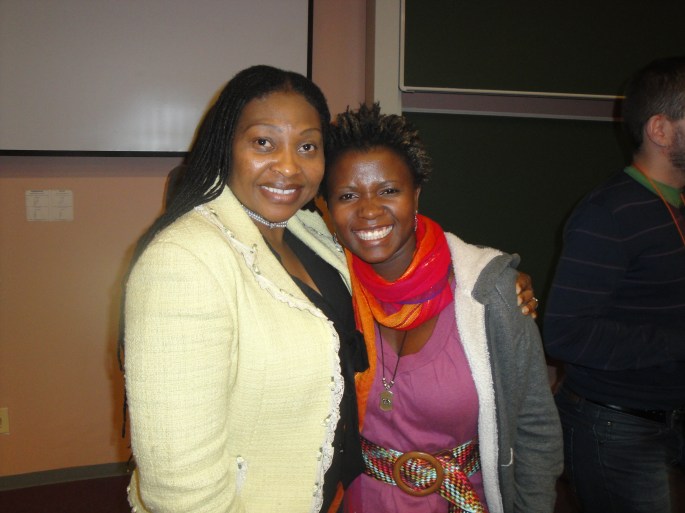
SA Singer Chaka Chaka and I at the Man Up campaign kickoff in Johannesburg July 5. Rosebell's Photo

Yvonne Chaka Chaka has described Man Up as “a brilliant campaign which
captures the heart of young people. Using music and soccer as a
catalyst for change is the best way to motivate young leaders to
transform how women and girls are treated in every country, in every
city, in every home around the world.”

Ugandan delegate Prudence Nyamishana with South African singer Yvonne Chaka Chaka. A Rosebell Kagumire photo

“This is a two-way street,” she said. “Things are changing. Gone are
the days when a woman’s job was in the kitchen. In my house, my
husband wakes up early to take care of the kids. Because they are not
my kids, they are our kids.”

“It’s us, society, that makes these rules and regulations.
Ten people can make more of a difference than 100 people who are causing a mess.

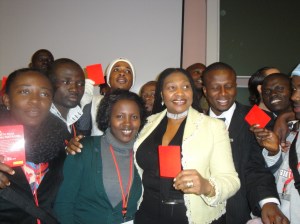
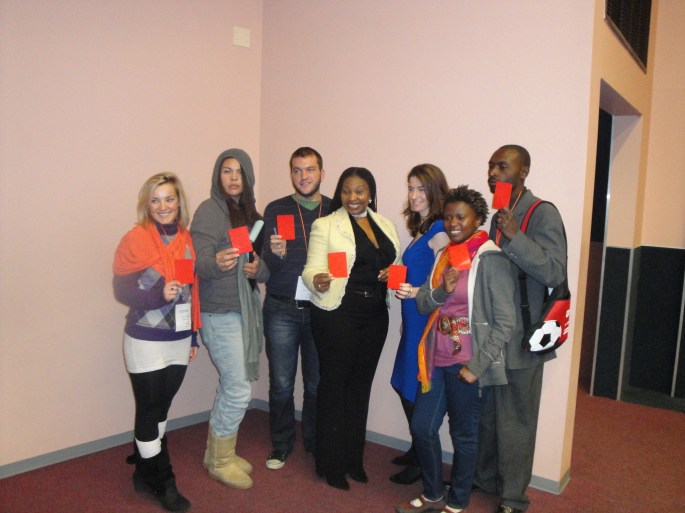
The Spanish delegation provided us with the red cards for violence against women.


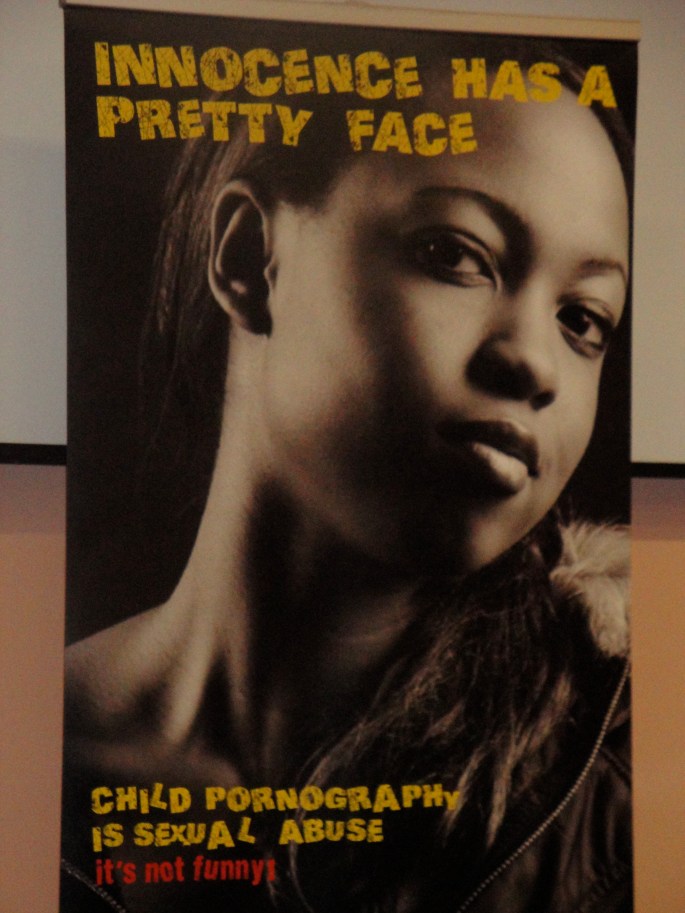
"Innocence has a pretty face" that's the captivating message on a poster by The National South African Film and Publications Board. The cyber can be a dangerous place for children, I loved the message.

And Man Up campaign begins

In South Africa with three other Ugandan youth to take part in a campaign on violence against women. We are not alone, we are together with other youth from other African states and North and South America.

It’s  first global summit during the 2010 FIFA World Cup in South Africa, bringing together a diverse group of men and women (ages 18 to 30 years) from 50 countries.  Man Up Campaign works directly with UNIFEM, international and grassroots NGOs and key stakeholders from the sport and entertainment communities to engage youth. 

Interesting topics lined up among them, Using football as a peacebuilding tool, using music and theatre for social change, Fundamentals of  Technology and social change. More can be found  www.manupcampaign.org.

I will be passing on interesting arguments and thoughts from the discussions. The whole idea is the use of music, art and sport to increase awareness on violence agains women.

Uganda Oil Sharing Agreements put before Parliament

Yesterday the government of Uganda finally succumbed to pressure and released the Production Sharing Agreements (PSA) for the country’s oil program in the Albertine region.

The agreements were tabled to the Ugandan Parliament but what was of concern the minister of energy ask the MPs not to disclose some parts of the agreement saying they could harm business for companies involved.

Most MPs outrightly said they would not leave anything unreported tot their constituents who have waited for years since exploration begun to know much about the new found country’s resource. This disclosure is not the victory, we have to consistently analyse all issues covered in the agreements and the hard job begins now.

As one journalist Charles Mwangushya of Daily Monitor said “this is a partial victory.” Mwangushya together with Angelo Izama , three years ago, in May of 2007 started the process of trying to force the government to make the agreements public. They are continuing to their efforts to ensure courts grant full disclosure of the petroleum program under the Access to Information law after losing the first petition

As the MPs scrutinise the agreements, I hope we the Ugandan media take part in this scrutiny.

A glimpse at Congo lives 50 years after the Belgian rule

The BBC carried a pictorial of Congolese from all walks of life. There are some comments that caught my eye. Look out for the 15 year-old market trader and see how longlasting effects of  imperialism can be, the Housewife’s story is similar to that of many jobless ugandan women, the Taxi driver’s story sounds like he’ s lives in  Kampala and then the 26 year-old Office Worker, her story is what I have heard from some Ugandans before. We can’t stop hoping though that one day Congo will find its other Patrice Lumumba.

TIME Photo essay and dignity

I wont say much because this got me to. A few months ago an Italian photographer published pictures of a body of a Ugandan girl he helped exhume in order to tell a story of human sacrifice in Uganda. A story caused much backlash from the online world and Pultzer Center took down the pictures. Now  I found myself looking on in disbelief how TIME could run some of their pictures in the essay about maternal mortalityin Seirra Leone. Pictures of one woman road from pregnancy to death and pictures show her during labour and the funeral.

As a journalist I understand the desire to tell a comprehensive story and the use of pictures but why do western media persistently publish pictures of Africans that in their own countries would simply be out of question?  I don’t ask this because our own media is any better but I am puzzled because these are leading media houses in the world.

I have learnt one thing that while telling the African story, there’s always a different yardstick used. In Africa, show victims in anyway you want for the line between dignity and the abuse of it  and all those tenents that the media claims look to be almost permanently blurry. Where else would you take pictures of naked women in labour with blood all over them en identify them and expect that be an act of goodwill except in Africa?  I would expect TIME not to publish picture no 3.

No doubt Maternal mortality in Africa is still a huge challenge becuase of a myraid reasons but how do we tell the entire story without overriding peoples dignity?  In Uganda the mortality rate is above 400 per 100,000 births and some countries are worse than that but how do we tell the story of limited progress in reducing these deaths significantly but maintaining the cap on dignity for those thousands of families accross Africa that go through such horrors everyday?

New Enough Project report on LRA killings in Central African Republic

For more than two years, the Lord’s Resistance Army has been waging a ruthless campaign of terror – largely ignored by the outside world – against civilians in the Central African Republic, or CAR. In a new report, “On the Heels of Kony: The Untold Tragedy Unfolding in the Central African Republic,” Enough Project Field Researcher Ledio Cakaj describes the LRA’s deadly but under-reported track record in a largely forgotten corner of Africa. 

Based upon extensive interviews with eyewitnesses, the Enough Project report details 57 LRA attacks that resulted in hundreds of killings and abductions since February 2008. Enough has documented 134 deaths caused by the LRA and over 500 abductions in CAR. Of those abducted, 273 people, many of whom are under 18 years old, remain with the LRA.  

LRA violence is creating a growing humanitarian crisis. Nearly 15,000 people have been internally displaced and more than 5,000 Congolese live in refugee camps in CAR. The lack of humanitarian aid and inability to cultivate crops due to fear of LRA attacks have caused drastic food shortages. 

“The LRA continues to brutalize and kidnap defenseless civilians across the Central African Republic,” states Cakaj. “There is a distinct risk that this widely dispersed rebel organization will regroup. The regional security threat posed by the LRA remains acute due to the lack of international attention to the ongoing violence in CAR.” 

The report also reveals how LRA leader Joseph Kony, an internationally wanted war criminal, nearly fell into the grasp of the Ugandan army during the past year.  

“The fact that the Ugandan army almost apprehended Kony by stumbling upon him demonstrates that the apprehension of the LRA’s leadership is an achievable task,” states Enough Project Executive Director John Norris. “However, the operations of the Ugandan army – the only military force pursuing the LRA in CAR – risk morphing into a war of attrition that will further endanger civilians.

So it is incumbent upon the United States to lead a renewed international effort to protect civilians and apprehend the LRA’s leaders. Absent a new level of effort, the international community continues to do too little, too late to end the scourge of the LRA.” 

I am yet to read the entire report to get to understand what they mean by new level of international support. Kony has escaped from all past attempts to capture him and so stating the last year’s attempt shows that his capture is achievable is not the best reason the project can give us.

I don’t know if this comes from the fact the project is  American but in their last reports they seemed to overemphasise the importance of US intervention and i don’t know what they suggest should be done if  the US said it’s hands were full.

Otherwise the project has so far managed to keep track of LRA activities in the region and has become the major source of statistics about LRA brutality in last year.

More of this report can be found at Enough Project

What’s in a name at the 2010 World Cup?

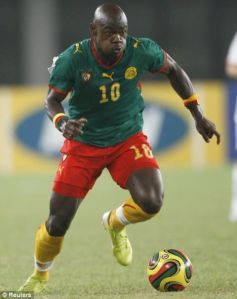
A Daily Mail photo of Cameroon's Achilles Emana

Last night many Africans watched painfully as Cameroon’s chances of advancing to group stages waned in a match lost to Denmark as the continent’s pack of six fell to five. The Indomitable Lions were not impressive from the start of the World Cup but watching Et0’0, one of Africa’s most decorated players move off the world stage  at such an early level was sorrowful. The World Cup is such a painful place but it is much easier if you are in Kampala where hilarity from Uganda’s unlimited comical people rules.

Last night through many  tense moment when Cameroon was wasting loads of chances in the box  at one of Kampala’s many football fans filled bars, I couldn’t help but laugh as one man with all hope gone said, “Bano babasasuddeda,” meaning that the  Cameroonians played like they had been bought off before the game. Coming from a country that is well used to disapointments in football, Ugandans know better what it is like to watch your team fire blanks.

Yet as the Indomitable Lions look like they are headed back to Yaounde at end of the first round what Ugandans will miss is Cameroon Shirt 10 won by Real Betis’ Achille Emana. The man with that jersey has a name that is very much a taboo to speak about loud in public in Uganda and some east African countries.  The name Emana in many Bantu languages in Uganda means Vagina. It’s only during the Africa Nations Cup and the World Cup that many Ugandans get to yell that name out loud in public with a lot chuckles following nomatter where you are. But not all will easily say the man’s name that brings grins to many faces. The guy seated next to me last night chose to shorten the name and kept shouting Ema, Ema as the Cameroonian shone a few times bringing laughter to the entire bar. Whether fans of Cameroon or not, many have been drawn to watch the Indomitable Lions to enjoy the humour the follows the one Midfielder on the pitch.

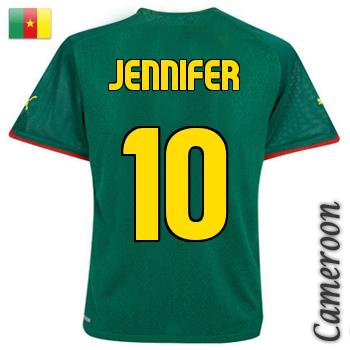
Cameroon's Shirt No. 10 with a fan's name on.

Another arena has been facebook where an application gives users a chance to pick your favourite World Cup team and a player and put your name to it and many Ugandans have gone ahead to choose Cameroon’s shirt 10.

So the World Cup doesn’t only bring the football action to many football loving Ugandans but it makes exceptional moments to overide Uganda’s traditional cultures that put an unwritten never-say -that -out-loud tag on the word Vagina. As the Indomitable Lions get out of  South Africa many Ugandan football fans will surely miss this one man Emana.