Th Internal affairs minister Kirunda Kivejinja had told Parliament that the stick-wielding goons that have become the face of violence at any demonstration in Uganda will be prosecuted.
This group is unknown to the Police. The Police want to find out who they are. Once identified, criminal charges will be brought against them.
These men first appeared on the scene on April 17, 2007 during a political demonstration against the give-away of part of Mabira forest for sugarcane growing. They again appeared last week at an opposition demonstration. Here is the Youtube link to the recent saga.
The Minister is now telling Ugandans that these men are unknown to the government that runs a country.
Why don’t they appear when other groups are matching through town? Why are they synomous with political opposition demonstrations? A responsible government that is concerned about the safety of citizens whether they are dissenting or not must be in position to know any author of violence. If it can take three years for government to figure out who these goons are what does this tell us about out safety?
Well that’s assuming that what the minister’s word is true but i am inclined to to think that these kiboko squad men are part of state terror that seems to take any form whenever members of the opposition come up. In an earlier post i quoted an investigation by the New Vision newspaper that gave details of where these men are from and who’s behind them.
The major question should be why would a government with enough forces to handle a political demonstration in Kampala resort to the ugliest tactics of all at times that are not necessarily of highest resistance?
Just like many inquiries that we have seen in the past we will see what Kivejinja tells Ugandans when these men turn up again. Such illegitimate actors that government has allowed to freely commit crimes might make demonstrations in Uganda more violent as demonstrators in future might look for ways to defend themselves. God knows what would happen with the excessive use of force that the both these goons and our uniformed police resort in times of demonstrations.
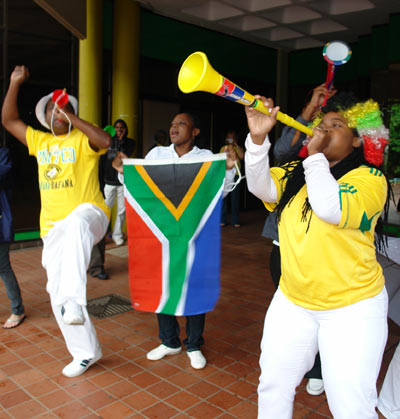
The World Cup is already underway and I decided to run back to the continent in time. The African teams have not had a great start save for the Black Stars but I do believe Ivory Coast and Nigeria have good chances to bounce back. I am hoping by the time i head south for the semis and final which will find me in Johannesburg, an African team will be still present.
I will be part of the Ugandan youth delegation to the Man Up campaign summit on violence against women which hopes to use music and sport to raise awareness among physical and structural violence against women. I hope the haters of the Vuvuzela will not suceed to stop it. I will be with many distinguished activists to vuvuzela away violence against women as the curtains come down in Jo’burg.
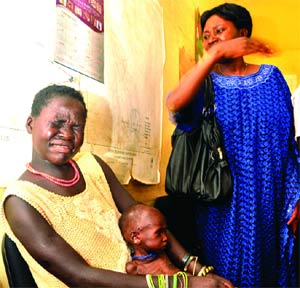
New Vision reports the Member of Parliament Winfred Kiiza who was pictured slapping a suspect in police custody denied doing so in a police statement.
A Ugandan female legislator slaps a suspect in police custody. A New Vision photo
And who will take up that case? A woman beggar is assaulted by a politician and with no idea of the justice system such a case will be left to collect dust in the police station. I hope somehow this MP would be taught about consequences of taking the law in your hands.
And there goes a news report detached from the context of the incident and any sort of deviation from the statement of denial.
Today’s New Vision front page story; Legislator slaps beggar over child abuse raises many questions. The woman legislator from Kasese Winifred Kiiza had been to the Police station for a totally different case of attempted conning if i may call it that.
A Ugandan female legislator slaps a suspect in police custody. A New Vision photo
Then a long the way she took time to take the law into her own hands at a place where suspects are supposed to be in safe custody, to slap one Lukiyo Agino, a 23-year-old Karimojong girl, who was had been arrested over child abuse.
The story goes Lukiyo was fronting a malnourished child from her friend to people on the streets trying to get money. Lukiyo’s child abuse story is not too intriguing. The problem of Karamoja is a well documented one. It’s one place with a harsh climate that relies on food aid throughout the year. Government has almost kept alive the long held notion of we shall not wait for Karamoja to develop by not helping it to develop even when the First lady is the minister in charge of that region. Most of what we see about Karamoja is about guns and disarmament.
It’s women who suffer most in that part of the country where one has to walk miles to access water. This is a place with about one hospital for about 10,000 people and many have run away to the streets of kampala with their children. While Lukiyo’s alleged act of child abuse is inexcusable, the source of such cases is not these poor women on the streets. And you would expect a legislator to be fully cautious before putting her judgment on such women.
Kiiza’s behavior is only a glimpse into the mob justice culture in Uganda. A person elected to represent a district is the same person to commit crimes right at police station.
The story goes on to say the woman had smiled when the MP asked her if she new the pains of childbirth. What a question to a woman from who probably has never stepped in a school. And even if the question was in Luganda i doubt she has good understanding language BUT above all who’s Kiiza at the Police station?
The most unethical of all acts in this story is journalists geering and asking the MP to give more beating to the woman saying “Mwongere”
This is shameful but it shows how much Ugandans are into mob justice. Even those who are supposed to watch it are involved in it. The story ends with a no comment from a Police officer declining to state if the legislator would face any charges. Of course people like Kiiza understand the workings of our police force. They too practice such violence on suspects so how can they rescue one from a politician who has a district they represent.
This harassment of a suspect by a legislator right before the eyes of the police tells a much bigger story about justice in Uganda. Kiiza must be brought to book for use of violence and if our parliament is worth its name should take such a case seriously. Torture and harrasment are not part of a job of a legislator and If Kayihura still insists that the force doesn’t brutalise civilians he must answer why a suspect would be beaten up at a police station and no action taken.
I read a bit of Human Rights Watch report on Uganda’s bill on HIV.
There’s are many issues but for now I will focus on the part of the Bill concerning mandatory HIV testing for expecting parents.
I was looking through the AFP report that had an interview with the executive director of The AIDS Support Organisation (TASO) Robert Ochai and here is what he said.
If you make testing compulsory, the individual doesn’t buy into the result. For them to take action, like getting treatment for example, they have to accept to outcome of the test.
What are we going to do with all these people we forcibly test? We don’t have the resources to support them. People could run away from their doctors, or their homes. You could have suicides.
For many years now, mothers in Uganda have had to be tested because of the need to reduce the high rates of Mother-to -child HIV transmission. I have seen friends who had never thought of taking an HIV test until they were expecting and when faced with that they go ahead and lay thier fears aside and test. They indeed have not seen the mandatory testing as violation but as measure to prevent this deadly disease from getting to their precious children. So the Bill is not introducing something new. The practice has been going on and though there haven’t been any study or attention to it, I more inclined on the fact that it has helped people come to terms with their status and brought them the joy of knowing even if they are positive their child can be negative.
Uganda’s most new infections are high among married couples and about 80 percent of those with the virus don’t know they have it. And if any Ugandan tried to sample among their married friends they have had to take the test for the sake of their children. The Bill says something important for those interested who have an eye for women’s rights and equal treatment. It also calls for mandatory testing for men with expecting wives.
It’s been almost only women who undergo HIV testing during pregnancy which can be unproductive if men are not tested. I pay attention to this becuase we live in a country where about 50 percent of married women who are infected with HIV have had one sexual partner. I have read stories of men forcing only their wives to take the test and sometimes if the woman takes the test on her own is abused and accused of being the one who brought the HIV.
These stories of women suffering for their children to be HIV free cannot be missed in our newspapers. A journalist from West Nile once told of a story of how many were ashamed to take tests and when women get tested and confirm their status to positive men force them to share their prescribed ARVs.
Sometimes you hear husbands relieved after their wives have taken HIV tests which in itself is not a relief for there’s something called discordant couples. The practice of mandatory testing of parents has been going on and we must carry the burden of protecting our children from the scourge.
Uganda now has thousands of young people below 25 years who contracted the disease from their parents. Has anyone talked to them to see what their thoughts are? I am sure many Ugandans know how traumatizing it is to reveal to a 6 or 8 old child that he/she has HIV and the hopelessness that comes with this revelation. How can we talk about intentional transmission if parents can be free to decide whether to infect their children at birth or not. And in the end the resources that people like Ochai are worried about will not be available for all these young infected people.
Such a law is complex and indeed some people can opt to stay away but suggesting mass suicides is a bit exaggeration. Have we wieghed the otherside . Organisations like HRW must be challenged that sometimes issues are not a matter of individual rights .There must be a balance between anyone’s rights and responsibilities. I will not comment much on Uganda’s own AIDS organisations for now because they are a business venture for most part.
The presentation of our country’s issues as black and white will not help. There’s also an obsession with criticisms rather than critical analysis in regard to this mandatory testing in the bill. I may not support the people in power in my country but I am always worried about oversimplification of problems we face and interventions that are needed.
The issue of prevention of Mother-to-child transmission doesn’t stop at parents and their child but the poor Ugandan health workers in our poorly equiped hospitals are at risk of catching the disease while delivering babies. No body ever seems to think about them. So if we are to talk about rights what should such health worker do.
To approach this issue as matter of violating confidentiality and individual rights of parents is not enough. We have lives at stake and few analysis have really gone indepth. I will be picking on another aspect of the bill soon.
And then i used to write more often on my blog and comment about those reports. Last weekend my attention was drawn to this not-so-special Daily Monitor “special report” .
Some Muzungu writing about leaving Uganda, like she had spent decades working on a special job in our country making her depature necessitating publication of a special report. And the headline went: I will miss everything but the potholes of Kampala roads. And the special report from an independent daily went about this volunteer working with an NGO and living with “adorable” people (of course we are adorable.). Then there’s a comparison of UK transport and Kampala’s which I bet John Speke did when he went back to Englad after ‘discovering’ source of the Nile. And the rest is about a visit to the nile which i think thousands of tourist do every year.
So am wondering why DM would give such crap as special report. I am sure many journalists in this newspaper have been to a sort of exchange program abroad and i bet they would never find any space at serious paper to publish a speech from a little unknown Ugandan who visited the country. Which leaves me wondering when did newspapers get space to waste when we live ina country with a million and one problems?
As my friend Wendy put it the special report “was more like a beautyqueen speech.”
If this is the norm I may be tempted to write in my terrible Spanish to a Costa Rican newspaper what I will not miss about their country- the use of women’s bodies to advertise anything. From perfumes to a car tyres, playing cards, calendars and surprising of all was the half naked picture of a woman on the flour i found at one of the supermarkets.
I will give it a try afterall I have been in their country for ten months, seven more than the author of the special report in the Daily Monitor.
Before I went to bed last night i was troubled by a post on a facebook page of friend which read:
“I may be wrong, but this story, I think, is a horrible attempt at taking journalism to another, undesired level. Marco, you didn’t have to exhume a body to take pictures, mate! That doesn’t stop the killing of kids: it shocks the s**t out of some of us”
I left him my thoughts as i prepared this post. Another follower put:
I agree with Joshua and Rosebell, this is a sad/horrible attempt at taking journalism to another level, if at all it was journalism anyway.The writer was not only insensitive to their pain, culture, I also think it was unprofessional.
The words exhuming a body caught my attention with a rush of adrenaline. I hit the link and I am taken to the Pulitzer Center Crisis Reporting page. Before I start reading a story by Marco Vernaschi I see a warning: “Please be advised the following project contains graphic images that may not be suitable for all audiences.***”
I read the story and before I came to picture I get lines about how this journalist sponsored by Pulitzer Untold stories series came to Uganda to report about child sacrifice. The Child’s name Babirye Mergret, 10 years old had been mutilated and murdered. Read Marco’s whole story here.
It turns out in the search for what Marco calls visual evidence, led him to convince the chief of the village and after some attempts succeed to convince the family to dig up the body of their child whom they had only burried a day before in order for him to take pictures.
This journalist also gave money to the family which he hints was for them to afford justice but a police officer incharge of the case said the money was actually to influence the mother to allow for the illegal exhumation of the body but not for a defence lawyer. The pictures have since been taken down from other sites after many calls. The Vigilante Journalist also published the photos has since then explained their conversations with the journalist and published a response from the police in Uganda.
Such journalism exhibits what I call ‘Am -gonna-save-africa by a photo’ attitude that many foriegn journalist come to Africa armed with. Where else in the world would a journalist harass a grieving family and promises that pictures of their dead would be for their benefit. I detected such attitude in his words.
I try to imagine the fear and pain Babirye has experienced while a monster ironically called a “healer” was killing her; I imagine her 10 year-old, wide-open eyes crying and staring at the machete that took her life away. And I firmly believe, more than ever since I’m in Uganda, that this horrible death can be turned into something that will help prevent other crimes like this . – Marco
Respecting the dead is very much appreciated in the western media and the western world which i believe was the target audience of Marco’s story. For all the years that American and British soldiers have died in what many now accept was an illegitimate war in Iraq, I have never seen pitures of blown up bodies or pieces of those soldiers in the western media as an attempt to show the world how gruesome the war has been. I have seen enough condemnations of videos of beheadings of westerners that media houses in the Middle East have sometimes played. So am wondering why a center like Pulitzer would fall for such cheap sensational journalism.
The Western media either out of ignorance, lack of respect or their over-assumed power to change the wrongs in Africa, publishes sensantial pictures from Africa about the dying and the starving and now the dead. I can’t think of any other thought that Marco had apart from that eagerness to potray the wrongs in the most extreme ways including digging up of bodies all for a picture.
This is sheer insensitivity to people who are hurting and lying to obtain information. Infact what Marco did without speaking like an enforcement officer could land him a jail sentence for disturbing the dead. For Marco’s knowledge, Human sacrifice is a story that the Ugandan media has cover consistently and it has made it to major international papers in recent months. The same stories about Albino sacrifice in Tanzania and Burundi are well documented and there have been campaigns to curb that. It is just that there’s limited mechanisms to stop these child abductions and killing from happening and the digging up od bodies in the wee hours of the morning will not eradicate the problem.
The past week I have been swamped with propaganda lessons (or tactics) from those who mastered persuasion and used it for better or worse causes. Propaganda is commonly looked at in a negative way and it is only mentioned when referring to an enemy or rival when actually it can and does have positive values. Nowhere is propaganda, whether it’s positive or negative, best demonstrated than during elections.
As Uganda heads into general elections early next year, what can especially the opposition learn from one of the greatest propagandist, USSR’s Vladimir Lenin? At the beginning of the 20th century, Lenin, while organising in the Soviet Union on his way to power, argued that agitation and propaganda were a great weapon to attain power. He said that the task of the person seeking to lead, “must be to utilize every manifestation of discontent and to make the most backward worker understand or feel that the student, the sectarian, the peasant, and the writer are exposed to harms…which oppresses and weighs on him at each step of his whole life.” Lenin argued that the backward farmer having felt that will irresistibly react on his own initiative to demand for changes.
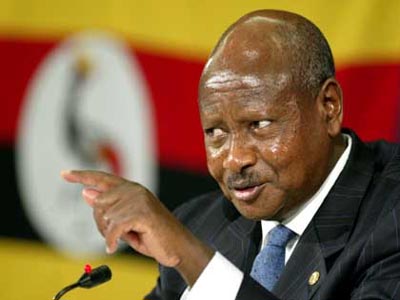
Uganda's President Yoweri Museveni
How does this apply to Uganda? Let’s begin with Yoweri Museveni, the incumbent president, who is set to be his National Resistance Movement (NRM) party’s flag bearer after an inner plot amongst his party’s inner circle and diehard loyalists declared that position was not up for contest when the party holds its primaries later in the year. Firstly, he is clearly no longer the darling of the masses he was in his first years as president 15 or 20 years ago. Since the 1996 presidential elections, his support (as gauged from election results, two of which in 2001 and 2006 even the Supreme Court unanimously agreed were not free and fair) has been falling by 10 percentage points. Statistically, this would mean Museveni will likely get around 49 percent of the total ballots cast in the 2011 election, that after all the cheating and rigging has been factored in. This is below the constitutionally required 50 plus one percent to be declared a winner. Assuming that the constitution is not changed in the next eight months to scrap off this condition (we had to amend the constitution to deal away with presidential term limits in 2005), this would lead into a re-run.
Last week one of NRM die-hards Mary Karoro Okurut, who ‘represents’ us Bushenyi women in the parliament, wrote an opinion saying that this time the president will get more than 59 percent. Her weak arguments being that in the last five years the lives of Ugandans have changed to the right direction pointing to among others the end of Joseph Kony’s rebellion that the opposition cannot break the NRM strongholds in western Uganda without stating why they can’t.
A more recent Afrobarometer survey in May, 2009, which lends credence to this statistical analysis, showed that President Museveni would not win a clear majority if elections had been held at the time of the survey. 41 per cent of the polled respondents thought they would vote for an NRM candidate if a general election were held the next day. Put slightly differently, they would vote for Museveni since the NRM has not known any other candidate but him.
Museveni clearly knows what is at stake: He must convince voters that he is still relevant after 24 years in power. So, he is already traversing the country trying to do exactly that. Yet it is a line that will be hard to push successfully when over the period he has been president, training institutions, for instance, have put out more qualified people than have been workplaces to absorb them so much so that getting a job is no longer primarily about what you know than who you know. Most of these qualified but unemployed people are youths who now languish in Kampala’s slummy suburbs depending on their parents who often have to send them some food to survive on as they hit what we call “streetology” (that is, endless walking the streets and knocking on doors looking for employment). In areas like northern Uganda especially the Acholi sub-region, general unemployment is at about 70 percent. For parents who have given everything within and beyond their means to send their kids to school on a promise of a better future not only for the kids but also for themselves, there cannot be a more saddening situation than having to go on tilling land to sell their little produce to look after 20-something-old educated but jobless men and women. And unemployment is only but one of the sore issues that plague Museveni’s presidency. There is stinking corruption, the breakdown of all types of services embodied by lake-size potholes in the middle of the capital city, sectarianism in access and distribution of resources (for a man who once abhorred even the sound of the word) et al.
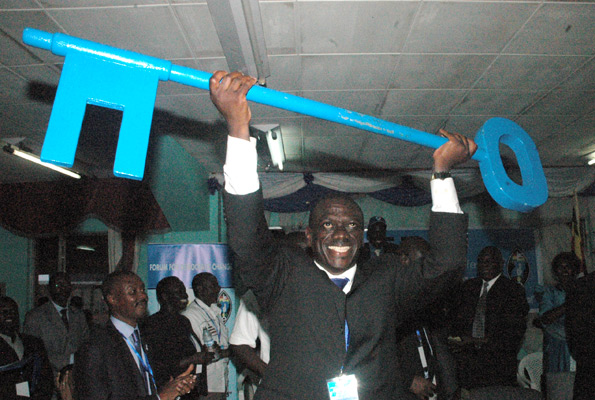
FDC President and Museveni's main challenger in the last two elections Warren Kizza Besigye Kifefe. Daily Monitor photo
The question then becomes: can the opposition link such widespread discontent to Museveni and his NRM to such a magnitude and rate that they can get massive support from such groups? After all, the biggest percentage of the voters in 2011 will be youths because 70 percent of all Ugandan citizens have been born under Museveni’s leadership. The battle for hearts and votes for 2011 should take place among Uganda’s most voting population. Only time will tell whether the opposition can take the battle to this key demographic. In the past I haven’t seen any sort of mobilization or trying to put a clear message and linking problems that everyday Ugandans face to the ineffective leadership of Museveni. That remains the challenge for anybody who wants to lead Uganda.
All the major political parties have completed their primaries and two of them – Uganda People’s Congress (UPC) and the Democratic Party (DP) – even got new leaders: Olara Otunnu, the former UN Under-Secretary General and Special Representative for Children and Armed Conflict, and Nobert Mao, former MUK Guild President, Parliamentarian and now Gulu District Chairman, respectively. The other, Forum for Democratic Change (FDC), returned Dr. Kizza Besigye who has challenged Museveni twice so far. These and a few other not-so-major parties have formed an interparty cooperation. They intend to field one candidate, which is their key strategy to ousting Museveni out of power he has held for 24 years now. If Besigye is chosen as the coalition’s candidate, he will take on Museveni for the third time running. The former military colonel can be single-handedly credited for proving that Museveni was challengeable and some people think he still stands a better chance against Museveni. Yet it does not really matter who leads the coalition – Otunnu and Mao have equally sufficient resumes, political and organisational skills to match any standard – if nobody puts to action that lesson from Lenin.
One more lesson from Lenin: once he captured power he had to ensure that people don’t turn their backs on him. The closest comparison between Leninism and Musevenism, if I can call it that, once Lenin captured power he sustained support by blaming all the shortages and injustices on the past regime(s), going as far as using films (he controlled the film industry) to remind people how terrible things were under the Czarist Russia to deflect attention from shortcomings under his rule.
And this art of reminding the population of the horrific past that some of us never even saw especially in regard to our security, is what Museveni has ridden on to keep his support, at least for those living outside northern and eastern Uganda for the last 24 years. In every speech, whether it is at the opening of a new school, a factory or just a road that usually will have taken forever to be completed, we have to be reminded of the past so that we look at the present in the prism of our past. The use of the past to control what we agitate for today and in future is what we need to deal with. Museveni has already mastered that and the opposition are yet to enrol in the school of Leninism propaganda.
In the last few weeks, Ugandan papers have carried a story of the Coordinator of the Intelligence Services, Gen. David Tinyefuza warning the Uganda Peoples Party President and former UN undersecretary Olara Otunnu about his claim that the current government killed people on their way to power.
NRM-speaking the bush war is a liberation and that’s what many my age have been taught whether in school or outside. Like any other ‘liberations’ the people who die before the victory are unfortunate and their death is treated as collateral damage and in some cases denied.
In the Luweero bush war that saw President Museveni ascend to power where he has been for the last 24 years, many people were killed and nobody knows the real estimates. When Otunnu, in his acception speech to lead UPC in March, called for an inquiry the government warned him about inciting people.
Betty Kamya, the FDC renegade, wrote an opinion saying Otunnu’s call our backfire and he would be the loser but she raised good points.
Let’s face it, the people of Luweero were not “innocent civilians” during the war, but active collaborators who hid, fed and fought alongside Museveni’s “bandits”. When government troops came looking for the “bandits”, the people protected them and misled the government army. Luweero people laid traps for government troops, but they protected the rebels and gave them useful information. They were motivated by hatred of UPC, not love for Museveni.
The reason Museveni’s government has survived this long is because people who lived during the UPC 1 and UPC 2 days are still alive and the mere mention of UPC breeds goose pimples on their skins. It’s the same reason Paul Ssemwogerere lost the 1996 elections, even at his own polling station and the same reason the NRM skulls and gunfire campaign was successful.
Map of Uganda showing Luweero
Luweero was used, and forgotten soon after power was captured, its story had been tacked away in the closet of Uganda’s controversial history save for the times when a display of skulls of those who lost their life works for the current government. I was born at a time when the NRM war was being fought and I still have no clue what truely went in Luweero, besides heroic stories from NRM. The closer I have come is seeing old men and women, backs long bent camping at Uganda’s parliament to claim their losses in that war. Whether some of these people are looking for shares more than they are entitled, the scene is simply heartbreaking. These claimants come once in a while and it is very easy as a journalist to get used to their story and newspapers just give it a brief. These war claimants, looking for what they lost for 24 years now is a shame to our country especially those that this so called liberation benefited most.
Iam glad the Ugandan scholars are increasingly looking into this.
The issues to be investigated were casues of arbitrary arrests, detention without trial, torture, mass killings, massive displacements “and possible ways of preventing these from happening in future” but it seems that future is stil far away. Most recommendations were not implemented may be it’s worth a try to seek views of people of that commission like Attorney General Khiddu Makubuya who will most likely offer an interview after months of asking, then John Nagenda who is a presidential advisor now.
What is worrying about the warnings to Otunnu from the military is that this is part of the whole toughened ground for freedom of expression especially in regard to violations during the conflicts. Gen.Tinyefuza and the army have also threatening to arrest people who question about the army’s conduct in the war in northern Uganda. I believe a government in power, if its hands clean, should not be threatened by such inquiries. Besides who is going to do the inquiries? The government and if there’s nothing to hide and all the killing was on Obote’s part then Otunnu and others like him would be answered. Whoever was responsible would be established. But would such an inquiry be fair and not influenced? Going by the recent reactions from the government, I have no hope.
I spent exactly one week in Cuba so I can’t claim to know it. What I will say is my own subjective experience in Cuba.
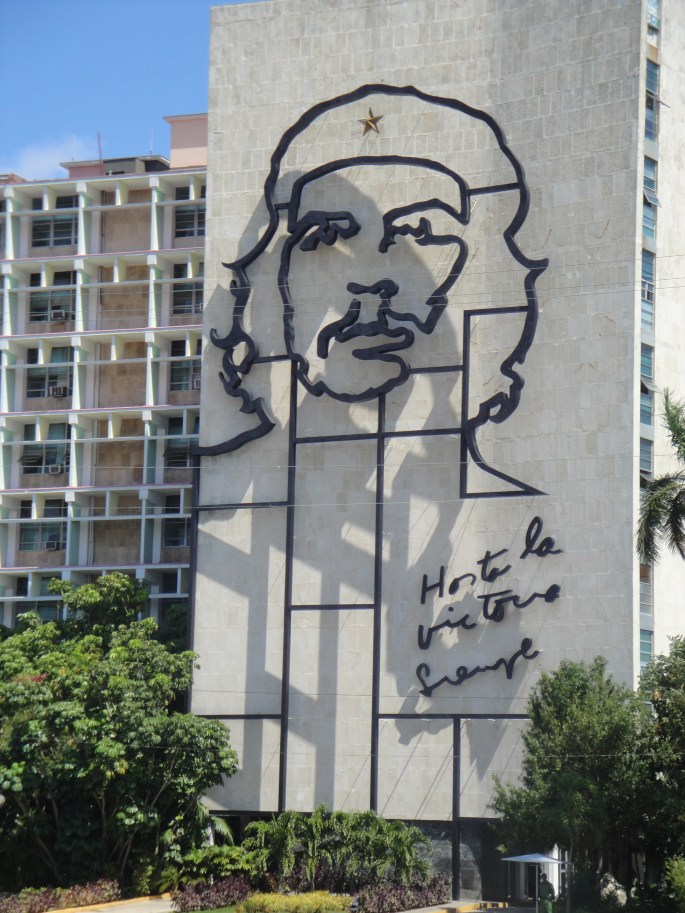
Che at the Plaza la Revolucion. Rosebell Kagumire photo
In Cuba, you will hear the about la revolución many times. I stayed in Habana, the capital for 3 days and it was quite a place that gives a historical experience but leaves you with a heavy heard. In my homeland that I have traversed over the last five years, I have seen pain, suffering and poverty but I can say I have not seen Ugandans, save for war affected north and Karamoja, line up for food.
Everything is fried and if you ever find beef then you know it is a miracle. The few cattle, I read somewhere, are owned by the government. Everything is rationed, communist style. For the ordinary Cubans is lining up whether it is at a bakery or ‘supermarket’, at a clothes store (which are not many) is the norm. In Cuba I came to realise what food insecurity is all about.
Before I left, I had this well crafted romanticized view of what Habana would be like, the cigars, a Mojito, a Havana club and I never heard of the other side. There are few streets in old Habana and centro which are well polished for tourists, and then a few blocks, the reality of life here hits you. I was alone so I found asking myself many questions and having no answers. Questions about the dilapidated buildings, the sewage on almost every street, human waste not just on the streets but on the Capital building that is a major feature of the city. I had to face that yes, spitting is part of this country and you won’t move even five minutes without finding someone spitting on the street sometimes right in front of you.I was reminded of a story that goes around Kampalaa that Rwandan President ordered that you can’t spit on the streets in his country. While some say that’s a dictatorial sign having seen Habana streets, I say such a ban is ok.
For me some of these streets felt like being at some police post in Uganda with that stench of human waste that engulfs you on your first step.
The revolution is just what many Cubans reminisce about, dream about and live on. The revolution was indeed a great success but more than 50 years downs the road, when all those revolutionary figures are long dead and those surviving are in the evening of their lives, what’s in it for the current generations and generations to come. To have a government control everything you want to be, what you eat, whom to talk to and to seek permission move out of that country is absurd.
How long can you live on history or how much should history control you? When Fidel Castro decided to hand over power to his brother Raul Castro in 2009 , there was a hope that the younger Castro would bring some reforms but not much has been done. So the talk of revolution is a comfortable talk, you can hardly criticise the government here and evidence as the country has so many political dissents in jail.
One of the houses I stayed at was this 60 something old man who had fought in Angola and all we talked about was the need to fight America’s influence just like the Cubans have done.
I agreed to the fight but the fight against foreign control must be balanced by developing our own countries. To me the concentration on a foreign ‘enemy’ many times makes us forgot to question events in our own countries and that’s what makes us remain with only history to hold onto.
The poverty right in the heart of the capital made me wonder whether countries like US have a clue about who bears the burden of their fights to isolate countries like Cuba. I only saw the isolation of a people and my trip was abit depressing on one part. Alcohol and tobacco are the only cheap things here.
Well I saved the best experiences for last. Habana is about museums and history, out of Habana great scenery, tobacco fields and sugarcane plantations, I ventured out to the colonial town of Trinidad which is very beautiful with good beaches close by. Coming from Uganda I am mesmerized by the ocean beauty.
Capitolio building in Habana
The I visited the Che Momument in Santa Clara where his remains are buried and where all the stuff he used, knives, guns, radios are. Che here is a demigod whom I gladly ‘worshipped’. He made a big impact in Latin America and the world and this is seen in his work in the Congo where he worked with charismatic Patrice Lumumba. His pictures from Congo hang in the museum and there’s a street in this little Che town called Lumumba which excited me becuase in Kampala there’s Lumumba avenue .
The whole of Cuba is living history from all continents. From Spanish colonial influence to heavy African culture so I was more than glad to expereince the African culture that survived slavery and evolved over centuries. The Afro-Cuban dances are amazing and I was many times thought to be Cuban. Well I may be way far lacking in nationalism but I say Hasta la Victoria Siempre if that victory is about people getting to live in a more dignified way. And i hope Cuba will take steps in better direction.




 Rosebell Kagumire