Kampala is set for African union meeting: will Bashir test the ICC waters?

Since The International Criminal Court issued indictments against Sudanese president Omar al- Bashir he has been reluctant to visit over 30 countries in Africa are signitories to the Rome statute.

In July the Ugandan media was full of contradictory statements from government figures after
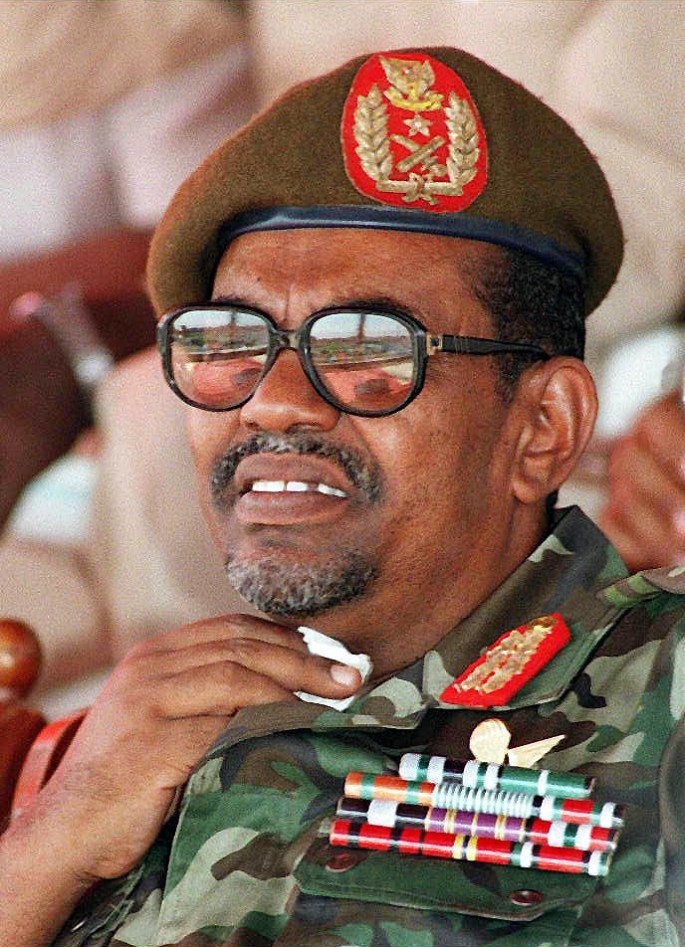
Sudanese President Omar al Bashir. from cosmicdynamic

Uganda invited Bashir to the 19th edition of the International Global Smart Partnership dialogue in Kampala. The minister for international affairs said Uganda would do it’s duty to arrest the Sudanese leader if he honoured the invitation and that Ugandan police was ready to effect the warrant.

After this President Museveni rushed to refute this statement and went ahead to apologise to the Bashir government. In the end Bashir stayed away from Kampala and the government thought it was off the hook.

It’s not be long, now Bashir has another chance to test the ICC waters if he goes ahead to attend AU meeting due in Kampala next week. This time President Museveni has come out to say Uganda will not arrest Bashir ahead of the meeting. But much as the African leaders are awaiting a report from a committee they instituted to investigate the crimes committed in Darfur, Museveni faces a doubled faceted issue of being good to a neighbour who has supported an armed rebellion (LRA) that has claimed thousands of Ugandan, south Sudanese and Congolese lives or risk the diplomatic row. Though the indictments have nothing to do with Bashir’s support for the LRA, many Ugandans would not want to see the man who is alleged to have committed crimes against humanity and war crimes against black tribes in Darfur to be on the red carpet in their country.

Whether Museveni can convince him in private to stay away from the Kampala meeting is yet to be seen. But in case he does Uganda will not be the first country to deny Bashir a visit. South Africa invited him for President Zuma’s inauguration but included a stern warning about the country’s obligations to ICC and he never turned up. If Museveni manages to keep away Bashir this time round, it will increase the chances that  the 28 other African countries will limit Bashir’s movement. Bashir faces the same fate in more than 90 other countries worldwide that are signatories to the International Criminal Court’s (ICC) Rome Statute.
Rwanda genocide: should Uganda take money for arrest of Nizeyimana?

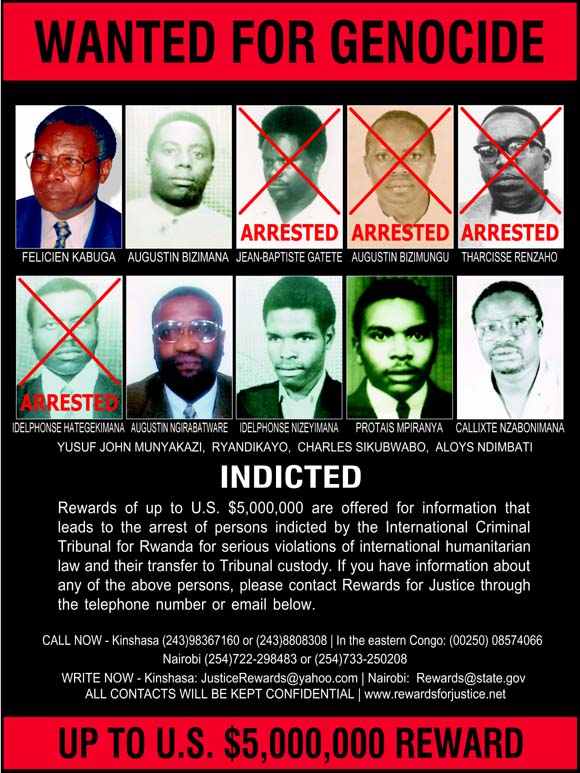
Uganda’s foreign affairs junior minister Isaac Musumba says the country would welcome a payment of worth $5 million offered by the US for their capture of Idelphonse Nizeyimana, who is alleged to have had a big role in the Rwandan Genocide.

According to the African Rights organisation Nizeyimana is a key member of the FDLR militia. He was arrested in Uganda this week. Uganda may have a right to claim the money but what are moral implications of linking money to justice?

wanted poster
wanted poster

Do we need money offers in order to arrest of a man who took part in one the most horrendous crimes? I have always wondered why money should be involved, isn’t this capitalisation of justice? When did it begin and why? What purpose does it serve?  Does this reflect the inhumanity in us that somehow we must have a material gain before we can ensure justice is served? If the likes of Nizeyimana are protected by people who don’t value that money, they will hardly get to face justice.

The same money has been put on others like Felicien Kambuga, a big businessman who partly funded RTLM, a radio that helped in plans and incitement of people to go kill their neighbours. He is still on the run reportedly in east Africa. Another thing if the money made it to the country probably it will remain in someone’s account for there are no guidelines how such money should be spent. But should we make money or should we be driven by the desire to ensure such crimes are not repeated not just in our borders but in the world? I think we shouldn’t try to capitalise justice especially in crimes against humanity for the sake of the victims, dead and alive. It’s only human to bring the perpetrators of genocide to book.

Burundi in the news; reflections on Uganda’s health care system

Ask any ‘East African’ about Burundi, they will either point to the recent wave of killing of Albinos or the long armed conflict.

I hardly see any positive stories out of the country. There’s  limited interregional and international coverage of the country but this week a BBC story: http://news.bbc.co.uk/2/hi/africa/8271331.stm got some positive story on how the health system is improving.

The story is that three years ago children under five years of age and new mothers in Burundi were granted free access to medical care. I immediately reflected on what this would mean if it was in Uganda. Of course it has brought visible changes knowing maternal mortality is high in most sub-Saharan countries. If  Uganda had this in place, the disease burden would be substantially reduced because children under five and new mothers constitute a big part of the people who can’t easily access health yet the mortality rates in these groups are high.

Uganda has lagged behind in presenting a good intervention like transparent health insurance policies where citizens can pay as low as a dollar a month to cater for their health. Burundi’s intervention indeed has made a big difference but it still lags behind Rwanda’s increase in health care coverage for ordinary people. African countries need to do much to deal with the disease burden. Why should Ugandans travel all the way to India for a heart surgery or move to South Africa, to be treated by Ugandan educated doctors? We must keep doctors in the country, they should have a decent pay.

Gender academician’s take on Violence against women in recent Kampala riots

Aramanzan N. Madanda is a lecturer at the Department of Gender and Women studies at Makerere University. This is how he responded to my article on Violence against women manifested in Kampala riots.

I have read your blog  and what I can say is that what happened in the Kampala streets regarding attacking women is a manifestation of the broader problem of violence against women (VAW). Almost any study of VAW in Uganda reports about 60%  prevalence. What this translates to is that out of every 10 women 6 have experienced VAW is some form. This violence comes from mostly intimate partners like husband or boyfriend, but it can be from security agencies or the general public.

The justifications for VAW are usually embedded in the whole conceptualisation of women’s sexuality where in many cases females are objectified as instruments of sexual pleasure or even sexual humiliation. So the comment like “she was undressed because she is beautiful” – as if beauty is concealed somewhere in the under garments are some of the manifestations. When a woman is raped, some people begin by asking if she was “properly” dressed as if it is in order to rape anyone even if she was naked!! When a woman is beaten it is taken as disciplining and a show of love!! So whenever there is any chaos (riot, war, skirmish, etc), some people take advantage and vent their sexual and other egos on women in many forms.

Peace to Uganda: Excerpts from I am an African speech by Thabo Mbeki

My mind and my knowledge of myself is formed by the victories that are the jewels in our African crown, the victories we earned from Isandhlwana to Khartoum, as Ethiopians and as the Ashanti of Ghana, as the Berbers of the desert…. All this I know and know to be true because I am an African!

Because of that, I am also able to state this fundamental truth that I am born of a people who are heroes and heroines… The great masses who are our mother and father will not permit that the behaviour of the few results in the description of our country and people as barbaric. Patient because history is on their side, these masses do not despair because today the weather is bad. Nor do they turn triumphalist when, tomorrow, the sun shines.

I am born of the peoples of the continent of Africa. The pain of the violent conflict that the peoples of Liberia, Somalia, the Sudan, Burundi and Algeria is a pain I also bear. The dismal shame of poverty, suffering and human degradation of my continent is a blight that we share… Whatever the difficulties, Africa shall be at peace!

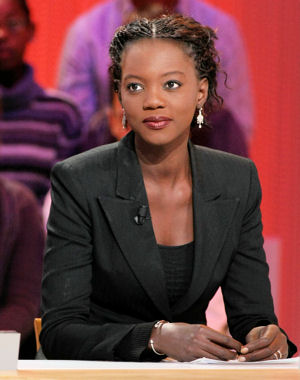
African women to watch: Rama Yade France’s junior minister for youth

Rama Yade, France's junior Minister for youth and sports. linternaute photo

I have read a few stories in the past about this inspirational woman, France’s junior minister for youth and sports. At only 32 she has already penetrated the French politics. She was born in Senegal before her mother moved to France where she grew in  an immigrant neighbourhood. Yade is a brilliant  black muslim woman.

She has a book which I am yet to read titled “Blacks of France,” which according to the Washington Post “analyzed the place in French society occupied by African immigrants’ children and other French blacks.”   The paper says the book reminded people that, despite her own swift rise in a conservative movement, Yade carried the heritage of a black woman in a predominantly white society.

A friend of mine Shaazka has also brought to my attention that  Yada  boycotted official functions for Muammar Gaddafi last year in Paris. She said Gaddafi should be made to understand “our country is not a doormat on which a leader, terrorist or not, can come wipe the blood of his deeds off his feet.”

Go gal.


Violence against women manifested in Kampala riots

“And that was not all. I also saw, for the first time in my life, women being undressed in public by rioters. Whether these women were being looked at as bad omens no one knows.” Paul Musangi. This was extracted from a Daily Monitor story which entailed ordeals of those who are held up and shot in Kampala riots just over a week ago.

Another notable comment: “Hooligans tried to pull our mainly female students out of the tour jeep, tried to smash the windows of our car, and damaged the first of our three tour vehicles.”

The riots in Kampala were sparked off by government’s refusal of the Kabaka to visit Kayunga because the Banyala wanted him to seek permission from their leader. But in the end 21 people were killed and hundreds were injured in battle that saw the police  resort to live ammunitions.

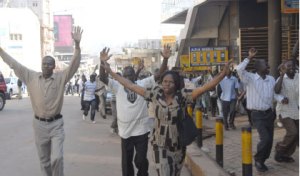
People trying to find safe haven during the riots. Daily Monitor photo.

I picked Musangi’s words because up to now no one has explained or paid attention to the abuse of women during the riot. This reminded of an incident when the police publicly humiliated Kampala woman MP, Nabillah Sempala by trying to undress her during her arrest at a political rally in the city. Nabillah’s incident was captured by TVs and it was in the pictures but few put attention on the increasing humiliation of women in political battles in Uganda. I watched this video in disbelief and wondered what could have prompted police officers to resort to this.

This was so difficult for the female lawmaker to narrate to journalists that she sobbed in the middle of interview. But her sobbing was not enough to make women in parliament to make a big statement. Even the Old Kampala Police Commander, Moses Mwanga went ahead to justify the undressing of the Member of Parliament within parliament.

And we never saw any action from female MPs of whom majority were voted because they are women (read Affirmative action). Not a walk out or no nothing to show their positions and part of the problem is because for most of them belong to the ruling party where they are more less home mamas who have no role in political decision making or influencing it. The only reaction that made headlines was Kahinda Otafiire’s who instead blamed the police actions on Nabillah’s beauty.

“If it were me they wouldn’t have undressed me, it’s because she beautiful.”

And where were our so called women activists who have for the greater part turned the field into donor-money getting one. Or was it because this story was not juicy enough to sell to the donors?

Well this one of the women in the riots for sure is a good one to talk about. So far I haven’t seen any woman interviewed who went through these humiliating experiences. I am no femmist but it’s only natural that when a person is wronged most that we pay more attention to them. We all know that violence against women is like a culture that some women have accepted and actually go ahead to say if your man doesn’t beat you then he doesn’t love you. But for those abused in the riots to tell a story as being one of those ‘who were undressed in the riot’ is a difficult one.

We can’t be silent about this public display of violence against women. What did women have to do with the decisions of the government and Kabaka? It’s not clear how many women died in this riot but you can be sure many faced the most abuse just because they are women. If we can’t hear stories of those who were undressed, God knows if we will ever know those of some who might have faced greater abuse like raped in these riots.

Some women I understand were being attacked for wearing trousers but this is just a lame excuse because Uganda is no Sudan. Women wearing trousers in most of Uganda is not seen as bad enough to evoke hostility. In places like Bosnia, we saw many women humiliated as men in the conflict resorted to rape as a weapon of war and most of their stories are yet to be heard. I fear that if Kampala or Uganda faces a much bigger riot or turmoil, the women will not survive this abuse. You can say those who were undressed in the riot were in the wrong place at the wrong time but who are the ‘wrong people’ who carried out these acts? They are there among us and if Kampala succumbs to another bigger battle – God forbid- they will come out and will be ready to humiliate women again and this time it will be at a larger scale. And if Museveni is to compensate those that lost their properties, how can we ‘compensate’ for these women’s lost dignity?

Prof. Nabudere on fragmentation of Uganda

Interesting article in Daily monitor Prof. Nabudere explains recent riots, the devide and rule policy of President Museveni, the unemployment of youth could lead Uganda to more chaos.

Bunyoro political battles: new proposal too patriarchal

Today I read in disbelief about a proposal entailed in working paper presented to President Museveni calling for government to “bar any person whose paternal grandparent was not living in Bunyoro by 1926 from contesting any political office from parish level to Member of Parliament.”

I find this proposal unfortunate and I even wonder if there was any women in this delegation. We may be living in patriarchal society but the constitution calls for giving women equal access to power. And that’s why there’s affirmative action. If this is implemented it means anybody who happened to be brought up on their mother’s side will be indeed sidelined. It’s important not to take the little strides the country has made in giving women a platform back to the ancient view of ancestry. That’s why our constitution for instance doesn’t say for one to be president their partenal parents must be Ugandan.

It is even more difficult to trace these roots for the record and political purposes. While the proponents of this proposal say they are angainst the first position of ‘ring-fencing’ of offices for only one tribe, their new position is even more radical and would exclude almost all immigrants.

Al Shabab’s deadliest attack on AU troops; Isn’t this mission impossible?

Al Shabab has successfully attacked the AU troops in Somalia and has left a top Burundian force commander dead.

Uganda and Burundi are the only African countries that allowed to deploy in volatile Somalia to support a weak Transitional government.

Press reports indicate about 16 people are dead after suicide bombers arrived in stolen UN vehicles.

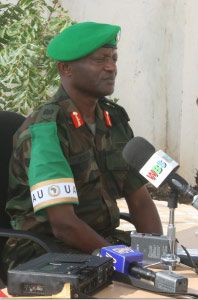
Maj.Gen.Mugisha, the injured force commander in Somalia. Daily Monitor photo.

The dead include the deputy commander Maj Gen Juvenal Niyonguruza from Burundi.

Force commander Gen Nathan Mugisha, from Uganda, was lightly wounded. The Ugandan military has not yet indicated how many Ugandans died in the blast. But this is the first major attack on the base since Uganda entered Somalia under the AMISON.

I have always wondered what Uganda has to gain or to stand up for in Somalia that we must risk our troops’ lives in a mission impossible. Uganda cannot simply continue to ignore the rising influence of the militants and the conflicting interests from the west and neighbouring countries like Ethiopia and Eritrea that have partly played in the mess in this country. Ugandan troops a few months were reported to have passed on arms from USA to the TFG which controls a small part of the country.

Why should Ugandans be in Somalia as peacekeepers in the face of violence where they are targets? How many lives do we have to lose to see that a peacekeeping mission at this stage cannot work in Somalia? What is the AU thinking or is this asking too much? I think Ugandans especially those whose relatives are deployed in Somalia should start asking government questions that should have been answered before deployment.