Why is Thomas Kwoyelo, a former LRA commander captured during the operation lightening thunder being tried for with the lesser offence of kidnap with intent to murder instead of war crimes. Well the answer lies in the fact that Uganda has been slow in enacting the ICC bill which would see formally war crimes and crimes against humanity be recognised by the Uganda local judicial system.
According to an article by Bill Oketch on IWPR, Thomas Kwoyelo’s trial will begin in August and that prosecution decided to try him for a lesser crime to speed up the legal process. Well this will have implications in the whole process of seeking justice for northern Uganda war victims. Kwoyelo will initially appear before the regional court in Gulu, but his case will be submitted to Kampala once initial investigations are over, according to local lawyers.
If Kwoyelo is not tried by the Uganda War crimes court to which president Museveni appointed 2 judges last year, it will be a failure on part of government to deal with LRA impunity.
There have been delays in the passing of the ICC law in Uganda and one of the controversial parts is the move by government to give immunity to a sitting president in case he’s accused of war crimes yet under the Rome Statute there’s no immunity for heads of state.
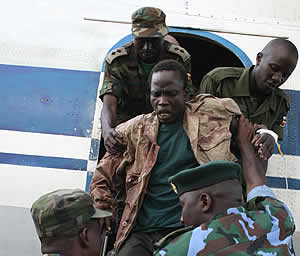
Thomas Kwoyelo getting off a plane at Entebbe Airport from Congo where he was capture. New Vision photo
If the court is to be effective, police must be trained to investigate war crimes, continued the judge. Likewise, prosecutors and defense lawyers need to be trained on how to prosecute and defend the accused. But all this seems to be on hold. The judiciary is ready at least according to one of the judges of the court whom I spoke to but the law is not there.
But this hurriedly trial of Kwoyelo will have an impact on future trials of those accused of committing war crimes in northern Uganda in a two decade conflict.
Government especially Parliament are giving no choice to the Director of Public Prosecution. They must act soon.
Kwoyelo, 37, was captured in the Democratic Republic of Congo in March, following a gun battle between the Ugandan army and LRA soldiers.He faces 12 counts of kidnap with intent to murder relating to the disappearance of villagers from Atiak and Pabbo, sub-counties of Amuru and Gulu districts, who were allegedly seized by LRA soldiers. They were not seen again. And that’s it, a delay in enacting a law gives a mass murder a charge of intent to murder. How are we mindful of those who lost their lives, their limbs and their loved ones?
Most of you have probably watched this video or heard the news of how the US Secretary of State Hillary Clinton lost her temper when a misinterpreted question from a student was put to her. Well my thinking is the misinterpreted question was not offessive so Mrs Clinton should have not used excessive force to put the question out of the way. This hailed woman should have known where she was, this was Congo where millions are displaced and many have died so there were way too many situations to make her lose her cool than a little reference to her husband which was never there in the first place.
As the media plays this clip over and over, the really story of her country’s offorts to help Congo has been put in the shadow and it will not be easy to put it out there. The trip extend to Goma in eastern DRC, in fact it was the first for a US Sec of State. Having gone through the grilling days of the Democratic primaries, Clinton should have learnt a thing or two on how to handle the media especially the western media when it comes to questions related her husband.
The western media got their juicy story of the day for their audience instead of putting facts and images of what is on the ground in Congo. They linked the outburst to Bill Clinton snatching headlines in North Korea late last week when he secured the release of two US journalists, an act that many in the west saw as heroic. And the media were waiting to jump on any moment when Hillary would show her frustration at this competion for media attention and she granted them the chance. I don’t fault the media much, I simply think Clinton should have known better that if she lost her cool in the Congo, Congo would be the loser.
But going in details of what message she delivered, she promised real help for victims of sexual violence which is a great gesture but more effort is needed to end the war otherwise putting up a fund for victims when the war is still raging we will treating just symptoms.
This trip helped little to bring crimes going on in the Congo back to the international arena. The Secretary of State was the subject of the news instead of Congo. Congo victims remain mostly unheard.
In the last two years, courts in Uganda have delivered two major judgments that have brought to the light the illegal prosecutions carried out under the military justice system in the country. On 9th July 2008 the Supreme Court of Uganda ruled that the trial of civilians by the General Court Martial (GCM)is unconstitutional and GCM is an inferior court to the high Court and other courts of record.
This was a long awaited ruling that came out in light of a case where twenty five men suspected
Brig. Bernard Rwehururu new chairman of the General Court Martial and Lt. Gen. Ivan Koreta. A New Vision photo
to members of Peoples Redemption Army (PRA) – wispy rebel group allegedly operating in DRC- were arrested in March 2003 by the army and charged before the GCM on 16 April 2003 with the offense of treason and later remanded on 15 May 2003 to Makindye military prison.
For more than two years, the military kept these men under detention and refused to honour High court orders for the suspects to be given access to lawyers and their relatives and to be granted bail.
Their treason trial together with FDC leader Dr. Kiiza Besigye is one of the cases that have tainted President Museveni’s regime when the regime sent the infamous black Mambas, a paramilitary group, to storm the High Court and re-arrested the suspects after being granted bail later in November 2005.
By detaining and trying PRA suspects with charges ranging from treason to terrorism, the military attracted some “unwanted attention” from the public.
The PRA case generated public disapproval; it was the first time that Ugandans and specifically the legal fraternity took a hard look at the workings of the military justice system especially the General Court Martial.
At the time of the Supreme Court ruling last year, most of the men who had been incarcerated for more than three years had chosen the easier way out, to confess that they were indeed rebels and get amnesty instead of putting up with the prolonged trial that seemed to have no end.
But this ruling meant that no other civilian would ever be subjected to the whims of the miltary court if the court order is respected–the military has in the past ignored court rulings. Although the military never really reacted to the ruling with Lt. Gen. Ivan Koreta as the GCM chairman, I believe it is time for Ugandans to demand that the military pledges to respect such court decisions.
Nevertheless the Supreme Court ruling was a big step but it wasn’t and shouldn’t be the last effort to check illegalities within the military justice system.
Ugandan soldiers. Some have suffered under an unjust miltary justice system
Early this year, in February, the Constitutional Court gave another stinging ruling for the Ugandan military justice system this time related to the prosecution of cases against soldiers. It ruled that the march 2002 execution of two UPDF soldiers in Kotido district by the Field Court Martial was illegal because they were denied right to appeal.
Pt. Abdallah Mohammed and Corp. James Omedio were executed after a trial for the murder of an Irish Catholic priest, the Rev. Fr. Declan O’Toole and two other civilians.
They were convicted, sentenced to death and immediately executed by firing squad. The Uganda Law Society and Jackson Karugaba filed a petition to the Constitutional Court and in his ruling Justice Amos Twinomujuni said: “I would hold that the accused persons in the Kotido trial were entitled, as a right, to appeal through the military court systems up to the Supreme Court.”
Then he said that even if the Supreme Court had repealed their appeal, the accused soldiers had a right to hear if the president could grant a prerogative of mercy.
While I was still in Kampala I spoke to lawyers that are familiar with the military system and have represented some people there.They said most soldiers are detained for long without trial, and there is unfair trials while some soldiers are framed. Because most cases if not all are tried in Camera, the public never gets to know how things go in that court. Most of them are not well off to get lawyers, they serve sentences in jails and are dismissed from the army with no one ever coming to their rescue. They say a few things have improved since Gen. Elly Tumwine was replaced but the system leaves a lot to be desired. There’re still many complaints that there is a lot of influence-peddling from army top ranks.
It’s reported that the army has executed 26 people over the past three years. There are currently many UPDF soldiers in the condemned sections of Luzira Upper Prison and Jinja Main Prison
A report by Foundation for Human Rights Initiative says “the greatest problem currently facing these inmates is a failure to receive an appeal against their convictions and sentences, a clear breach of their constitutional rights. They appear to have been left in legal limbo, with neither the military nor the civilian courts taking responsibility”
The report said there are over 30 military personnel in the condemned section of Luzira Upper Prison who have not yet received an appeal, despite claims that their appeals have been noted in the GCM. All of these soldiers were convicted by these lower military courts and sentenced to death.
In their 2005 report on Uganda, the International Federation of Human Rights (FIDH) highlighted what they believed to be a ‘scapegoat policy’, where low ranking soldiers are imprisoned and executed to show observers that the army deals swiftly and effectively with personnel who commit crimes.It is this effort on the side of the government to show that they have security issues under control and that their military is incomparable to past regimes that has made many blind to the injustices against UPDF soldiers.
I was working on this story and I thought I had got a headway when someone tried to get me in touch with a soldiers that served a sentence for years after failed attempts to appeal and he was now dismissed from the army but he withdraw from giving the interview at last minute fearing for his security.
Miltary justice system is hardly reported on in Uganda nad the media seems to follow only high profile officer cases, the likes the Henry Tumukunde, and the famous ghost soldier cases. With new leadership at the GCM, I think these stories need to come out not just reporting about the change of the chair.
Some lawyers were calling for changes in the military justice system. One called for a UK kind of system where prosecution of military officers is controlled not by the military, but by an independent body, the Service Prosecuting Authority which insulates the military justice system from abuse from within.
Below is how Uganda military justice works.
Unit Disciplinary Committee
Field Court Martial
Division Court Martial
General Court Martial and Court Martial Appeal Court.
The latter two sit as appellate courts, with the Court Martial Appeal Court acting as the highest appellate court in the army judicial system.
I have read many articles on the growing ethnic tensions that have been fuelled by the president’s words in Bunyoro over the last few months. But the latest, urging Bafuruki (migrants) not to stand for office in the oil reach Albertine region is below the belt. I don’t know how this will end as the Bafuruki are also turning the heat on the president but this should bring us to discuss fully and find solutions for tribalism before it consumes us the Kenya way. And as we see, that will not be done by government but us Ugandans in our every small way we can.
Oil exploration works going on in Uganda's Albertine region. The area is facing ethnic tensions
The president needs both Banyoro and Bakiga votes as he continues his rule in 2011 but we must question why the president is ever so tribal. Well the president is not a foreigner so I assume with a lot of tribalism in the country he was not lucky to escape it but what is even more lethal is applying tribal sentiments in the wake of oil exploration as if he has not known a place called the Niger delta. He wants to please two groups but it seems he knows no way how to. What he’s doing is unconstitutional but this shouldn’t be out argument for we are all aware he can easily make it constitutional. He just needs about 5 million shillings to pay to non Bakiga NRM MPs and he will have his way. So we should not rely so much on the legality of the president’s move if we are to bring to realise that his way is the one to hell but rather bring the point closer to his compound. Someone needs to tell him that by raising tribal overtones in Bunyoro leadership positions, Museveni will be siding with those who have always doubted his Ugandan origins therefore his presidency. In his Rwakitura home, the president if he’s to apply the same rule that he’s advocating for in Bunyoro, he should be treated as a Mufuruki but he goes to vote for people there some of whom are Bafuruki like him. In his government and his cabinet people like Kuteesa shouldn’t be allowed to stand for any office in Sembabule for it lies within Buganda. May be when we show him that he too is a Mufuruki and he has been able to live freely and achieve what he wanted with nobody threatening him basing his tribe, he will understand our point of view. More pressure is needed to show that his is not a solution but a catalyst to these two ethnic groups. Today he will deny the Bakiga to stand office; tomorrow he may take away their rights to vote because they are Bafuruki and trust me he can because he has a lot of time left before he clocks 75, his official retirement age, for now. Museveni’s regime has always been accused of being tribal especially in the army promotions and other security organs but taking tribalism to oil wells, Ugandans must wake up before the sectarianism consumes the nation. And the Banyoro should reject the president’s offer for it will never be a solution to their problems or to those of their sons and daughters for generations to come long after this regime.
It’s just days when I left Uganda and my friends messages keep on coming in. Today I received a rather interesting one.
“Take good care of yourself, there’s a new strain of HIV am sure as you have learnt and it’s looking for more people to jump on.” This message made my day. Why? Who gets advice on HIV from a friend and in an email? It’s just not many. Well the fact that you can have someone say something that important in a casual ‘easy’ conversation tells a lot about how far my country has come in dealing with HIV whether it is about information on prevention or dealing with stigma.
In the past there was a lot of stigma that I imagine for a friend to send you such a message you would say hold on a moment does she think that am that wild to give me this advice? But things have loosened up and people know better. And I chose to cite this message because I wanted to highlight the plight of some African women and this week I call it Women who need the grace. And one such woman is an unnamed Cameroonian. She’s the first to be identified with a new strain of HIV. A new strain of HIV has been discovered in a woman from Cameroon. It differs
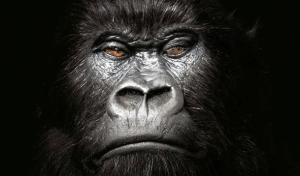
New strain of HIV is related to the simian virus that occurs in Gorrillas.
The finding “highlights the continuing need to watch closely for the emergence of new HIV variants, particularly in western central Africa,” said the researchers, led by Jean-Christophe Plantier of the University of Rouen, France.
This unnamed Cameroonian woman needs the grace and I hope the new strain is contained and that it is not yet wide spread. Although there’s no HIV drug/vaccine yet, major steps have been made and that’s why we have Antiretroviral drugs which help HIV carriers’ immune systems and with increased access to drugs, places worst hit by HIV like Africa have been so hopeful. The three previously known HIV strains are related to the simian virus that occurs in chimpanzees. The most likely explanation for the new find is gorilla-to-human transmission.
It’s still a mystery how the virus actually got to the woman and not much is known about how it will react to existing drugs so I can only imagine what this woman is going through. Many newspapers in Uganda have already given the development a lead and although it may be very scaring, it’s good for people to have this revelation as it comes. I say spread the word on this strain whichever way and keep us informed, this way we can stay at the top and save ourselves.
According to Daily Monitor , the Uganda army Land Forces Commander, Lt. Gen. Katumba Wamala has revealed that they are ready to go ahead and attack Islamists strongholds in Somalia if they are given a green light by the United Nations and the African Union. If such a mandate is issued it will see about 4300 Ugandan and Burundian peacekeepers more embroiled in the Somalia conflict. The two countries went to the horn of African nation in the name of peacekeeping but of late have been calling for change of mandate with increased attacks from Al Shabab.
This comes at a time when the troops are battling an unknown disease they contracted in Somalia. Some people have hinted it could be poisoning but about 40 Ugandans were airlifted to Kenya following the outbreak of the disease that has so far killed one UPDF soldier and four Burundians.
The opposition leader in Uganda Dr. Kiiza Besiggye has called on government to withdraw troops from Mogadishu saying “Rather than keeping peace they were sucked into civil war. There is ample evidence that the UPDF supplied arms to one of the warring factions and that is why we are saying they should return home.”
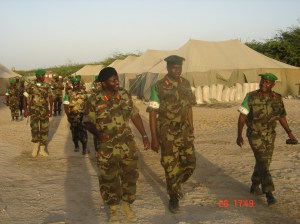
Lt.Gen Katumba Wamala, Uganda's army Land Forces Commander (L) while visiting troops in Mogadishu last year. AMISOM photo
Two weeks ago The Independent carried a lead story questioning whether 43000 AU troops could succeed where about 38000 UN troops failed in the early years of the conflict. No doubt if this mandate is given a go ahead it will further complicate the position of the AU and the two troop contributing countries in Somalia. Will they win or lose the fight and in case they win what price are citizens of Uganda and Burundi will to pay? If this intervention fails how would AU deal with this taking sides?
It’s been days without a post but I have been in transit mostly. I am on my way to Costa Rica where I will be spending the next one year studying a masters in Media Peace and Conflict studies at the UN-backed University for Peace http://www.upeace.org/
I will continue to write the commentaries on what is happening in both Uganda and my little university world. Thanks for the visits I hope to continue hearing from you.



 Rosebell Kagumire