Leymah Gbowee is the founder and the Executive Director of Women Peace and Security Network Africa (Wispen-Africa). She had a great role in the Liberian Peace Process and the Women’s Leadership Board of the Kennedy School of Government at Harvard University awarded her the 2007 Blue Ribbon Award. Gbowee’s movement during the Liberia civil war is captured in the documentary Pray the Devil Back to Hell. Thedocumentary shows how the women of Liberia managed to influence talks and events that ended the reign of Charles Taylor. It shows the power of women and particularly the potential of African women in pushing to peace. I met Leymah in Johannesburg at the Man Up campaign summit. What really amazed me was her threat to undress in front of those rebel leaders that were stalling the peace efforts in Accra Ghana. She did this as these rebel leaders together with Charles Taylor were commanding thousands of child soldiers who caused mayhem in Liberia.
I spoke to Leymah about a recent article by Foreign Policy which put Liberia among 60 failed states in the world. To me this was naïve knowing the progress the country has seen under President Ellen Johnson Sirleaf. Leymah tells me Liberia has the toughest laws on violence against women and there’s a special court to tackle sexual offenses.
At the beginning of the twentieth century only 10%-15% of those who died in war were civilians. Research has shown that by the end of the century over 75% of those killed in war were civilians. Civilians became a target of many separatist and other armed rebel groups especially in Africa where civil wars have sprang up since the struggle for independence. But events of yesterday in Angola added to the growing phenomenon of targeting of games and sports by insurgents and rebels for political motives.
You can say it has been there for ages and one can point to from the religious sectarianism among clubs like in Scotland, acts of violence and Hooliganism in some parts of Europe. Then there came the 1972 Summer Olympics in Munic when members of the Israel Olympic team were taken hostage and eventually murdered by Black September, a militant group that was said to have ties to Yasser Arafat’s Fatah organization.
Then March last year there was an attack on the Srilanka cricket team in Pakistan by militants. Such incidents are many but I picked the ones I remember. And in all I wonder whether these attackers really think such acts help their causes.
Adebayor escaped unharmed. Dailymail photo
Yesterday’s shooting occurred in the Angolan oil-rich territory of Cabinda, where rebels have been fighting for independence. The Gunmen fired on a bus carrying the Togolese national football team to the Africa Cup of Nations on the way from the Republic of Congo where they were practicing ahead of the tie. An assistant coach, press officer and driver were killed. Two players were shot and injured
And the attack on the Togolese team produced two different reactions, whether it was due to the difference in information access or not we are yet to know. The Angolan government called the incident an “act of terrorism” but the Africa Cup of Nations officials described the attackers only as armed robbers.
May be these football officials wanted to stay clear from the politics and away from the word that has been used to bring untold suffering to many innocent people (terrorism) but still there are questions to be asked. And the question is whehter the Angolan government provided enough security knowing this is an area susceptible to FLEC rebel attacks.
I am concerned about the increasing attack on the most famous and beautiful game. A game that unites a people at least for 90 minutes. A game which will bring the world’s attention to Africa come June. These attacks as aimless and heartbreaking as they are seem endless. In October last year a Colombian guerrilla group kidnapped and killed ten football players.
According to Daily Monitor , the Uganda army Land Forces Commander, Lt. Gen. Katumba Wamala has revealed that they are ready to go ahead and attack Islamists strongholds in Somalia if they are given a green light by the United Nations and the African Union. If such a mandate is issued it will see about 4300 Ugandan and Burundian peacekeepers more embroiled in the Somalia conflict. The two countries went to the horn of African nation in the name of peacekeeping but of late have been calling for change of mandate with increased attacks from Al Shabab.
This comes at a time when the troops are battling an unknown disease they contracted in Somalia. Some people have hinted it could be poisoning but about 40 Ugandans were airlifted to Kenya following the outbreak of the disease that has so far killed one UPDF soldier and four Burundians.
The opposition leader in Uganda Dr. Kiiza Besiggye has called on government to withdraw troops from Mogadishu saying “Rather than keeping peace they were sucked into civil war. There is ample evidence that the UPDF supplied arms to one of the warring factions and that is why we are saying they should return home.”
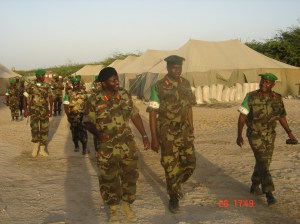
Lt.Gen Katumba Wamala, Uganda's army Land Forces Commander (L) while visiting troops in Mogadishu last year. AMISOM photo
Two weeks ago The Independent carried a lead story questioning whether 43000 AU troops could succeed where about 38000 UN troops failed in the early years of the conflict. No doubt if this mandate is given a go ahead it will further complicate the position of the AU and the two troop contributing countries in Somalia. Will they win or lose the fight and in case they win what price are citizens of Uganda and Burundi will to pay? If this intervention fails how would AU deal with this taking sides?
The war between Khartoum and South Sudan may be long ended but the reconstruction of South Sudan is not going to be an easy ride. Even as the ruling on Abyei was recieved, African women and children in Sudan still face challenges from food, infrastructure to lack of security. One major obstacle left behind by the war are land mines. Some were planted by the Lords Resistance Army and others by government forces and rebels in Sudan. For this week’s Women of Valour, I chose the women of South Sudan who bear the harsh hot sun to demine the villages to make safe places for people to resettle.
Holocaust scholars– including Yad Vashem Professor Yehuda Bauer and the president of Genocide Watch, Gregory H. Stanton – signed a petition praising Uganda’s move to ‘block’ Sudanese President Omar al Bashir from attending a conference in Kampala over the ICC indictments.
Map of Sudan showing Darfur region where Bashir's is accused of supporting a conflict that claimed thousands of lives of black tribes
The media was awash of stories as Bashir kept quiet on whether he would attend the conference, a move that would have put Uganda between a rock and a hard place.
I know and I have gained from Gregory H. Stanto’s vast knowledge of the Genocide at the young leader’s forum in Montreal in 2007. I learnt alot about the stages of genocide and that genocide can be prevented.
While Santon and other scholars said “Uganda’s action helps isolate Sudan’s president and shames the Arab and African countries that have given him red-carpet treatment,” I believe their move is not worth the praise. This is because it wasn’t done in total belief in justice. Uganda simply did what was politically convinien by asking Bashir not to attent in person to avoid a diplomatic row. If Uganda really believed in the whole Rome statute the government wouldn’t be moving to enact a law that grants a seating president immunity from prosecution for war crimes.
See pictures from Darfur by Stuart Price a photojournalist who spent more than a year in the region.
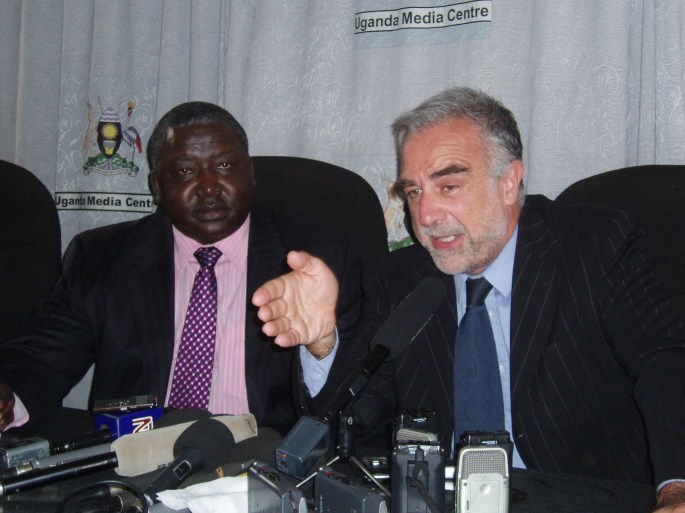
The International Criminal Court Chief Prosecutor, Mr Luis Moreno-Ocampo, arrived in Uganda on Saturday to consult with government on the arrest warrants of Lords Resistance Army leaders and Sudanese President Omar al-Bashir. Minister for International Affairs also Henry Okello said Ocampo discussed with top government officials involved in international justice issues among others Jean Pierre Bemba’s case.
Uganda Minister for International Affairs Henry Okello Oryem and ICC prosecutor Luis Moreno-Ocampo addressiing the press in Kampala on July 13. Rosebell Kagumire photo.
Much as the attention seems to be going to Gen. Bashir’s expected visit to Uganda on July 27 for the 2009 Smart Partnership Dialogue in Kampala, I dwelt on what the government stakes are as the Congolese ex-Vice-President Bemba, whom they supported for long, faces war crimes charges. The ICC ruled in June that Bemba had to answer to war crimes charges for the actions of his troops in the Central African Republic in 2002 and 2003. He is to face trial on three counts of war crimes and two of crimes against humanity.
He led the Movement for the Liberation of Congo which was a major player in the Congo’s long civil war. Some of his lawyers have hinted that Bemba’s charges may be politically motivated, to remove him from future politics of the DRC. He lost a landmark run-off election against President Joseph Kabila in 2006 and in 2007 he fled the country after he was charge with treason. Uganda comes into the picture because they supported Jean-Pierre Bemba, whose rebel forces at one time held nearly one third of Congolese territory. Uganda is alleged to have armed Bemba’s group and helped train his fighters who are implicated in this case at the Hague. Many people have been critical of the reluctance by the ICC to expose what Uganda’s role was and to what extent it led to the mayhem in the Congo. Uganda has come up many times in the trial of Thomas Lubanga and it is expected to come up as Bemba stands trial.
This is what Minister Okello Oryem has to say.
“We discussed the issue of Bemba. We are saying that the Bemba case should be properly handled so that it doesn’t cause a backlash in the DRC. DRC is unstable as it is and we don’t want the supporters of Bemba to think that he’s being prosecuted as an individual because of his differences with Kabila. But it should be understood that Bemba is being prosecuted because of the crimes that were committed under his leadership.”
On Uganda’s role in Bemba’s rebellion:
“There’s no secret that Uganda supported Bemba in the past but now that he is being prosecuted in the courts of law Uganda has got no authority or power to intervene in this case. If he’s innocent it will be proved in the court.
We have nothing to hide we are not going to lose sleep over anything because there’s nothing that we did with Bemba which is wrong. And there’s nothing we did with Bemba that was a cause of him committing the kind of crimes he’s being prosecuted against.”
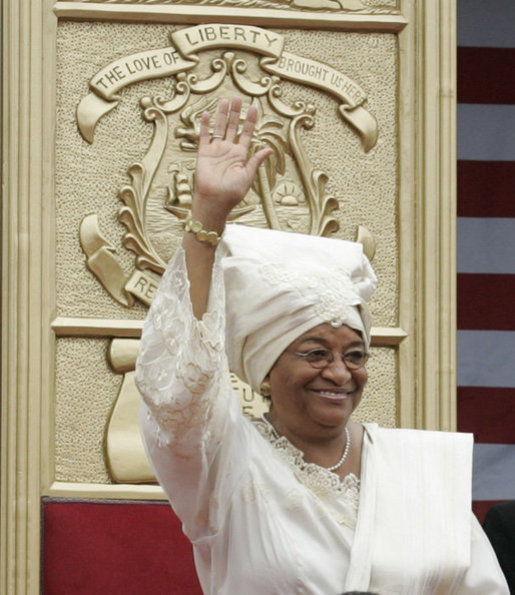
The Truth and Reconciliation Commission (TRC) of Liberia in its final report this week recommended that President Ellen Johnson Sirleaf among others should be barred from holding public office for 30 years.
The recommendation also extended to all those associated with former warring factions, their leaders, political decision makers, financiers, organizers, commanders, foot soldiers. President Sirleaf has already spoken on the subject saying she gave support to the Charles Taylor group but “only intended for humanitarian purposes.”
The TRC doesn’t outright say Sirleaf is guilty of partly fuelling the 14 year old conflict that claimed thousands of lives in the West African nation but their recommendation has got many thinking about the implications. President Sirleaf has been one of the African women that inspire me not because she was the first female head of state but because of her ambition displayed in a career in the finance industry built over decades. In the elections I was excited by George Weah because of his football career but a good look at Sirleaf made me believe she was the right person for the job of heading a country emerging out of a war.
I never knew I would have a chance to talk to Sirleaf. But that chance came in February 2007 in Kigali Rwanda where I had gone to cover a huge African women conference. I was working for NTV at the time and it was a one man crew. I had to secure an appointment for an interview with the president at her suite at Kigali Serena Hotel.
After waiting for long hours (because the SABCs CNNs of this world had to go in first) I got into her room. I was told by her press secretary that I had exactly 15 minutes to setup the equipment and do the interview. First she was amazed at how a lone girl from Uganda could make it in these minutes and she said something to that effect before the interview began.
Why am I bringing this up? It’s because I asked how Sirleaf could have supported Charles Taylor during this interview. And her answer was that she thought of him differently at the time. She didn’t think that Taylor wanted power for himself just like many other leaders on the continent. She agreed it was a misjudgment on her part but she insisted she had started a new page of rebuilding her nation. Sirleaf said that as a woman and mother she understood well that women suffered the brunt of war through rapes and that such wounds can mostly deeply be understood by a woman. She said she was determined to see justice served.
To me she cut across as an honourable politician and I was in no doubt she was the iron lady I had long read about. Her experience on international stage gave her a different added understanding of conflict and governance in Africa as she put forward her views of leaders who cling to power during the interview. With this judgment from the TRC I am left thinking, what options does the honourable iron lady have? And if she’s to step down would this be good for Liberia? Before I even think of her stepping down, what truth is in her defense when she says her support was for humanitarian use? Charles Taylor is still being held at The Hague, on trial by the Special Court for Sierra Leone for war crimes and crimes against humanity committed during the conflict in Sierra Leone. So this means we won’t hear from Taylor whom Sirleaf dealt with but this shouldn’t water down the case for or against Sirleaf. There should be extensive revelations whether Sirleaf was aware of Taylor’s mischief and whether Taylor was the only person through whom such supplies could have passed to reached the people.
I still believe that Sirleaf should remain president unless there’s insurmountable evidence that her support for Taylor was aimed at elevating herself politically. After her work that has improved lives in Liberia, I think Sirleaf should be given a chance to correct her wrongs if she hasn’t done that already. At the end of our interview she was warm and she asked how I find my work and the challenges. After my brief answer she said: “We need women like you in the media in Liberia.” This statement showed me this is a president who thinks of her country in every sense. If the recommendation of the TRC is to be adopted, they will put an abrupt and ugly end to the career of a great woman. And such great women in African who can traverse male dominated political playgrounds in a dignified way to go on to become great leaders are hard to come by. This is where the question of justice or moving on comes in play. With appreciation that one can hardly move on without justice, I still believe banning Sirleaf will be Liberia’s loss.
I just read this piece from International Magazine that a total of 31 African heads of state were assassinated in less than 40 years after independence.
This was brought forward by President of the Commission of the African Union (AU), Jean Ping, at the opening of the 15th session of the Executive Council of the AU.
This means that on average a Head of State was killed per year is a “regressive political developments disturbing.” African presidents are calling for a coherent response to ensure minimise similar occurrences.Just in March this year, the President of Guinea-Bissau, Joao Bernardo “Nino” Vieira, was murdered and a coup followed. Similar events have occurred in Madagascar and Mauritania.
At the 12th Conference of Heads of State and Government of the AU in February in Addis Ababa, African leaders asked the AU Commission to submit recommendations for the implementation of adequate preventive measures against unconstitutional changes of government.
But no amount of recommendations will save African governments from coups. These leaders know what they should do to prevent coups but they aren’t doing it. They instead behave in a manner that can only encourage coups. For instance abrogating constitutions, stealing elections Kenyan and ZimbabweAfrica. Otherwise treating coups as though they are the cause of chaos rather than an outcome of certain misrule is not right. And I believe sometimes coups are the only hope for many states. style, not allowing opposition voices is the norm in many countries. Every time you here a dictator has changed the constitution to give himself more terms in offices and at worst leave it open for a possible life presidency. Many citizens in many countries only wait for the hand of God to take away dictators. Corruption is soaring and nothing is done on merit in many African countries. With this situation someone needs to tell African leaders that you alone can prevent coups in Africa.




 Many people have died or had their legs shot off because of a mine

 Rosebell Kagumire