If Bashir decided to come to Kampala at the end of the month, the Uganda government has to decide what would be more damaging, arresting the ICC indicted man or letting him free
A few views I have so far gathered:
“The institutional framework to practically deliver this arrest seem to be largely absent even at the ICC level. There is a gap as the court operates on the cooperation, failure to cooperate is not fatal to Uganda.” – a Ugandan lawyer.
Many believe that the positions on regional blocks like AU and Arab league are mainly cosmetic and also a deliberate measure to set protective precedents for any other possible arrests. And no doubt some leaders have watched over or facilitated the committing of similar crimes that Bashir faces.
Look at this quote closely, you will see that Uganda is not about to see the light.
“I will retire if there are no demands,” Mr Museveni said. “I am going to be 65 in September but I am still very strong. I would like to advise young people that if you look after yourself very well you can be strong for quite a long time. For us we don’t look at this as power; we look at it as struggle.”
The man keeps telling himself that he’s strong even when he’s not. He keeps seeing popular demand even when the polls show a different course. Well if Obama thought his message of change and not clinging to power was being taken, this proves otherwise. I hope we don’t have a Kim Jong because a Mugabe we surely are very close.
At seventy five he will say my people still want to see me in the seat and God knows what will be happening in Uganda. As my friend usually say If the president can’t leave power then I will leave the country and leave him to eat entire drum(symbol of power traditionally) and its skin. But then how many people have the luxury of being able to leave the country. The president keeps saying he has sacrificed too much for this country but who can afford to sacrifice for over 3 decades for people who can ably find an alternative which could be even much better if he gave them support? Well the president must know that To whoever much is given much is expected. His rule is not just about sacrifice, it’s also about gains and the gains way out march the sacrifice, so Uganda expects so much from him and the best he can do is retire before 75.
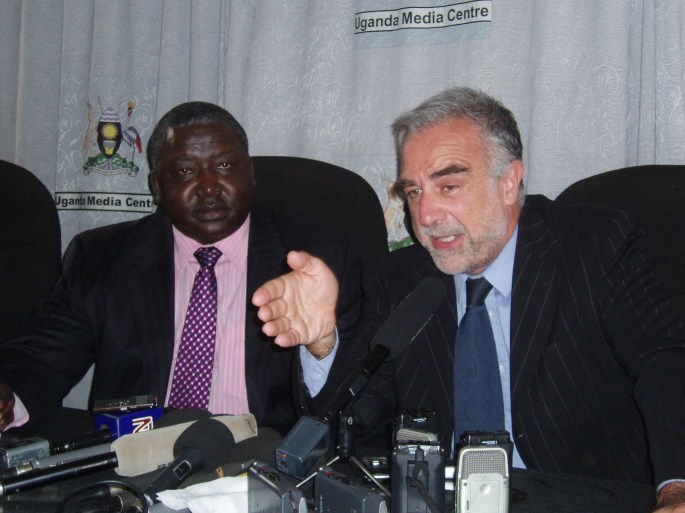
The International Criminal Court Chief Prosecutor, Mr Luis Moreno-Ocampo, arrived in Uganda on Saturday to consult with government on the arrest warrants of Lords Resistance Army leaders and Sudanese President Omar al-Bashir. Minister for International Affairs also Henry Okello said Ocampo discussed with top government officials involved in international justice issues among others Jean Pierre Bemba’s case.
Uganda Minister for International Affairs Henry Okello Oryem and ICC prosecutor Luis Moreno-Ocampo addressiing the press in Kampala on July 13. Rosebell Kagumire photo.
Much as the attention seems to be going to Gen. Bashir’s expected visit to Uganda on July 27 for the 2009 Smart Partnership Dialogue in Kampala, I dwelt on what the government stakes are as the Congolese ex-Vice-President Bemba, whom they supported for long, faces war crimes charges. The ICC ruled in June that Bemba had to answer to war crimes charges for the actions of his troops in the Central African Republic in 2002 and 2003. He is to face trial on three counts of war crimes and two of crimes against humanity.
He led the Movement for the Liberation of Congo which was a major player in the Congo’s long civil war. Some of his lawyers have hinted that Bemba’s charges may be politically motivated, to remove him from future politics of the DRC. He lost a landmark run-off election against President Joseph Kabila in 2006 and in 2007 he fled the country after he was charge with treason. Uganda comes into the picture because they supported Jean-Pierre Bemba, whose rebel forces at one time held nearly one third of Congolese territory. Uganda is alleged to have armed Bemba’s group and helped train his fighters who are implicated in this case at the Hague. Many people have been critical of the reluctance by the ICC to expose what Uganda’s role was and to what extent it led to the mayhem in the Congo. Uganda has come up many times in the trial of Thomas Lubanga and it is expected to come up as Bemba stands trial.
This is what Minister Okello Oryem has to say.
“We discussed the issue of Bemba. We are saying that the Bemba case should be properly handled so that it doesn’t cause a backlash in the DRC. DRC is unstable as it is and we don’t want the supporters of Bemba to think that he’s being prosecuted as an individual because of his differences with Kabila. But it should be understood that Bemba is being prosecuted because of the crimes that were committed under his leadership.”
On Uganda’s role in Bemba’s rebellion:
“There’s no secret that Uganda supported Bemba in the past but now that he is being prosecuted in the courts of law Uganda has got no authority or power to intervene in this case. If he’s innocent it will be proved in the court.
We have nothing to hide we are not going to lose sleep over anything because there’s nothing that we did with Bemba which is wrong. And there’s nothing we did with Bemba that was a cause of him committing the kind of crimes he’s being prosecuted against.”
“In sheer American fashion, Obama explained boldly that he picked Ghana because of the West African nation’s “democratic commitment.” While Kenyans, Nigerians, South Africans and others were searching their souls, Ghanaians were preparing to do what we Africans do best: dress in colorful attire, sing, dance and chant in praise of presidents. Although other African countries found their souls very quickly -– “democratic commitment” is such a clear message –- they couldn’t do so in time for Obama to add them to his itinerary.”
I need to hear from you. Do you think African blood saved Obama from scrutiny much more than the blood gave him an edge to chide African governements the proper way that no other outsider can afford without being percieved as being abusive?
My favourite part of the speech was when told African youth that this is their moment. The youth for instance in Uganda make more than 60 percent of the population yet they are the most left behind in political participation, in employment and I think if this country is improve the youth must get out of their comfort or uncomfort zones.
Here’s the part:
“Fifty-two years ago, the eyes of the world were on Ghana. And a young preacher named Martin Luther King traveled here, to Accra, to watch the Union Jack come down and the Ghanaian flag go up. This was before the march on Washington or the success of the civil rights movement in my country. Dr. King was asked how he felt while watching the birth of a nation. And he said: “It renews my conviction in the ultimate triumph of justice.”
Now, that triumph must be won once more, and it must be won by you. And I am particularly speaking to the young people. In places like Ghana, you make up over half of the population. Here is what you must know: the world will be what you make of it. You have the power to hold your leaders accountable, and to build institutions that serve the people. You can serve in your communities, and harness your energy and education to create new wealth and build new connections to the world. You can conquer disease, end conflicts, and make change from the bottom up. You can do that. Yes you can. Because in this moment, history is on the move.”
When I first heard of the story about the murder of Marwa Sherbini, a veiled (and pregnant) Egyptian woman, as she prepared to give evidence in a German courtroom against a man who physically assaulted her early this week I couldn’t comprehend the situation.
I later read the story over the news sites and I wondered how this could happen. I have heard enough stories from friends, colleagues who have lived in Germany and how they faced racial discrimination and sometimes abuses. In one of the stories story my friends were on a bus ride and some German couple had a child who started crying at the sight of my friends in the bus. A few metres from their stage, the bus driver decided he couldn’t stand the noise made by the child and he ordered these African women off the bus. My friend told me this story and I remember wondering what I would have done. I told her that getting off the bus when it’s public she was giving in to racism. And other stories from German include stepping in a shop and people refuse to serve you but Sherbini’s story was just too much to take in. And this racism is not limited to Germany but my thinking is how can a country that was the epic center of the horrors of Hitler still have such wide spread elements of extremism more than 60 years down the road. But to also think that this poor Egyptian was murdered in court room where people should be seeking justice sends Europe not just German a warning that this segregation is headed to destruction. When I read her story, I couldn’t remember any other horrifying story that I have read. This story reminded chilling stories by former captives of the LRA rebels and how they were forced to kill their families but the cruelty is the only similarity. The murder in German was right inside what is supposed to be the temple of justice. Of course many in German are not this racial but the attitude towards Islam or to some races is still an issue to watch in Europe.
Daily Monitor reports that a number of employees at the Directorate of Public Prosecutions were yesterday a subject of criminal investigation after thieves gained mysterious entry into their Kampala headquarters and stole records of high-profile cases, among them Global Fund files.
Justice John Bosco Katutsi is expected to pass judgment on Tuesday against Ms Annaliza Mondon and Ms Elizabeth Ngororano both directors of Valued Health, a local NGO accused of mismanaging Shs18.7m from the Fund. Former Health minister Jim Muhwezi and his ex-deputies; Mr Mike Mukula and Dr Alex Kamugisha are awaiting trial for allegedly misappropriating money meant for HIV/Aids, Tuberculosis and Malaria treatment as well as immunisation.
Well, there is a mystery to this whole robbery of files. It is really embarrassing that a whole DPP’s office can be raided by thieves. Hope investigations will deliver an answer but the question is if Global Fund money could be stolen and used for all sorts of personal projects with no one raising an alarm until it was too late how you expect files on the cases to remain interact. The truth the Global Fund money incriminated a lot of people and its difficult to point who is more threatened.
We will even spend more money on investigations as we see shortages in the delivery of services to fight Malaria, TB and AIDS. The country has had a shortage of TB drugs for months now and we can afford to make it easy for GF files to be stolen.
I love the ability of the writer to capture problems facings most ugandans like poor health care delivery, falling prices of coffee and the seasoned moves by the state to stifle freedom of expression by dismissing demonstratios. This is one of the few songs that go beyond the wata gwani, bad man, love songs that seem to be the norm.
According to the results of the Economist Intelligence Unit’s Democracy Index for 2008 Uganda ranks 101 in the world in democratisation. The index shows that globally the spread of democracy has stagnated after decades-long global trend in democratisation.
Uganda has performed worst in political participation scoring just 3.9 out of ten. In east Africa, Uganda comes behind Tanzania but is above Kenya, Burundi and Rwanda is the only authoritarian regime in the region.
With less than 20 months to the preisdential elections and more than half way into the year 2009, do you think Uganda has improved on the 2008 indicators?
Last evening I went home late and I missed the night news. People in my house had one thing to tell me about the news, MPs wept. I wondered what could have moved Members of Parliament to shed tears publicly in the house. I was told it was about the famine in the Eastern and Northern parts of the country. These areas have gone through years of war but haven’t seen substantial recovery programmes. This famine is a result of lack of a proper rebuilding and resettlement plans as a country and the increasing effects of climate change. It has been reported that about 35 people have died due hunger.
The Prime Minister of Uganda Apolo Nsibambi moved to console the region by calling the famine a “national catastrophe” and that the government had provided an extra Shs10 billion to buy food supplies for affected people.
But this will this government and the minister for disaster preparedness who uttered insentive words in the face of criticism continue to sit and wait for disasters? Female MPs shed tears as they protested government indifference.
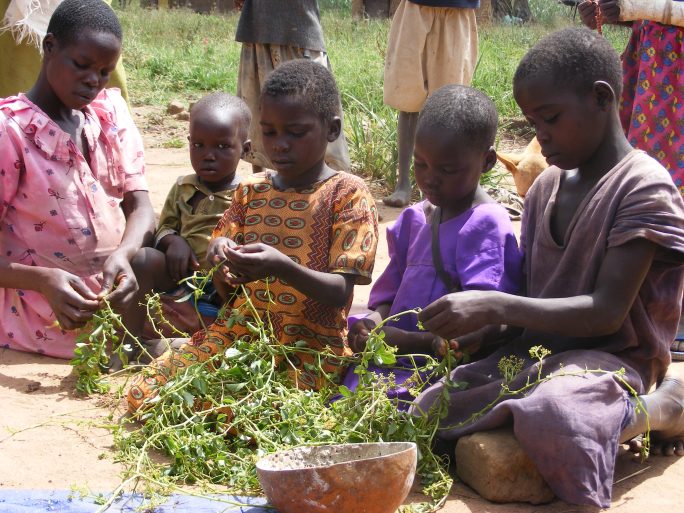
Children in Katakwi collect some vegitables. The area has been hit by famine. John Njoroge Photo
The other MPs called for Prof. Kabwegyere’s resignation. Instead of looking for a logical way to defend himself, the old Prof, known for his verbal disparage displayed arrogance in the fame of death of Ugandans saying “If I resign you think those people will not die of hunger?” Unbelievable! The day before Kabwegyere had addressed the press together with the State Minister for Agriculture Aggrey Bagiire blaming the famine on drunkenness.
You would expect Minister Bagiire, himself an Agriculture graduate to give the nation a more convincing answer to the crop failures in the regions. Even though the government gives millions in emergency aid, these areas will continue to experience such famine in future unless they rethink agriculture production in the face of climate changes. Also people in Teso and the north must be resettled properly and there should be a lot of efforts put into agriculture production both in terms of capital but also in technical support. And Kabwegyere with his loose mouth might be after all the right person for the post of disaster response.
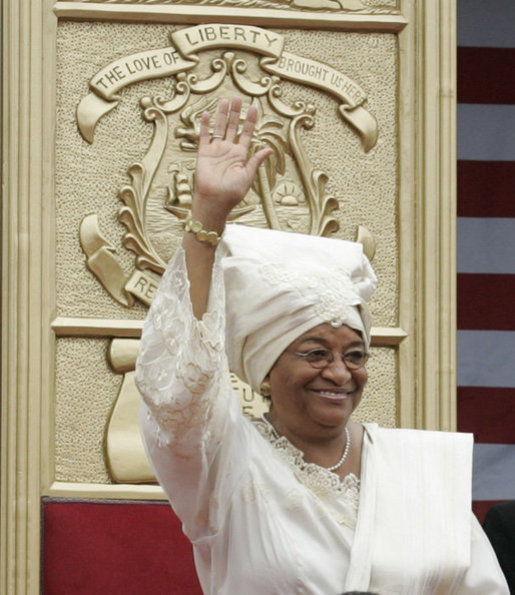
The Truth and Reconciliation Commission (TRC) of Liberia in its final report this week recommended that President Ellen Johnson Sirleaf among others should be barred from holding public office for 30 years.
The recommendation also extended to all those associated with former warring factions, their leaders, political decision makers, financiers, organizers, commanders, foot soldiers. President Sirleaf has already spoken on the subject saying she gave support to the Charles Taylor group but “only intended for humanitarian purposes.”
The TRC doesn’t outright say Sirleaf is guilty of partly fuelling the 14 year old conflict that claimed thousands of lives in the West African nation but their recommendation has got many thinking about the implications. President Sirleaf has been one of the African women that inspire me not because she was the first female head of state but because of her ambition displayed in a career in the finance industry built over decades. In the elections I was excited by George Weah because of his football career but a good look at Sirleaf made me believe she was the right person for the job of heading a country emerging out of a war.
I never knew I would have a chance to talk to Sirleaf. But that chance came in February 2007 in Kigali Rwanda where I had gone to cover a huge African women conference. I was working for NTV at the time and it was a one man crew. I had to secure an appointment for an interview with the president at her suite at Kigali Serena Hotel.
After waiting for long hours (because the SABCs CNNs of this world had to go in first) I got into her room. I was told by her press secretary that I had exactly 15 minutes to setup the equipment and do the interview. First she was amazed at how a lone girl from Uganda could make it in these minutes and she said something to that effect before the interview began.
Why am I bringing this up? It’s because I asked how Sirleaf could have supported Charles Taylor during this interview. And her answer was that she thought of him differently at the time. She didn’t think that Taylor wanted power for himself just like many other leaders on the continent. She agreed it was a misjudgment on her part but she insisted she had started a new page of rebuilding her nation. Sirleaf said that as a woman and mother she understood well that women suffered the brunt of war through rapes and that such wounds can mostly deeply be understood by a woman. She said she was determined to see justice served.
To me she cut across as an honourable politician and I was in no doubt she was the iron lady I had long read about. Her experience on international stage gave her a different added understanding of conflict and governance in Africa as she put forward her views of leaders who cling to power during the interview. With this judgment from the TRC I am left thinking, what options does the honourable iron lady have? And if she’s to step down would this be good for Liberia? Before I even think of her stepping down, what truth is in her defense when she says her support was for humanitarian use? Charles Taylor is still being held at The Hague, on trial by the Special Court for Sierra Leone for war crimes and crimes against humanity committed during the conflict in Sierra Leone. So this means we won’t hear from Taylor whom Sirleaf dealt with but this shouldn’t water down the case for or against Sirleaf. There should be extensive revelations whether Sirleaf was aware of Taylor’s mischief and whether Taylor was the only person through whom such supplies could have passed to reached the people.
I still believe that Sirleaf should remain president unless there’s insurmountable evidence that her support for Taylor was aimed at elevating herself politically. After her work that has improved lives in Liberia, I think Sirleaf should be given a chance to correct her wrongs if she hasn’t done that already. At the end of our interview she was warm and she asked how I find my work and the challenges. After my brief answer she said: “We need women like you in the media in Liberia.” This statement showed me this is a president who thinks of her country in every sense. If the recommendation of the TRC is to be adopted, they will put an abrupt and ugly end to the career of a great woman. And such great women in African who can traverse male dominated political playgrounds in a dignified way to go on to become great leaders are hard to come by. This is where the question of justice or moving on comes in play. With appreciation that one can hardly move on without justice, I still believe banning Sirleaf will be Liberia’s loss.

 Rosebell Kagumire