Bushenyi roots.
editor, public speaker, feminist writer, award-winning blogger and socio-political analyst. Words seen in international media like The Guardian, Al Jazeera, Quartz and Mundo Negro. Expertise in new media, social justice, migration, gender, peace and security issues. Was honored with the 2018 Anna Guèye Award for her work on digital democracy, justice and equality by Africtivistes. She is the co-editor of a book: Challenging Patriarchy: The Role of Patriarchy in the Roll-Back of Democracy. Rosebell has expertise in human rights, gender, peace and conflict issues. Rosebell was recently recognized by Avance Media as one of the 100 Most Influential Women in Africa for 2021 edition.
I studied Mass Communication at Makerere University, short courses on Non-violent conflict at Tufts University, Global Leadership and Public Policy at the Harvard Kennedy School and MA in Media, Peace and Conflict Studies from the University for Peace. Outside Uganda, I have lived in Costa Rica, Switzerland and a bit in Ethiopia.
I am in Brussels where two days ago Congolese community had clashes with Police when they went out to demonstrate agains the president Joseph Kabila’s ‘re-election’ which has so far been rejected by international election observers and leading opposition candidate Etienne Tshisekedi.
The Carter Center said “we find the irregularities are significant enough to undermine the credibility of the election results.”
Again the contention is on the tallying process. Earlier the opposition had warned that the Electoral body had chosen to announce first results from Kabila’s strongholds in Katanga, a move seen by many as way to psychologically prepare the population if Kabila is finally announced as a winner. But Once again we have a Cote d’Iviore situation, both men have announced themselves as winners of the election. There are reports of government moving troops into Kinshasa and rounding up youth linked to the opposition. The situation is unpredictable and no one seems to know how this stalemate will be solved. And as tensions flare I am reminded of women of DRC, eastern DRC in particular who have endured all sorts of inhumane acts by soldiers and militias. On this day they see the little hope of having a government that can bring peace wane.
And I bring a story of Ester Munyerenkana a health worker at Panzi. I have held onto this story for quite a while. Her and other health workers daily have to deal with the end result of the broken political system and violence in Congo Continue reading “No near end to violence as DR Congo election is disputed.”→
This week I was in Kasese taking part in validation of a study soon to be released by Isis-WICCE on child marriages in Uganda. I met Sarah Biira, 19 year old who had her first child at 13 years. Kasese is a post conflict area but has largely been ignored in terms of development. It has been under conflict since 1940s and the education of a girl child is a challenge because of poverty, cultural beliefs and loss of livelihoods to war.
Many Ugandans, through various social networks, have expressed skepticism over the 100 combat troops the US deployed to Uganda to help stamp out the rebels of Lord’s Resistance Army currently operating in the Democratic Republic of Congo (DRC), Central African Republic (CAR) and parts of western South Sudan.
They think what they are actually here to do is secure for their country Uganda’s newly found oil.
a photo i took on Wednesday morning at Entebbe International Airport.
The mistrust and suspicion of American military interventions is well understood considering its record world over. However, I found many who are opposed to this deployment lacking much knowledge on what havoc the LRA have inflicted on the peoples of the three countries whom governments have largely ignored. And also many don’t look at what alternatives are there to stop these brutal massacres Continue reading “Obama’s troops in Central Africa to fight LRA; will they deliver?”→
Last week, President Ellen Johnson Sirleaf and Leymah Gobwee won the the Nobel Peace Prize jointly with Tawakkul Karman from Yemen for their work of bringing peace in non-violent ways in their countries. I met Leymah last year at the Man Up Campaign conference alongside the World Cup in South Africa. I have interviewed President Sirleaf twice. I thought it was very significant for African women to be recognised in the area of peace and security. Most often the image of African women is that of a victim of war and not a participant in bringing about peace.
Here is what I shared with Al Jazeera Newshour the day the winners were announced on Friday 7 October.
This week at the press briefing in Kigali, I asked President Paul Kagame what this prize meant for Africa.
I am only happy for the women of Africa. We need to go beyond this being a symbol for women. Women need attention not just in Africa but in the rest of the world. When I travel and read i see marginalisation of women. We appreciate the quest to empower women and have them as an integral part of our society on equal terms. But as we get help here in Africa, i feel we may need to take this help to some of these countries. For instance you go to discuss business in these countries and all their boards have about 20 men and one or two women. They too need help. This Prize is a reminder that we should work beyond the prize that was given for us to meet expectations of women of Africa. We need more women presidents!
In the interview I mentioned the status of women in South Sudan and I intend to write a separate post soon from my recent trip to Juba and interactions with women leaders in that country.
This week I am in Kigali, Rwanda where I am taking part in a meeting with Echenberg human rights fellows, a program coordinated by McGill University to bring together youth from around the world to discuss various human rights issues.
On the list of people to meet was Rwanda’s First Lady Jeannette Kagame whom the group met yesterday October 10. Shortly before I left Kampala on Sunday President Museveni had given a medal to his wife Janet Museveni who is a minister and member of parliament, for her part in the fight to ‘liberate’ us. This was given out as Uganda celebrated 49 years of independence. It was yet another controversial medal taken care of by the controversial medals budget from State House.
Going into the meeting with Rwanda’s First Lady I wondered how I would put my question about family rule. Then I asked on twitter what people would ask Mrs Kagame. @Afric01replied and I put his question first.
Today, Kampala is very colourful. Lately it’s only this colourful on events like these. It’s two days before Uganda ‘celebrates’ it’s 49 years after independence but those years seem to mean nothing much this friday as Uganda plays Kenya tomorrow October 8. This game means so much for Ugandans. It has been 33 years we have have waited to make a come back to the African Nations Cup.
The world and many in Uganda may be used to seeing the name of late President Iddi Amin next to words like monster, killer or beast but for many Ugandans he was a great man. His reasonable actions in other fields might be overshadowed by his rogue side but Ugandans know it was a year before he was ousted that Uganda last competed in the continental tornament where it only lost to Ghana on the final. And his leadership and backing of sports had something to do with that historic appearance.
The past year has been tough for us, the economic crisis and our government that loves to spend have not helped. We bought ourselves fighter jets at millions of dollars, our currency can’t stop weakening against others and our inflation stands at 28.3 % this month. We have had strikes by different professions, teachers, taxi drivers e.t.c. Many are struggling to put a meal on the table and keep their children in school or even enjoy a beer (our president advised us to drink milk instead.)
The Uganda Cranes, our national team seems to be the only thing holding us together, the little light that we are seeking in our darkness. Uganda has has 10 points and Kenya is at 7. Uganda must get win to avoid any calculations based on the other group game between Angola (9 point) and Guinea Bissau.
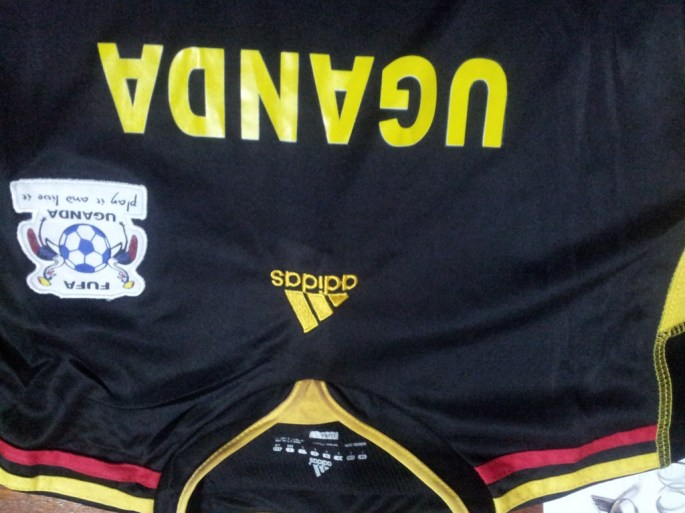
My Cranes jersey!
Uganda last lost to Kenya at home in 1991 so the Kenyans have their own 10 year jinx they will be looking to break. But the 33 year jinx means much more. Football has remained the only place for Ugandans to show their patriotism and love for their country. According to tweets i have read many would wish not even see the face of their politicians at this game. The ordinary people feel the staduim is the only place they can unite and defeat someone. It’s the hopelessness that has engulfed us in the midst of failing systems whether education or health care, unwanted public expenditure and unending promotions of the corrupt and the wicked of the regime.
In one of the qualifying games, the now Prime Minister Amama Mbabazi, whose name is painted all over different corruption scandals was the chief guest. He dared to flash his party sign and his aides had to shield him from flying water bottles from the Cranes fans. A few days ago he visited the Cranes camp and so did the first son Col. Muhoozi Kainerugaba. Both donates some thousands of dollars. First the money is largely seen as our own tax payers money and then if this government genuinely invested in sports (am dreaming ) they wouldn’t need to come out at last minute to pledge. Truth is national sport survives because of few good hearts and the very supportive fans.
Football and the Cranes games in particular are almost the only remaining things that Ugandans can put their hearts to and spend their money on. It’s the day you see Uganda flags in numbers you wont find at any event not even the 49th Independence anniversary. Ugandan leaders have largely been so meaningless to ordinary people that seeing corrupt leaders – much as they have a right to be there- come to claim they are behind the country’s pride makes many mad.
The Nelson Mandela National Stadium is simply the only place we come to forget -for just day- about you looters of our country! Ugandans come to forget what is happening to Uganda. And it’s the only place you see genuine nationalism therefore breaking the 33 year jinx is about history, pride and Namboole is the place to be ourselves!
It’s really emotional to read through this. To read the farewell speech of outgoing Zambian President Rupiah Banda who has conceded defeat in this week’s election to opposition leader Michael Sata. There’s not much you can add to it. With all his weakeness and policy flaws, Banda has given Zambians what many old men on the continent have denied us- a respectful power transition and political maturity.
I say this is the speech that many Ugandans would love to see some day-hopefully soon. I have seen great quotes from Banda that resonate to many Ugandans and others on the continent. Zambia is another show for Africa that we live above the politics of division, election violence and clinging to power against all odds.
“Zambia must not go backwards, we must all face the future and go forward as one nation. Not to do so would dishonour our history.
“My generation… the generation of the independence struggle– must now give way to new ideas; ideas for the 21st century.”
“Did we become grey and lacking in ideas? Did we lose momentum? Our duty now is to go away and reflect on any mistakes we may have made and learn from them. If we do not, we do not deserve to contest power again.”
“But my greatest thanks must go to the Zambian people. We may be a small country on the middle of Africa but we are a great nation. Serving you has been a pleasure and an honour. I wish i could have done more, i wish i had more time to give.”
“I have no ill feeling in my heart, there is no malice in my words. I wish him well in his years as president. I pray his policies will bear fruit.” — Rupiah Banda.
It takes courage, respect and love to say these words and Uganda is waiting, it has waited since 1962 when we got independence. Below is the full speech Continue reading “A speech that Ugandans long for”→
For the last week i was on a break in Addis Ababa visiting friends but i kept an eye on news in Uganda. Two things struck me most.
It has become the regular news about pregnant women dying in labour due to our crumbling health care system. No matter how many cases you hear from relatives to friends to work colleagues, it still aches. First you see statistics that tell you 16 pregnant women die daily and when you go beyond the stats you read the horror that families go through. In July, my boda boda (motorcycle) rider lost his wife in childbirth, then came a friend of a friend. So last week we lost another woman. Cecilia Nambozo, a teacher at Busamaga Primary School in Mbale, eastern Uganda. She was left to die because she couldn’t raise UGX 300,000 (USD120). That amount is probably what Cecilia was being paid in 3 months. In a country where health workers are not paid well and the working environment that can easily drive one insane, the negligence has increased as compassion has slowly slipped away. So i don’t see the death of Cecilia as just neglect at the hospital but the whole social injustice system that makes it impossible for even a teacher to access proper health care. In May the Centre for Health Human Rights and Development (CEHURD), a Ugandan NGO, and the families of two mothers who died in government hospitals in 2009 went to the Constitutional Court alleging the women’s deaths were caused as a direct result of Uganda’s failing healthcare system. We are waiting to see the outcome of this case as it will have implications and how to hold government accountable in health service delivery. Although even a positive court pronouncement won’t make a huge difference, i think it would be a good start. Maternal mortality is not just a health issue, it’s a social justice issue.
After Cecilia’s case I received an email from a friend i went to high school with which made me more worried about Uganda. Worried because i feel like with increased economic hardships people are becoming more frustrated and putting their anger on imagined enemies. My friend’s message was in response to an article i wrote on tribalism in the wake of 2009 Buganda riots. I had written on reports of attacks on people because of their ethnicity. I didn’t expect this to end with the riots but these reports make wonder what Uganda might go through given the current projections of political instability in future according to many reports. After seeing over 1000 people killed in Kenya in ethnic clashes in the post election violence, we can’t simply ignore the role of tribe in politics and how one group becomes a target. This is what my friend wrote to me about.
Rosebell,
Imagine today I flagged down a taxi on Kampala road, the driver stopped, took a closer look at me and as I prepared to board he angrily shouted at his conductor to shut the door because tetwala banyankole (he doesn’t take Banyankole in his public passenger vehicle)… I simply couldn’t believe it and was overwhelmed by emotion that my eyes started tearing! I don’t want to imagine what would happen to people like us if all hell broke loose..
Since the year began it’s been tough with the economy on the rocks, inflation rising and discontent brewing. And while many would fault government, to some government is simply a certain ethnicity and therefore they will blame everything happening to that ethnic group. one thing is for sure, power in this country is increasingly in the hands a few people who belong to one ethnic group but blaming the politics of ethnicity and the guilt by association will not give us a secure future. My friend’s email left me pondering how we can go away from this course. We have enough lessons from our own history and that of neighbouring countries on what ethnic politics can do a society.
Apart from generating media hype, I doubt many policy makers in the West are genuinely interested in the DRC. I happened to be listening to an interview with Gerald Prunier recently and his conclusion was not that different: our perspective of the DRC conflict are clouded by racism. No one wants to address the politics. Instead, the image of total chaos is encouraged. The tragic consequence is that many more continue to die and suffer.
I support efforts by Panzi hospital, but like all interventions that are emergency we can’t help wonder, is the humanitarian focus enough to solve the conflict? I guess, one may say, the two are not mutually exclusive. Besides, who am I to be asking such a question? Except, I was in those same places not so long ago.
It’s taken me some days to come to write about my time at Panzi but this passionate email I received from a friend who is both Rwandan and Congolese gave the needed push. It followed a chat on my recent trip to Bukavu and Panzi in particular where I spent a week with a team of Psychologists and a Psychiatrist assessing war trauma among health workers.
What my friend raised above in the email were the same questions and feelings I found with the health workers I found at Panzi. Many wondered what difference they were bringing. They treat the sick and try to revive devastated lives of women who are sexually violated. Women violated in ways that you won’t easily get an explanation of why this goes on.
My friend’s concern of providing humanitarian aid and not solving the root cause of conflicts in Eastern DRC had many health workers feel helpless. They constantly asked questions of how can we ever address war trauma when we receive same cases everyday . Many had a hard time seeing how they can reduce trauma if the wars are still going.
Panzi receives at least 10 raped women a day. These women come from the Kivu provinces, Katanga other neighbouring provinces. Most times they arrive after many days or months after the violation.
One of the initial ways to manage trauma, i am told, is avoidance but in DRC, it’s difficult for a health worker to avoid the horrors of rape. They shoulder the burden of having to listen. If you have experienced war trauma or dealt with communities out of war, one of the most challenging but necessary things is having to listen to the terrible stories. Some people say it’s easier to just forget but they really never forget. For health workers they have to listen in order to heal others but who listens to them? these accumulated images of killing and raping have a very big impact on the health and life of healthworkers..
One surgeon told of how sometimes she doesn’t know where to begin. She said many women come with pieces of wood that have been pushed in their vagina and beyond and she’s supposed to figure out where to start with the surgery. Such is the work of health worker in DRC. Dr. Dennis Mukwege the founder of Panzi told me the rape in Congo is not just a sexual matter.
“They are using all sorts of things to destroy the society. This is beyond a sexual matter, it’s a way to destroy us.”
Dr. Mukwege also told me it’s a situation that one can easily give up on due to the magnitude yet they have stayed and played their part. The political leaders and international community haven’t really played their part much.
“I have spent ten years repairing fistula everyday and sometimes you lose hope. I stay because it’s important for Africa that we have our destiny in our own hands. We are good enough to make it.”
Listening the different health workers and social workers I felt these are the people Naomi Shihab Nye talks about.
“How do they maintain any shred of dignity and balance? You know those are the courageous people to me. All the simple people of the earth who don’t lose their sanity in the face of constant dis-ease in the world they live in.”
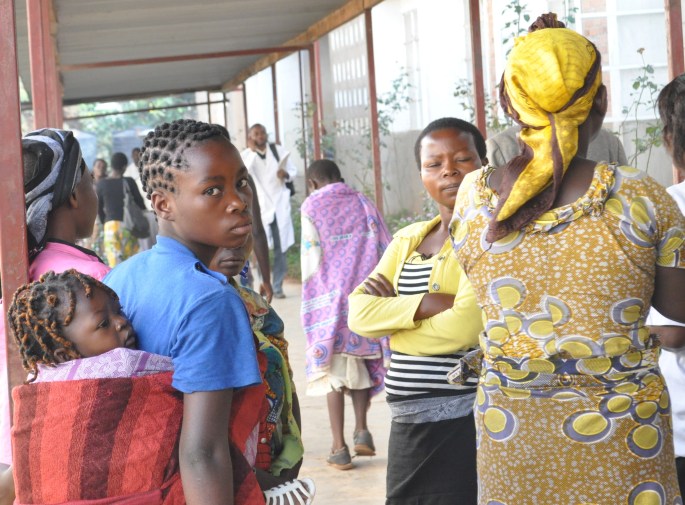
Women during a prayer at Panzi. The hospital hosts prayers for all patients every morning.
As one person on twitter said when I put up the last post, Panzi workers are some of the world’s most hardworking health workers. Many have lived through war and everyday their work revolves around tending to war affected. The presence of the UN in Congo has not helped so much is getting the DRC government to take charge. Some of the rapes have gone in close proximity to the UN. What has the UN done to strengthen the military capacity of the Congo to govern itself? The more stories I heard from Congolese about the UN the more I realized that someone else won’t save the Congo. They will continue to address humanitarian issues because they are the easiest to tackle.
For the health workers that try on daily basis to piece together shattered lives in Eastern Congo , the worry is not just about if the women can recover but when will they see an end to the violence.
A few months ago there was a report that put DRC as one of the worst places in the world to be a woman. I found this kind of description troubling even in the face of what many of the women and Congo as a country have gone through. I even wondered how Dr.Denis Mukwege, the director at Panzi hospital, a man who has dedicated himself to the care of sexually violated women, would think.
I had learnt about him through the media from a few awards he had won. I never expected to be in Bukavu, South Kivu and at Panzi soon. This week am at Panzi with a group of psychologists and Psychiatrists doing an assesment of trauma among health workers at Panzi. It’s the main hospital caring for survivors of sexual violence which is unacceptably high in South Kivu. Many health workers wondered how they could deal with trauma and sexual violence yet the source of all this-the conflict-is far from being solved.
I always wondered how their hearts are not in pieces, how they are not resigned amidst all this heart breaking stories. But now interacting with them I am learning from their resilience and their frankness on the challenges they face. For this week we are listening to the stories they listen to on daily basis. I am here with Isis-WICCE and the Stephen Lewis Foundation on their program- African Institute for Integrated Responses to Violence Against Women and HIV/AIDS which aims to create a network of African-based, women centered technical support on issues of violence against women, HIV/AIDS and counseling.
Not everyone here is a victim of sexual violence but it’s the hospital that has a big department dedicated to sexual violence. Below are random pictures i took during morning prayers and training of health workers.
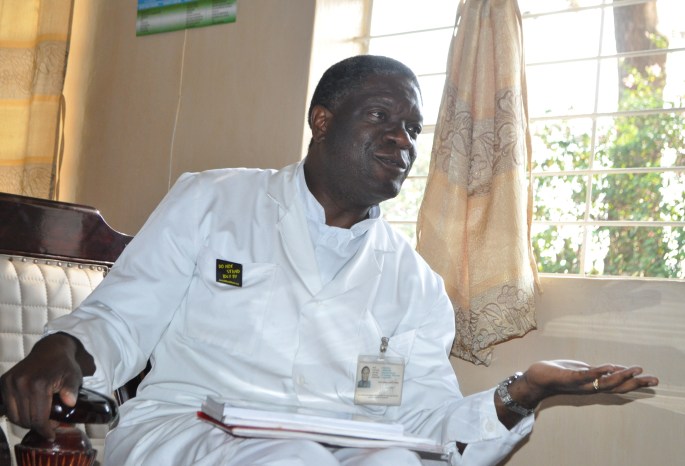
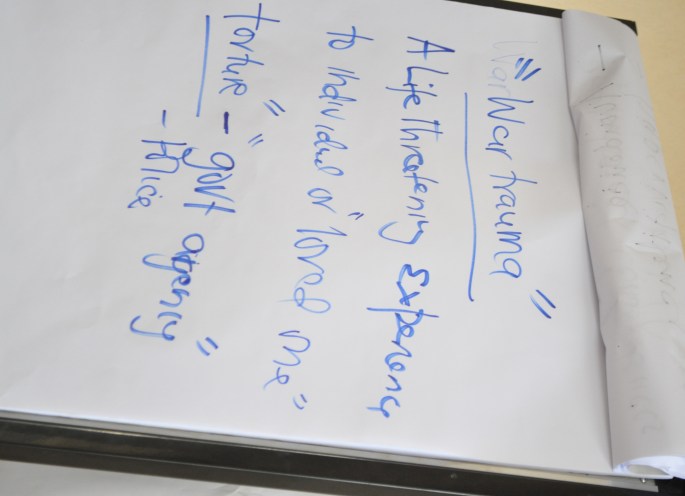
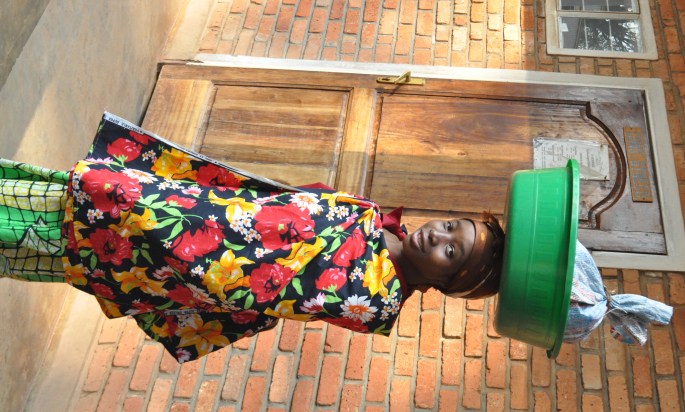
Dr.Mukwege at his office Tuesday Aug 23. during a meeting at Panzi HospitalDr.Christine O. and a colleague at one of the trainings in Panzi.War trauma! so much to do about it.A man reads the bible during the early morning service at Panzi hospital.A woman praying at the morning service at Panzi hospital. The service is important for both patients and the caretakers plays role in both detecting those who need help and recovery.Beautiful girl in the corridors of Panzi






 Rosebell Kagumire