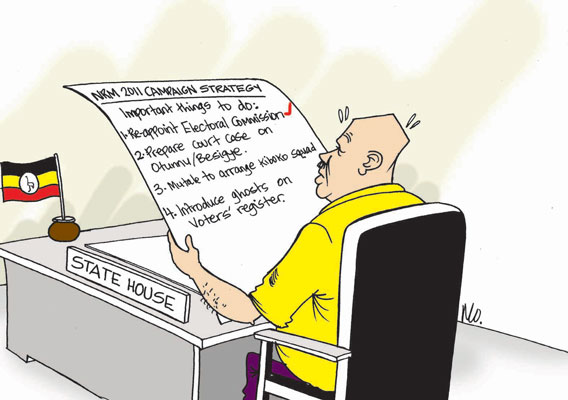
Questions on Mayombo death in a UN report on attacks on freedom of expression

For the last few days I have been in Geneva as Internet Freedom Fellow with the U.S. Mission to the United Nations in Geneva and Institute for Media and Global Governance with many other digital activists, bloggers and journalists from Burma, China, Tunisia, Egypt, South Korea and Indonesia. One of the tours took me to the United Nations office of the Commissioner for Human Rights. I got to discuss parts of the report of the Special Rapporteur on the promotion and protection of the right to freedom of opinion and expression, Frank La Rue released two weeks ago. Uganda had a few cases in there but one caught my attention. And since we just celebrated Heroes Day with more medals out (similar way we create districts), I thought the case of the Late Noble Mayombo was timely.

In report I found a case that hadn’t seen much in the media in Uganda. Joram Bintamanya, a journalist , Gerald Kankya and Prosper Businge who are members of Twerwaneho Listeners Club, a non-governmental carrying out human rights advocacy through radio programs in Toro area were arrested for talking about Mayombo’s death. This information, according to the report, was gathered last year.

On April 1 2010 Prosper Businge was summoned to Fort Portal police interrogated about a talk show he hosted on Better FM where Kankya and Bintamanya had requested government to release the report of investigations into the 2007 death of former permanent secretary of Defence Ministry Brig.Noble Mayombo. There was a team appointed by President Museveni regarding the death but not much has been heard from the team or a report.

The two human rights advocates like many in Uganda have had to report to police on weekly basis for interrogation on a case that would probably never stand in courts of law. Bintamanya was charged with sedition after a day in jail and according to the report the two men have faced threats and police has told them to abandon their human rights advocacy. The two men are being stopped from talking about the death of Mayombo, a subject that many people stay away from because his death has many theories around it.

They work outside Kampala so there’s a likelihood that their arrest and intimidation will not make it to many national media outlets yet these are the people making mind shifts in rural Uganda where we have limited civic awareness and limited knowledge of rights and state protection. Just like all the cases reported last year the government of Uganda has never responded to the queries into abuse of right of expression.

Having seen reports of more heroes’ medals it is only reasonable that we ask where the report on Mayombo’s death is. To my knowledge he was many peoples hero and many looked up to him. Why shouldn’t people talk about this subject in public when it is very much alive in private discussions?

Museveni gets instruments of power; rival’s supporters get the cane, teargas and bullets

“I am not going to a theater of death but if it takes my life to bring equity to Ugandans, I’d regard that as a privilege,” that’s what one young Ugandan told his friends before he set off  yesterday morning to welcome home opposition leader Dr.Kizza Besigye who had been receiving treatment in Nairobi Kenya.

After being blocked by what many believe were Ugandan authorities to get into the country on May 11, Besigye decided his return would conincide with President Yoweri Museveni’s 5th swearing in ceremony at Kololo Independence grounds.

Museveni’s swearing in ceremony was not that well attended by even African leaders  save for DRC, Kenya, Tanzania, Ethiopia, South Sudan, Somalia, Nigeria and Zimbabwe. As President Museveni’s ceremony was ending with dances, on the otherside of the town crowds had already gathered, not to catch a glimpse of their revolutionary president but to welcome a man that has taken the brutality of this regime to international limelight.

Besigye left Uganda for treatment in Kenya after his brutal arrest that left him almost blind. His support has suddenly increased as the government has deployed thousands of police and military in different parts of the country to quell the walk to work protests, a campaign by the opposition against the rising fuel and food prices.

In April, 9 people were killed and hundreds were left with gunshot wounds. So when Brian Bwesigye set out yesterday determined to walk to meet Besigye’s convoy from Entebbe, it was an act that could only come from a young Ugandan who is unable to make sense of his president’s speeches that seem to only point to the past.

The road Besigye and his supporters occupied for 8 hrs was the same to be used by President Museveni and his guests as they make their way to the lavish State House that the president put up in Entebbe.

Military and Police forces were seen beating up Besigye supporters to get them off the road. This must have been an embarrassing moment for the president and his regime sympathizers. A day that was meant to be for the president to boast of his 68 percent win in the February election became the day when thousands sacrificed, waited in the sun, faced with canes, teargas and bullets to catch a glimpse of Besigye.

President Museveni was forced to go through these crowds that waited for his arch rival on his day. The government’s account was that one motorcyclist was shot dead as he insisted on crossing Nigerian President Goodluck Jonathan’s convoy. Reports show that Jonathan’s convoy got stoned and one government spokesperson said this on TV but the Nigerian president’s office has denied the story. Fred Opolot from Uganda government Media Center told the story of the shooting of a rowdy boda boda man, he looked unremorseful even knowing that there could have been other ways to get this man out of the way but not killing him. I guess that hows cheap life has become here.

So far that’s the only death the news media have reported. But Bwesigye who was part of the Besigye supporters posted a note on his Facebook saying:

Then as we approached Kibuye, TEAR GAS started rocking! Then bullets! Then helicopter gunships flying over us! Then poisoned water! Then dead bodies! Three of them, I saw with my naked eyes! Tension. I hid in a residential apartment nearby and from the third floor in someone’s house, I was watching Besigye atop his car in the face of the shooting.

I honestly did not know that I would later see dead bodies of civilians after being shot by the, military, I used the theater of death expression as a hyperbole, I was wrong, it was real.

It’s not yet clear how many people lost their lives just because they went out to welcome an opposition leader an like all past deaths from live ammunition we don’t expect to see any investigation or arrest of those responsible for they probably were following ‘orders from above’.

The numbers wont be clear also because of the way the government has pushed the media into a tight corner. For the State TV which covers most of the country it is almost abominable to show Besigye and his supporters, we have seen the New Vision coverage dwindle and last night it was clear the whip had well reached the private TV stations.

On the night when many Ugandans were injured and thousands gathered to see an opposition leader, NTV Uganda showed about 30 minutes of Museveni’s swearing in. One wd mistaken their coverage as a paid advert by the regime. One by one the reports followed about Museveni’s achievements and the beatings, teargas and bullets at Entebbe raod took 3 minutes with no mention of the injured.

The pressure is on but WBS TV offered Ugandans best coverage of the different events. If media is ready to give in to government threats at the earliest God knows what sort of news we will be watching by the end of the next five years.

The security forces went farther to assault journalists, steal their cameras and destroy other equipment in what seems like a well orchestrated move to curtail press freedom. And all this didn’t appear much on our TVs.

If the Swearing in day is anything to go by, one can only see that the next five years will be a tough period for Ugandans. Especially looking at the president’s speech which didn’t offer concrete ideas on how his government will deal with increasing unemployment and corruption.

With fresh memory of Tahrir Square , government keeps Walk to Work away from Constitution Square

On Thursday April 21, the fourth time that Uganda’s opposition leader Kiiza Besigye-Kifefe was blocked from walking,  Prof. Mahmood Mamdani, the director of the Makerere Institute of Social Research gave an important analysis of the events at a Rotary International District Conference at Munyonyo.

Besigye has today spent his 55th birthday in jail. Together with Democratic Party leader Norbert Mao are being held at a prison outside Kampala for participating in the walk to work campaign that protests current high fuel prices. Five people including two year old Juliana Nulwanga have been shot dead in the protests in different parts of the country in the last two weeks while dozens are nursing bullet wounds.

In reaction to these events Mamdani said

“Both the opposition that has taken to walking and government that is determined to get them to stop walking are driven by the memory of a single event.  The memory of Tahrir Square feeds opposition hopes and fuels government fears. For many in the opposition, Egypt has come to signify the promised land around the proverbial corner.  For many in government, Egypt spells a fundamental challenge to power, one that must be resisted, whatever the cost.

It’s the memory of the Tahrir that has driven President Museveni’s regime to allege that that the protests are aimed at removing a legitimate government. President Museveni told journalists that those using protests were committing treason but we have not yet seen this charge slapped on the opposition.

I have wondered why the government wouldn’t let people walk peacefully and then try to work against the campaign by addressing the issues that these people were raising. From what I gathered, the paranoia has been high that Besigye and the walkers might camp at the Constitution Square right in the middle of central business district thereby attracting more participants and international attention.

That’s why the government moved to put a walking ban on politicians who were taking part in the campaign . Kampala had seen unprecedented heavy deployments of forces even before the planned protest. Government has deployed security forces  at almost every corner in every neighbourhood in the city like never before and the reason we had earlier  been given was that of the frequent terrorism threats the country receives from the Somali militants.

However Prof. Mamdani says :

Matters have reached a point where even the hint of protest evokes maximum reaction from government.  So much so that a government which only a few weeks ago came to power with an overwhelming majority today appears to lack not only flexibility but also an exit strategy.  For civilians, supporters and skeptics alike, the sight of military resources deployed to maintain civil order in the streets, has come to blur the line between civil police and military forces as those in power insist on treating even the simplest of civil protest as if it were an armed rebellion.

President Museveni has gone to the extent swearing to eat his opponents like samosas. This paranoia about Tahrir possibilities in the country has made the regime put restrictions on media like never before. The Uganda Communications Commission and Uganda broadcasting council have come out to warn the media against messages that might be seen to promote “ethnic prejudice, civil violence and public insecurity”. The terms are broad enough to catch anyone that the regime wants.

Journalists have been threatened with phone calls, SMS while others have been trailed by security agents in the last two weeks. The steps that Uganda had made in the last ten years in press freedom and freedom of expression are slowly being washed away as we live the fear of Tahrir.

Today I went to Mulago to pay a visit to Brenda Nalwendo, a 19 year old pregnant woman who was shot in this week’s protests. I was ther upon a request by a Ugandan living abroad who wanted to help after seeing the horrifying photos of her shooting. At ward I identified myself as a journalist and the ladies on duty looked at me suspicious, exchanged glances before telling me they had to first inquire from some people.  They had even suggested I leave the money with them but I insisted on seeing Brenda’s mother who had no problem taking me to her daughter. By God’s grace Brenda has survived and now she can sit and her unborn baby is ok.  It is gruesome images of her intestines that hang out of her belly on April 18 that clearly showed what kind of brutality Ugandans have faced.

And it is such pictures and such peoples stories that the government is eager not to see them be told. But with some young Ugandans now using internet to give first-hand accounts of events as they happen, the coverage of these demonstrations has been very effective on facebook and twitter. That’s why the government was keen on shutting these channels down. These channels are the most uncontrollable unlike TVs and Radios which may worry about closure and hence give in to government directives. It’s because of the great role being played by youth in Uganda on these networks that internet freedom is slowly being threatened even before we have achieved much access. As of July 2010, only ten percent of the population in Uganda used internet. The numbers have changed I believe with more telecoms offering free facebook access and more affordable phones on the market with internet access option. As long as the social media is not blocked, the story of those protesting in a country where protests have become almost illegal, will continue to be told.

With opposition leaders jailed, we don’t know yet what the brains behind this walk to work campaign have in plan. It’s important for any non-violent campaign to deny those in power a target. In walk to work campaign, the regime was given targets in form of top opposition leaders and it will remain to be seen whether the campaign can continue without them. Museveni remains firm in refusing to put fuel tax cuts like Kenya did because this would show that the protests worked.

Like Prof.Mamdai said:

Whatever its outcome, ‘Walk to work’ must make us rethink the practice of democracy in Uganda…No matter how small the numbers involved in the developments we know as ‘Walk to Work’, there is no denying its sheer intellectual brilliance. That brilliance lies in its simplicity, in its ability to confer on the simplest of human activities, walking, a major political significance: the capacity to say no.

Delivering with barely anything; a story of Ugandan mother

On Wednesday March 30, I visited Buyinja Health Center IV in the newly created district of Namayingo which lies on the shores of Lake Victoria in eastern Uganda (somehow we rarely say south east). I was there to interview  Jessica Were, a woman nominated for the upcoming Women of Courage Awards hosted by Isis-WICCE and the US Embassy in Kampala. Were is a mother mentor working to bring mothers to get more involved in Prevention of Mother to Child Transmission (PMCT) of HIV. She also works to defend the rights of women living with HIV and orphans who are always denied land.

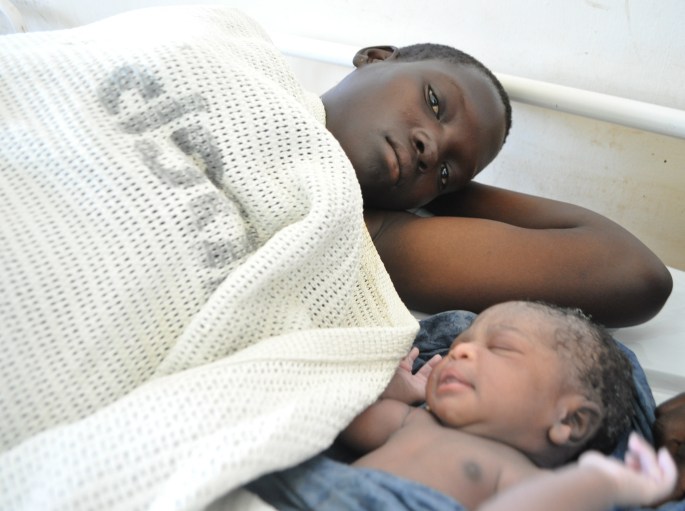
In a new district, Buyinja is supposed to be elevated to a hospital but for now it has a few blocks with a male and female wards and a maternity wing. Jenifer Friday arrived on a boda boda (‘motorcycle taxi’). When I saw her I thought she had come for checkup but she didn’t go to the separate block where Were educates these women.  Fifteen minutes later I enter the maternity ward to catch a few shots to show Were’s working environment. I find Jenifer with a child who is barely two years crying out loud. Jenifer was also shouting as her labour pains increased.

Jessica Were tries to calm down Jenifer and also holds her one and half year old minutes before the second baby was delivered at Buyinja.

Jenifer arrived at this health center with nothing but her child on way to deliver another child. She had no clothes, no relative accompanying her. In fact her husband sent her to mother’s place at eight months.  Nurses looked around for any cloth; they work with barely anything. Sometimes they have to give their own clothes to cover babies and mothers like Jenifer. The nurse in charge tells me that there are many like Jenifer who arrive at the center with nothing. Health centers  rarely has gloves, razors and cloth, most stuff essential during delivery. I wondered how health workers keep their balance in such conditions.

Jenifer is 19 years old and she was having her second child. She delivered her first child at a traditional birth attendant’s place and after hearing Were’s message she made it here.  Were had to call relatives and they appeared after about an hour with a few clothes. Were had to tell that Jennifer needed sanitary towels or cotton and underwear.

Jenifer’s first child is from another man so she is basically lucky that her current husband would marry her and take care of both. In that position Jenifer couldn’t bargain to wait for the old child to grow before having this man’s child. She does home cores and the husband cleans boda boda for a living. I asked her what she would want to do in her life if given an opportunity; she was quiet for a while. Later she told me she wants to be a tailor.

Jenifer with minutes old baby Scovia.

Jenifer was about 17 when she got her first child and at the time she was in primary seven. Talking to her minutes after she delivered a baby girl called Scovia, I reflected on what difference education could have brought to Jenifer’s life. At 18 I was headed to university. For girls like Jenifer, their education is interrupted by so many things including poverty and general attitudes towards educating a girl child. By the time she’s 18 and in primary school, the chances of pregnancy and dropping out of school are high.

Three shot dead at Kasubi tombs, Buganda to launch inquiry into the fire cause

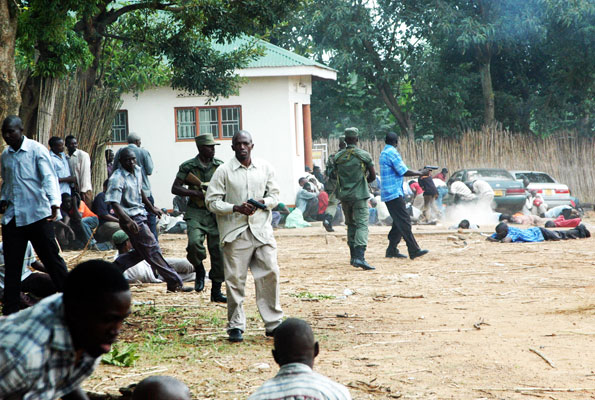
Daily Monitor reports that three people have been killed while five are nursing injuries at Mulago Hospital after they were shot by military police at Kasubi Tombs earlier today (Wednesday morning in Kampla).

Military police weilding guns at crowds at Kasubi tombs. Daily Monitor photo

The military opened fire after a crowd of people tried to block president Museveni’s convoy from accessing the cultural site that burnt to ashes.

The army spokesperson Lt. Col. Felix Kulayigye gave this explanation:

“Our soldiers deployed at Kasubi came under a hail of stones thrown by some rascals, They fired in the air in self-defence but, unfortunately, two people were hit and they died while five were injured.”

Do you have to shot three people armed with stones???

Well, President Museveni managed to visit the scene and the Buganda cabinet meeting  declared seven days of mourning in honour the royal tombs which were destroyed by a fire last night.

Government said it would investigate the shootings but many would doubt such an investigation becuase in the past demonstrations many have been shot dead and no police officer has resigned or been bought to justice. Also the cause of the fire might never be known as suscipicion towards government hangs around.  The cultural heritage has been in existence since 1882.

The King of Buganda Kabaka Ronald Muwenda Mutebi was moved to tears as he visited the place. The Kingdom has said it will carryout its independent investigation.

An NTV clip shows the scene

I am not in Kampala and therefore i rely  on news updates on newspaper websites which dont seem to be regularly updated. so if you’re in Kampala let us know what ther situation is like.

Note that besides the Kasubi tombs incident, Makerere students have been rioting over the death of two students shot dead by a guard at one of the hostels.

I am told the riots haven’t reached the centre of the city and that there’s heavy deployment of military in the city.

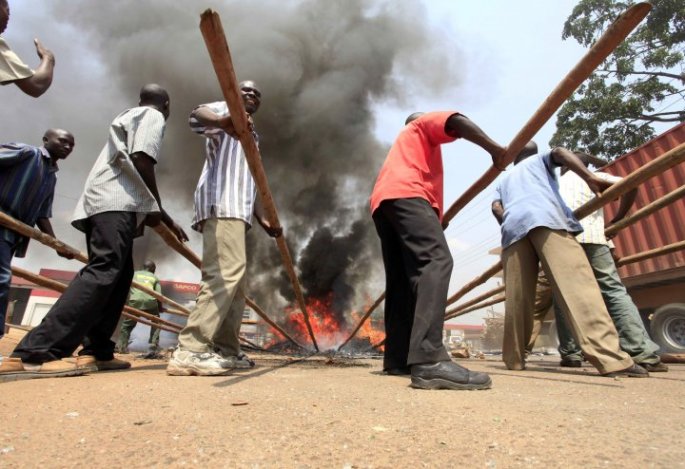
riots in Kampala city: photo picked up from Vision Voice facebook wall.

The discussion that followed this picture on facebook wall for Vision Voice radio, a partly government owned radio in Kampala was whether riots are justified.

“We have had many incidents of riots for many reasons from University students to political, cultural and economic reasons. But are riots justified under any circumstances”

I would say demonstrations are justified but riots where looting and destruction of properties of which owners have nothing to do with the events are bringing down our country and taking us nowhere.

There are indeed more civil ways to riot without targeting and destroying innocent lives.

Landslides in Eastern Uganda kill hundreds

Daily monitor says only 80 bodies so far found and quotes The Uganda Red Cross Society reporting that at least 350 people had been buried alive.

A Daily Monitor photo by NICHOLAS KAJOBA

The newspaper also takes an important question of how this disaster could have been avoided.

Landslides have always been a problem in eastern Uganda but what has been put in place to lessen the risk of many in these villages being buried whenever it rains. There are estimated 50,000 people, some occupying the immediate precincts of the extinct volcano, who are regularly exposed to the threat from landslides.

Every rainy season there are deaths in this part of Uganda but the only approach has been that of conservation of the national park to relocate people.

There has been no government effort to really try to find other ways to persuade these people and find them alternative livelihoods. In a place where many people depend on farming relocating from the fertile volcanic soils is difficult decision. So they live one day at a time and hope they survive the next rainy season.

While the Mbale LC5 chairman Bernard Mujjasi has a point in saying relocation is not the only solution, it should be part of the solution. The planting of trees that he’s proposing is not enough to prevent deaths in the coming rainy season. It takes years for the trees to grow and become of use when heavy rains come. And the pressure on the limited land can’t be avoided. There can’t be one solution to this disaster.

Mujjasi might argue the Bagisu don’t want to re-locate because “they value their graves, their traditions and attachment to their ancestors” but when faced with being buried alive in the place of your ancestors and living somewhere else, I don’t think many would choose that cruel death.

Relocation should not necessarily mean people should lose ownership of their land. But given the history of land conflicts in the country, I can understand where Mujjasi is coming from.

We only hope this doesn’t become another political game where district leaders and central government give lip service and don’t fully evaluate the situation to find solutions especially for those at the highest risk.

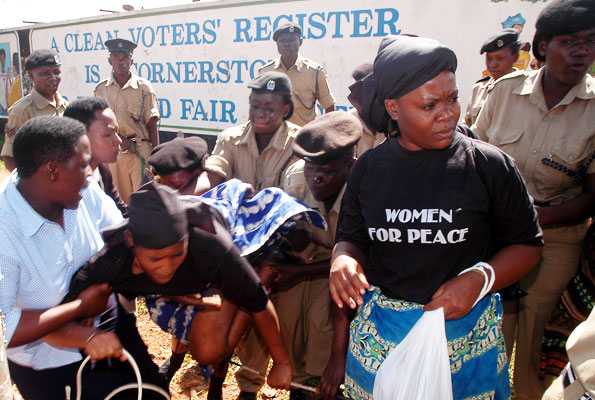
Uganda arrests 35 opposition women

I will be writing later but you can find a the story here.

Below is a picture from Daily Monitor showing police brutality.

US Khartoum Embassy issued attack warning. Uganda authorities learnt from embassy website

The East African photo

The BCC says The US embassy in the Sudanese capital Khartoum has warned of a possible attack on Air Uganda planes.

The embassy said it had information that US travellers faced a potential threat between Juba in Sudan and the Ugandan capital, Kampala.

A spokesman for the Ugandan army, Lt Col Felix Kulayigye:

US warning was a surprise.

Intelligence had been known since early December.

Uganda foreign affairs office:

Allegations of attack not grounded.

US manner of the warning criticised.

Uganda authorities not informed.

“They did not inform us of this security threat, we learnt about it from the embassy’s website,” – Foreign Ministry spokesman Moawiya Osman Khalid

AFP said an Air Uganda flight was returned to Entebbe airport in Kampala when it was ordered to return.

well no suprise but there’s no information on Air Uganda website

Is US up again about going it alone? Is Uganda paying the price of ‘fighting US wars.’

Government tightens the noose on press freedom as elections in Uganda get close

Last week it was the Daily Monitor editors who were summoned by police on charges of forgery and uttering a false document over the publication of President Museveni letter on politics in Bunyoro in July which has been widely seen as tribal.

One of the editors Daniel Kalinaki said: “Our journalists acted in the public interest and reported the best obtainable version of the truth. These charges, which are completely false, are only meant to divert attention away from the controversial contents of the letter.

But apparently it seems the government is not only looking at the Bunyoro issue but rather stories that will have real implication on the elections as Museveni who has been in power since 1986 seeks to extend rule in Uganda come 2011.

Yesterday the police summoned The Independent editors over a cartoon that they claim to be “seditious publication” under the Provisions of Section 27A of the Police Act.

Here is the Cartoon.

seditiouscartoon

How can Uganda see free and fair elections in 2011?

President Museveni shocked Ugandans by renewing the term of the Electoral Commission chairman Badru Kiggundu and four other commissioners. I have read Gaaki Kigambo’s analysis in The Independent and found interesting. One of the new commissioners is Justin Ahabwe Mugabi, a teacher who has no idea of how the commission works.

Eng. Badru Kiggundu, EC photo

And issues of competence of the current commission have been raised in the Ugandan media for quite a long time (since 2006.)  Many have said that Museveni is preparing to rig again come 2011. I think backgrounds of these commissioners need to be checked properly. When they appointed Sr Margaret Magoba many saw it as a ploy by Museveni to convince Catholics that he was with them and that he could choose a nun to be part of the organisation of elections. This could have been a good cover but I have got friends who went to Immaculate Heart Girl’s school where Sr Magoba was a headteacher for a good time. My friends were just 14 years in senior two when Uganda saw the first presidential elections under Museveni in 1996. My friend remained at school and the school was actually a polling station. She was actually forced to vote by Sr Magoba. No you can’t call it voting. My friend was called to the polling center which was in one of the rooms at school and they asked about her age and they gave her a ticked ballot, the only thing she did was drop it in the box.

The other friend a lady I have much respect for told me she was excited by the whole freedom to vote even when she was fifteen. She indeed ticked President Museveni under the watchful eye of Magoba. More than ten years after that she feels so bad about having to help a regime rig elections when she was only 15. So when out of nowhere she was appointed to the commission everyone new almost nothing about her and her part played in the past elections. It’s known that elections are not rigged at polling stations but at district levels so I think the opposition should not only concentrate on the EC but should move for reforms like mechanised polling process. Some Ugandans in South Africa have written in the past to the EC to ask if the can help procure the voting machines but the EC and government have turned a blind eye.

So if Kiggundu really stays he must be pressed to adopt changes so that the rigging is prevented. So events of having 15 year-olds voting in a little room at a school should not be repeated or having multiple voting which is done mostly in military barracks and other areas where government has deployed their vigilantes in the past.