President Museveni yesterday warned that anyone suggesting that his government had a hand in the burning of the Kasubi tombs would be dealt with.
I am waiting for someone to say so publicly and I really deal with him … I am really dying to lay my hands on such a person. If anybody is not yet sure of the evil and wicked intentions of some of these elements, a slander like this is part of the proof.
The government neither contributed to the fire nor its prolongation. Instead it’s the government that put out the fire; saved the kings’ remains, the walls of the house and cemented floor and some of the artifacts and stopped the fire from spreading to other buildings.
As President Museveni said, no body has publically said that his government is responsible, the president is being ‘worked up’ by the the never-dying Kampala rumourmill which plays an important role in spreading stories that never make it to the public arena. Sometimes the rumourmill gets it right sometimes it’s just another story that has ‘no head or a tail’ as a Runyankole saying goes. So the president may be waiting for years before he hears anyone publically say that they believe his government had a hand.
The President said this at a press conference. Daily Monitor has more on that report. Investigations are yet to give us a clue on what or who started the fire.
After calm restored to the city, two days after the burning of Kasubi tombs, the questions have moved to the conduct of armed forces which led to the killing of three unarmed civilians. Human rights defenders are calling on government to stop the use of plain clothed operatives in riot times.
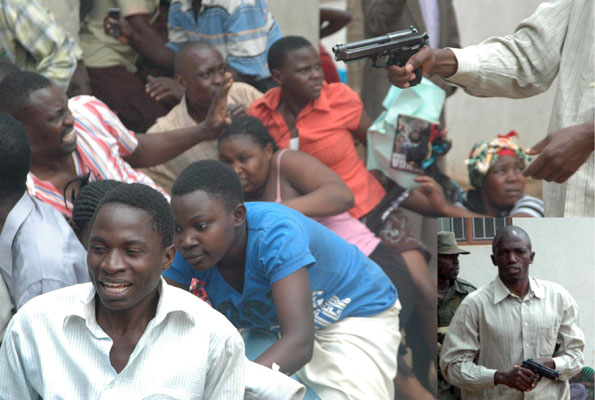
non-uniformed security operatives in action at Kasubi. A Daily Monitor photo
Most of these operatives were seen weilding pistols pointing at crowds at Kasubi. The use of plain clothed operatives to do government’s dirty job against it’s opponents in the past is well documented. During Kampala riots last September, Radio One presenter and moderator Karundi Serumaga was arrested by these operatives, tortured and was later dumped at a hospital.
Most political opponents and commentators face threats from such operatives. They arrest people with no court warrant and their work was at display between 2001-2005 when they continiously without warrants arrested many people linking them with the Peoples Redemption Army (PRA), a rebel group that is known only by our government.
Non-uniformed operatives again had an upper hand in storming the High Court to re-arrest PRA suspects who had just been granted bail in March 2007 . A scene that the Principal Judge James Ogoola described as the “the rape of the temple of justice.”
Med Kaggwa, the chairman of Human Rights Commission yesterday argued that
Operatives in civilian outfits find it easy to commit crimes, knowing they will neither be identified nor traced. This disturbs us a great deal because when an incident happens, as indeed it happened [on Wednesday], you cannot tell if the person is a security operative or a state enemy.”
Another incident on April 17, 2007 during a political demonstration against the give-away of part of Mabira forest for sugarcane growing , stick-wielding men in civilian attire, came onto the scene and whipped the demonstrators. The police never restrained them, they seemed to be working hand in hand and government later denied they were part of their security teams. Later, an invesitgation by a partly government owned newspaper New Vision showed that
There are at least five Kampala-based groups of strong men trained to control crowds without using fire arms. Three are registered with the Ugandan Police as unarmed private security firms. The other two are loose groups of muscled men, one attached to the Uganda Taxi Operators and Drivers’ Association (UTODA) and the other based at Arua Park. Whereas the registered groups are independent of the Government, they are sometimes seen operating alongside the Police.
Daily Monitor today also reported the number of those shot when the military dispersed a rowdy crowd ahead of President Museveni’s tour rose to seven.
As this discussion went, in my home district Bushenyi, a police officer commonly knows SPCs shot and injured three unarmed high school students who were cheering their teams after winning a football match at Kabwohe.
This comes only a month when two students of Kaloke Christian High School in Nakaseke District were shot by an SPC, after they had camped outside the head teacher’s office, protesting the poor conditions at the school.
These events tell us that criminal acts by those supposed to protect us are not about to stop, these trigger-happy well trained forces in handling civilians in an inhumane way are endagering our lives each day. It doesn’t if you’re a demonstrator or just not interested in anything going on, the chances of being in the wrong place with these security operatives have become high.They are even higher if these forces are not in uniform. I have heard stories of these operatives entering bars and threatening people at the smallest disagreement. In fact there are bars in Kampala where you enter and find these pistol weilding operatives. This is to tell you their threat is not only limited during riot times. Am hoping we wont stop at just statements from the Human Rights Commission.
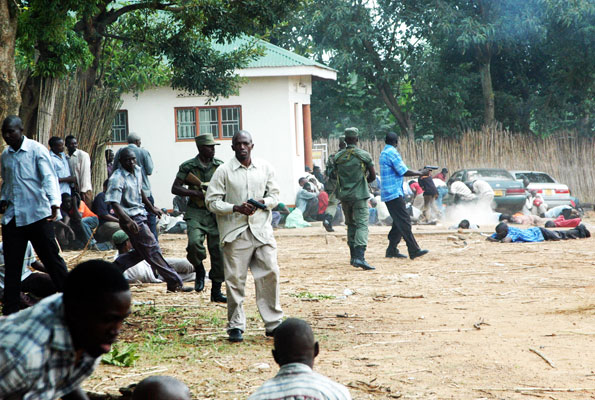
Daily Monitor reports that three people have been killed while five are nursing injuries at Mulago Hospital after they were shot by military police at Kasubi Tombs earlier today (Wednesday morning in Kampla).
Military police weilding guns at crowds at Kasubi tombs. Daily Monitor photo
The military opened fire after a crowd of people tried to block president Museveni’s convoy from accessing the cultural site that burnt to ashes.
The army spokesperson Lt. Col. Felix Kulayigye gave this explanation:
“Our soldiers deployed at Kasubi came under a hail of stones thrown by some rascals, They fired in the air in self-defence but, unfortunately, two people were hit and they died while five were injured.”
Do you have to shot three people armed with stones???
Well, President Museveni managed to visit the scene and the Buganda cabinet meeting declared seven days of mourning in honour the royal tombs which were destroyed by a fire last night.
Government said it would investigate the shootings but many would doubt such an investigation becuase in the past demonstrations many have been shot dead and no police officer has resigned or been bought to justice. Also the cause of the fire might never be known as suscipicion towards government hangs around. The cultural heritage has been in existence since 1882.
The King of Buganda Kabaka Ronald Muwenda Mutebi was moved to tears as he visited the place. The Kingdom has said it will carryout its independent investigation.
An NTV clip shows the scene
I am not in Kampala and therefore i rely on news updates on newspaper websites which dont seem to be regularly updated. so if you’re in Kampala let us know what ther situation is like.
Note that besides the Kasubi tombs incident, Makerere students have been rioting over the death of two students shot dead by a guard at one of the hostels.
I am told the riots haven’t reached the centre of the city and that there’s heavy deployment of military in the city.
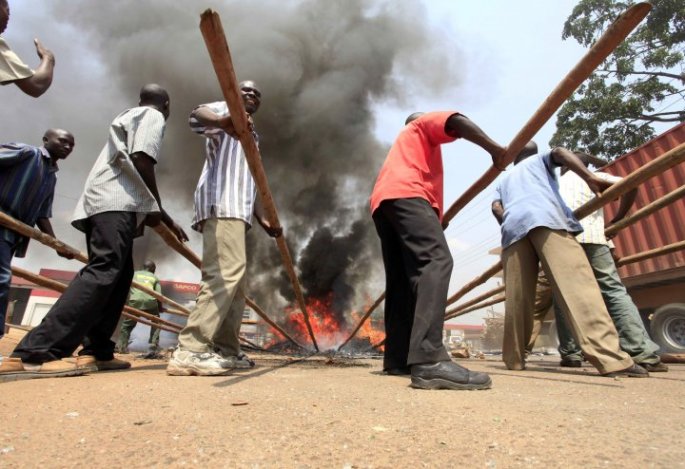
riots in Kampala city: photo picked up from Vision Voice facebook wall.
The discussion that followed this picture on facebook wall for Vision Voice radio, a partly government owned radio in Kampala was whether riots are justified.
“We have had many incidents of riots for many reasons from University students to political, cultural and economic reasons. But are riots justified under any circumstances”
I would say demonstrations are justified but riots where looting and destruction of properties of which owners have nothing to do with the events are bringing down our country and taking us nowhere.
There are indeed more civil ways to riot without targeting and destroying innocent lives.
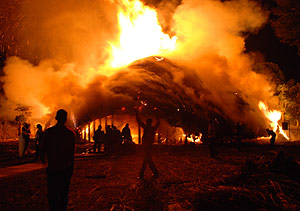
Kasubi tombs, a UNESCO World heritage site and burial place for four of Buganda Kings tonight (9:00 pm) Kampala time went up in flames. Daily Monitor reports that there’s arson suspicion but not much about the cause is yet known.
Kasubi tombs on fire on Tuesday night March 16th. A New Vision photo
Police was deployed as masses started gathering and charging as rumours of arson engulfed the city. Last year a riot that saw Buganda King supporters against the security forces left around 21 people dead millions worth of properties destroyed.
CBS radio, a Kingdom owned radio is still closed after government accused it of inciting violence during last year’s riots. This relationship between President Museveni’s government and Buganda Kingdom is far from rosy and this has already given fertile ground for many to think there was some foulplay. Many people seem to expect riots to breakout at dawn. We only hope there will be a thorough investigation into the burning of the tombs and that no people will lose their lives and property. This is crucial time for Buganda leadership too. The Kasubi tombs are equally a heritage for the country so i hope both sides deal with this issue with maximum restraint.
Xinhua reported that the police was not allowed to access the scene as the crowds gathered to throw stones at the police injuring one officer.
This is a facebook status i picked up from one of my friends. She was refering to the incidents in Rwanda in the last one month that have many ears raised in east Africa. Rwanda’s capital has experieced grenade blasts on two separate occasions in the last few weeks. It is still unclear who is behind them but goverment claims some former President Kagame RPF buddies in exile according to the BBC report. The one blast near Kigali’s genocide memorial left at
Gruesome: bodies at the genocide memorial site at Nyamata
least 16 people wounded in the near-simultaneous blasts on Thursday 4th.
Rwanda has enjoyed some calm since the 1994 genocide but there are concerns on the ever tightening noose on freedom by the current regime.
The Rwanda Revenue Authority complex one of the major infrastructual developments in the country but peace remains fragile.
There’s lack of space for political dissent as well as media freedom. The media is either government controlled or influenced.
The media played a key role in the genocide and it’s on this background that the government has treated post genocide media as force that you can dare let free.
The country has made major progress in development and it has been hailed for it’s healthcare system especially the insurance, rarely seen in other African states. The government has also managed to introduce technology setting a good example for the continent.
When you travel from Uganda to Rwanda by road, you will take more hours than necessary on Uganda’s potholed roads but as you cross the valley at the Katuna border, you appreciate the infrastructure that has been put on the Rwandan side.
But Rwanda still faces an uphill task of bringing a people together and with the Interahamwe, who were behind the genocide that killed about 800,000 Tutsis (mostly) and moderate Hutus formed a miltia in Eastern Congo after the genocide and are still active.
Amnesty International last month issued a report condemning attacks on a Rwandan opposition group as the country prepares for presidential elections in August 2010.
Also some of President Kagame’s allies have fled the country on accounts of intimidation. The latest being former Rwanda military chief Lt. Gen. Kayumba Nyamwasa. He gave an interview to Voice of America this week in South Africa. He was Rwanda’s ambassador to India and according to the interview his wife is under house arrest in India after he fled.
Daily monitor also reports that another Rwanda envoy Jean Pierre Bizimana in the Netherlands is also under suspicion for having granted present vocal opposition leader, Victoire Ingabire Umuhoza, a Rwandan passport. Ms Ingabire has been out of the country for over 16 years, returned last month and she is aspiring to run for president in the coming election. This will be a challenge for RPF who have won world accolades for the progress in putting women in leadership positions.
But for now the country remains in a fragile security threat and with no developed media and almost no room for the rumour mill and my friend’s question remains, who will watch the watchman?
BBC reports that one blast near Kigali’s genocide memorial left at least 16 people wounded in the near-simultaneous blasts on Thursday 4th.
Rwanda has enjoyed some calm since the 1994 genocide but there are concerns on the ever tightening noose on freedom by the current regime.
I will be posting reaction from different people on what Rwanda faces and how the country’s future can be saved from further violence.
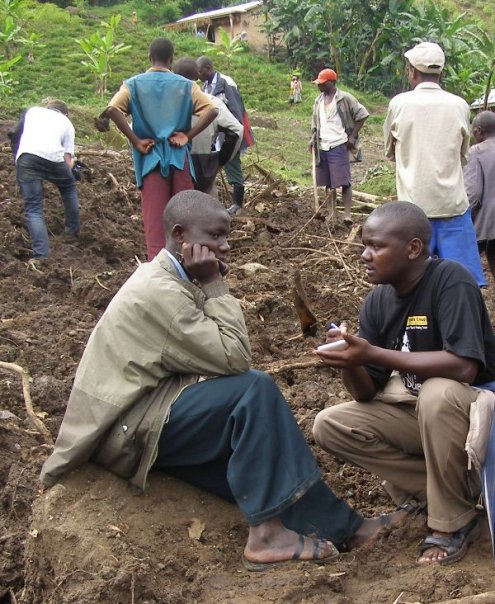
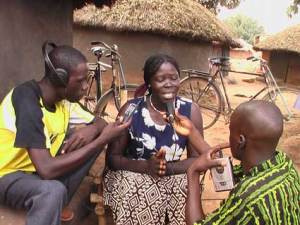
Henry Mukasa, a Ugandan journalist interviewing a survivor.
My friend Henry had this to say on the situation on his facebook page:
“I was in Bududa; the guys there are inconsolable after losing almost all relatives and their livelihood. Isaac Watyekele lost his father, mother and siblings!”
Isaac is the man he was interviewing in the picture. It’s simply tragic. The place is far from the capital and officials are saying some bodies will never be found as the army and aid workers only have their hands and ordinary hoes to plough the rocky Mount Elgon region.
Again I hope we will have more reports in the media focuing on how or what the government efforts should be after this catastrophy.
I have seen reports that some people are willing to migrate but one could say they are not in a good state to determine their future but we need to see a government plan.
President Museveni visited the area but only said the situation was due to the cutting of trees on the slopes of the mountain without saying that longterm solutions would be besides tree planting.
What has many wondering is why would a president visit a disaster hit area wearing an AK47 around his neck? Not even can these arms protect us from such catastrophies. so will such a day come to Uganda when this governments will shift it’s thinking from the show of arms to try to resolve problems of the common people?
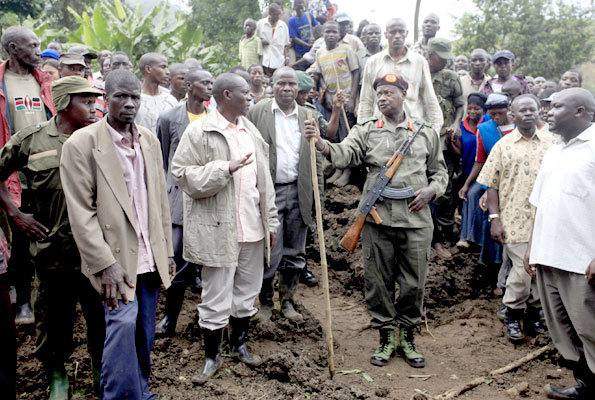
President Museveni on a visit to the landslide hit area.
Note that Museveni retired from the army and claims to only be a commander-in-chief of the forces but such appearances only reinforce the reality that many Ugandans know and are worried about. What the people of Bududa want is not a president in military fatigue as if the villages have been attacked by rebels, but a comprehensive solution to these landslides that affect the area every rainy season.
Meanwhile according to Daily monitor more than 30,000 people in Butaleja have been displaced by floods as the rain continues to pour. Government has issued alerts for Kabarole and Kasese, both in western Uganda where bridges have so far been washed way. I only hope that these floods don’t cause anymore deaths but this calls for proper preparation of the populations in the high risk areas.
Daily monitor says only 80 bodies so far found and quotes The Uganda Red Cross Society reporting that at least 350 people had been buried alive.
A Daily Monitor photo by NICHOLAS KAJOBA
The newspaper also takes an important question of how this disaster could have been avoided.
Landslides have always been a problem in eastern Uganda but what has been put in place to lessen the risk of many in these villages being buried whenever it rains. There are estimated 50,000 people, some occupying the immediate precincts of the extinct volcano, who are regularly exposed to the threat from landslides.
Every rainy season there are deaths in this part of Uganda but the only approach has been that of conservation of the national park to relocate people.
There has been no government effort to really try to find other ways to persuade these people and find them alternative livelihoods. In a place where many people depend on farming relocating from the fertile volcanic soils is difficult decision. So they live one day at a time and hope they survive the next rainy season.
While the Mbale LC5 chairman Bernard Mujjasi has a point in saying relocation is not the only solution, it should be part of the solution. The planting of trees that he’s proposing is not enough to prevent deaths in the coming rainy season. It takes years for the trees to grow and become of use when heavy rains come. And the pressure on the limited land can’t be avoided. There can’t be one solution to this disaster.
Mujjasi might argue the Bagisu don’t want to re-locate because “they value their graves, their traditions and attachment to their ancestors” but when faced with being buried alive in the place of your ancestors and living somewhere else, I don’t think many would choose that cruel death.
Relocation should not necessarily mean people should lose ownership of their land. But given the history of land conflicts in the country, I can understand where Mujjasi is coming from.
We only hope this doesn’t become another political game where district leaders and central government give lip service and don’t fully evaluate the situation to find solutions especially for those at the highest risk.
It’s the new song by Akon and Keri Hilson featuring The Soweto Gospel Choir as a charity single to benefit underprivileged African youth and it also means much as the continent is three months away from the historical moment. Go Africa!!!!
The Global Media Monitoring Project (GMMP) in 2005 found only one woman for every four men who are appear as subjects in the world’s radio, television and print news. Expert opinion in the news was overwhelmingly male. Only 10% of news stories focused centrally on women. In November 2009, the media was monitored in 127 countries to update the 2005 report. Will the preliminary findings of the 2009 Global Media Monitoring Project show any change?
As part of the 54th session of UN Commission on the Status of Women review of Beijing+15, preliminary results of the GMMP 2009/2010 will be launched at a panel event.The WACC/UNIFEM event is scheduled for 2 March in New York.
There will be panel that will discuss the progress towards fair and balanced representation of gender and women in the media, and debate on what should be done by the media, governments and gender activists to make progress.
Ugandan journalists interview a woman in the north. Adungu photo
But in my country you have women like Kabakumba Winnie Matsiko who are spokespersons but their first mandate is to serve the powers that be. Instead of pushing for policies that are more meaningful to women, they want cheap popularity with their ‘maker by even going to extremes to accuse a parliamentary committee of killing a businessman who had not accounted for public funds he spent.
I will be waiting for the results from this research and I hope that one day Ugandan women will be well represented in the media. For now our media is mostly cluttered with empty talk by women in yellow dresses which is difficult for the media to ignore.
Most reports often show women as victims or in the cases like of faking pregnancy, the women are portrayed as monsters and without shame without reporting root causes of such issues.
Two weeks ago, Costa Rica elected their first female Head of State which saw the ruling party, the center-right National Liberation Party grab another win. Then President-elect Laura Chinchilla pointed many goals for the next four years as improving public education, bettering health care coverage and continuing the country’s push for environmental sustainability.
The day before this election I had been part of an election observation mission from school which saw me and other students meet Chinchilla and the runner up Otto Guevara.
I asked both campaigns what plan they had for marginalised communities in Costa Rica especially black people in this country. Both of them rushed through their answers and literally avoided mentioning that this is a serious problem in a country that has been stable with no army for a little over 60 years.
The struggle of black people here is not necessarily different from that in other central and South American countries but I simply asked because this country is often held high, almost singled out as an island of democracy and development in Latin America.
When you first arrive in Costa Rica, you’re told of the beauty of the country and no doubt the place is very well gifted by nature. Then you’re told this a peaceful country but you should watch your back when you visit one place called Limon.
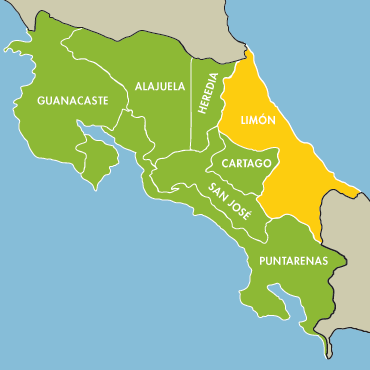
Limon is a province in the east of the country on the Caribbean Sea where most black people live. It is also home to the main port for Costa Rica’s imports and exports. The people mostly speak English and many are bi-lingual. So if you’re black and English speaking you’re told that the Caribbean is a must visit but most tourism which the country is well known for has been directed to the pacific.
The infrastructure development is almost non-existent in most tourist spots like Tortuguero (basically the land of turtles). Many schools in this province (am told by a friend who works with an NGO there) are in an appalling state. The dropout rate for school kids is much higher as many have to help their parents support families.
Getting out of San Jose to Limon basically takes you to a different world. There are visibly few black Costa Rican professionals in the major sectors and industries that the country has seen grow in recent years.
When I asked Chinchilla’s campaign team about this regional and racial inequality one man told me that he too is from poor place and that poverty is not just a problem for only Limon. This kind of attitude showed me that they are not willing to admit to historical misfortunes of their country.
Otto on the other hand told me that the problems of black people are founded in the lack of land rights but does a government need people to have land rights in order to construct proper schools, health facilities and good roads? But this is the same man who was talking of punishing criminals like there’s just one way to curb crime and I asked him aren’t this criminals created, to greater extent, by the country’s system but he said he also had plans for poverty eradication.
They all avoided the link between the isolation and marginalisation of a people and crime. All they sought was to assure the country’s majority that their safety will be guaranteed with more money to the police and more sophisticated operations against gangs and criminals. There were many Costa Ricans at the conference that came up to me and told me what a good question I had asked. They further confirmed to me that they don’t see any plan that their government has for this historical imbalance.
“They actually have a plan for Limon,” on gentleman said, “their vision is to use Limon for only specifically exporting their bananas and pineapples and nothing else.”
The ignoring of the racial issues, I noticed in most political adverts for the election. I didn’t come
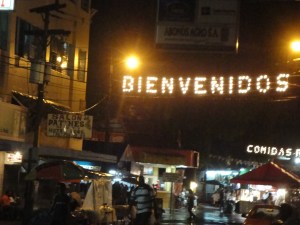
night time in Puerto Limon just before the carnival last year.
across any that featured a black or Indian person. This tells that segregation need not be written in laws. In such political events, we learn who is important and who is not.
As I put these questions to the campaigns, there was hardly any black Costa Rican in the room and I thought that’s why it was easy for them to ignore these issues because none of them is there to ask.
On the election night when the Tribunal was announcing the results, the numbers of absent voters in the region of Limón was the highest and it wasn’t a surprise. Why would one go to vote people that won’t change a thing in their life? This reminded me of elections in Uganda where most people don’t have hope in the elections only that in Uganda it’s also a mix of issues like vote rigging and voter disenfranchisement.
So while Costa Rica made headlines about voting a woman to the highest office, this is not meaningful to many lives here. For many in Limon and other areas with unequal access to resources it will be four more years of inequality and being forgotten.
Limon has a high crime incidence than any other part of the country and sometimes the UN has highlighted it as no-go zone for its staff for some periods. What the country is missing by neglecting certain people must be a lot.
This country is a poor one. This is a country the giant international software company Intel plant exported more than $2 billion in microprocessors and chipsets in 2009.
Of the 4.6 million people, black people account for 3 percent and most of them live in Limon province. For years the country had racist immigration and residence laws that restricted black people to the Caribbean coast until 1949, when the new Constitution came but they remained isolated from national culture.
Afro-Caribbean settled on the Caribbean coast as early as 1825 but most blacks today trace their ancestry back to the 10,000 or so Jamaicans hired by Minor Keith to build the Atlantic Railroad, and to later waves of immigrants who came to work the banana plantations in the late 19th century. They are now about 3 percent of the country’s population. Follow Epsy Campbell Barr a politician and economist to get a little idea about the issue.
I must say that it’s not common to experience open racism here save for a few instances. Like one time in San Jose when a woman at a restaurant yelled at her colleague for changing the music to reggae when my friend arrived for a meal. Even with her limited Spanish, my friend could grasp the irritation and the ranting of this one woman saying, “If you want black people music and reggae, just go to Limón. Not in my restaurant.” Of course my friend walked out gently and looked for some other place to buy her lunch.
While such incidents aren’t common, to the best of my knowledge, the inequality and systematic ignoring of the issues of race by subsequent governments has had a toll on development of black people in Costa Rica. Whether it is the exclusion of their history in the education system or the lack of investment in people who made this country’s economy to flourish as they constructed the railway and planted bananas and pineapples, I found this worth writing about.
Two weeks ago, Costa Rica elected their first female Head of State which say the ruling party, the center-right National Liberation Party grab another win. Then President-elect Laura Chinchilla pointed many goals for the next four years as improving public education, bettering health care coverage and continuing the country’s push for environmental sustainability.
The day before this election I had been part of an election observation mission from school which saw me and other students meet Chinchilla and the runner up Otto Guevara.
I asked both campaigns what plan they had for marginalised communities in Costa Rica especially black people in this country. Both of them rushed through their answers and literally avoided mentioning that this is a serious problem in a country that has been stable with no army for a little over 60 years.
The struggle of black people here is not necessarily different from that in other central and South American countries but I simply asked because this country is often help high in democracy and development.
When you first arrive in Costa Rica, you’re told of the beauty of the country and no doubt the place is very well gifted by nature. Then you’re told this a peaceful country but you should watch your back when you visit one place called Limon.
Limon is a province in the east of the country on the Caribbean Sea where most black people live. It is also home to the main port for Costa Rica’s imports and exports. The people mostly speak English and many are bi-lingual. So if you’re black and English speaking you’re told that the Caribbean is a must visit but most tourism which the country is well known for has been directed to the pacific.
The infrastructure development is almost non-existent in most tourist spots like Tortuguero (basically the land of turtles). Many schools in this province (am told by a friend who works with an NGO there) are in an appalling state. The dropout rate for school kids is much higher as many have to help their parents support families.
Getting out of San Jose to Limon basically takes you to a different world. There are visibly few black Costa Rican professionals in the major sectors and industries that the country has seen grow in recent years.
When I asked Chinchilla’s campaign team about this regional and racial inequality one man told me that he too is from poor place and that poverty is not just a problem for only Limon. This kind of attitude showed me that they are not willing to admit to historical misfortunes of their country.
Otto on the other hand told me that the problems of black people are founded in the lack of land rights but does a government need people to have land rights in order to construct proper schools, health facilities and good roads? But this is the same man who was talking of punishing criminals like there’s just one way to curb crime and I asked him aren’t this criminals created, to greater extent, by the country’s system but he said he also had plans for poverty eradication.
They all avoided the link between the isolation and marginalisation of a people and crime. All they sought was to assure the country’s majority that their safety will be guaranteed with more money to the police and more sophisticated operations against gangs and criminals. There were many Costa Ricans at the conference that came up to me and told me what a good question I had asked. They further confirmed to me that they don’t see any plan that their government has for this historical imbalance.
“They actually have a plan for Limon,” on gentleman said, “their vision is to use Limon for only specifically exporting their bananas and pineapples and nothing else.”
The ignoring of the racial issues, I noticed in most political adverts for the election. I didn’t come across any that featured a black or Indian person. This tells that segregation need not be written in laws. In such political events, we learn who is important and who is not.
As I put these questions to the campaigns, there was hardly any black Costa Rican in the room and I thought that’s why it was easy for them to ignore these issues because none of them is there to ask.
On the election night when the Tribunal was announcing the results, the numbers of absent voters in the region of Limón was the highest and it wasn’t a surprise. Why would one go to vote people that won’t change a thing in their life? This reminded me of elections in Uganda where most people don’t have hope in the elections only that in Uganda it’s also a mix of issues like vote rigging and voter disenfranchisement.
So while Costa Rica made headlines about voting a woman to the highest office, this is not meaningful to many lives here. For many in Limon and other areas with unequal access to resources it will be four more years of inequality and being forgotten.
Limon has a high crime incidence than any other part of the country and sometimes the UN has highlighted it as no-go zone for its staff for some periods. What the country is missing by neglecting certain people must be a lot.
This country is a poor one. This is a country the giant international software company Intel plant exported more than $2 billion in microprocessors and chipsets in 2009.
Of the 4.6 million people, black people account for 3 percent and most of them live in Limon province. For years the country had racist immigration and residence laws that restricted black people to the Caribbean coast until 1949, when the new Constitution came but they remained isolated from national culture.
Afro-Caribbean settled on the Caribbean coast as early as 1825 but most blacks today trace their ancestry back to the 10,000 or so Jamaicans hired by Minor Keith to build the Atlantic Railroad, and to later waves of immigrants who came to work the banana plantations in the late 19th century. They are now about 3 percent of the country’s population. Fellow Epsy Campbell Barr a politician and economist to get a little idea about the issue.
I must say that it’s not common to experience open racism save for a few instances like San Jose when a woman at a restaurant yelled at her colleague for changing the music to reggae when my friend arrived for a meal. Even in her little Spanish my friend could grasp the irritation and the ranting of this one woman saying, “If you want black people music and reggae, just go to Limón. Not in my restaurant.” Of course my friend walked out gently and looked for some other place to buy her lunch.
While such incidents aren’t common, to the best of my knowledge, the inequality and systematic ignoring of the issues of race by subsequent governments has had a toll on development of black people in Costa Rica. Whether it is the exclusion of their history in the education system or the lack of investment in people who made this country’s economy to flourish as they constructed the railway and planted bananas and pineapples, I found this worth writing about.


 Rosebell Kagumire