Costa Ricans go to polls

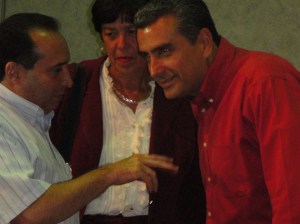
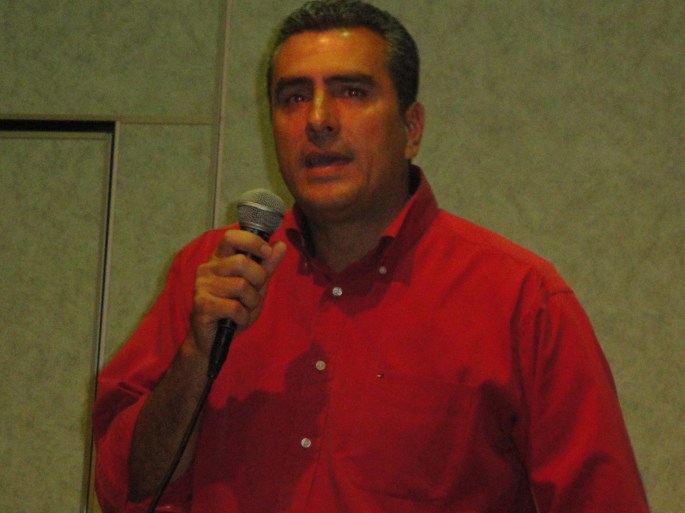
Tomorrow I will be taking part in the election monitoring of the Costa Rican elections. Today we caught up with the two front runners, centrist Partido Liberación Nacional’s Laura Chinchilla (pronounced as Kinkiya for Ugandans) who is seeking to be the country’s first female president and Otto Guevara of the Partido Movimiento Libertario. Otto who has a very ‘Ugandan’ name reminded of one of the drama kings in our parliament, Odong Otto. But that’s not all about this man. He’s all for free trade while Chinchilla believes in monopoly and nationalisation.

We had a Q&A session but i wont be posting my thoughts on the candidates i finish up with the observer mission tomorrow. Here are some of the shots i got.

Laura Chinchilla Miranda
Otto Guevara talking to one of the observers
Otto Guevara

To watch some of the ads the campaigns produced follow this link. And follow The Wall Street Journal analysis here


Beyond Elections: Making accountability work

We’re closing, in part, on this note:

Since the late 1980s, the number of elected governments in Africa has increased dramatically. Elections are now the norm on the continent, and citizens are using both traditional and new media to exert pressure for continuing reform and accountability. What tools and institutions are complementing elections to strengthen democracy and promote peacebuilding? How are communication technologies creating new platforms for citizen voices and government accountability?

One wonders whether rigged elections (Kenya, Zimbabwe, Nigeria, Uganda) also count in the dramatic increase in elected governments. Just asking.

Africa’s place in the digital age

Today’s conversation is about the much touted fibre optic cables that are connecting the last unconnected coastline in the world: The East African Coastline. The crux of the session is summarised as:

In 2009, the completion of several undersea fibre-optic cables connected Africa to cheaper and faster Internet access. The rapid expansion of broadband in Africa offers tremendous new opportunities for economic growth and social innovation. How is access to digital technologies and the Web shaping African business, government, and society? What are the risks and rewards of expanding broadband access?

Will report back on any takeaways from the session. Otherwise, the current speaker (Marc Giget, Professor and Chair of Technology and Innovation, Conservatoire National des Arts et Métiers (CNAM), France) is doing his thing in French, and I’m French-deficient.

Does Africa Need Rebranding?

That was the crux of one of the break out sessions at the ongoing conference about innovation, technology and prosperity in Africa.

From a lecture in public relations to another in social anthropology/social history to something incomprehensible from a lead economist from WB, it would be hard to tell if any of them answered even the most bare of questions: who has negatively branded Africa? What should the rebranding look like? And, for who is it supposed to benefit?

Does Africa need rebranding? Over to you, reader.

Oh, I had forgoten to include this blurb that explains what the session was supposed to be formally about:

“Africa’s ‘brand’ is created by the selective representation of the continent, often as a source of crises and as a destination for foreign aid. These perceptions of Africa matter. They shape our public discourse and influence important decisions in business and politics. With so many positive stories to tell about Africa, why do the negative ones dominate? How can Africa be ‘rebranded’? What about Africa should be highlighted in a rebranding strategy?”

What Is The Conference About?

This blog should have come before anything else. Anyhow, what’s this whole Africa’s New Frontier: Innovation, Technology and Prosperity conference about? The press release claims it will,

enrich our conversation about Africa, highlighting good news stories from Africa, and drawing on lessons learned, projecting trends, and focusing on the many ways in which Canada–Africa relations support innovation on the continent.

Some of the main sessions of the conference will be streamed live. So there’s an opportunity to be the judge. You can catch the streams here anytime you can. Other than that, return for my two cents worth of the whole conference.

Africa technology Conference in Ottawa

For today and tomorrow, my blog will be featuring guest blogger Gaaki Kigambo who is attending a technology conference focusing on Africa currently going on in Ottawa, Canada. enjoy the tech news from Africa!

Access to information in Uganda a myth: court dismisses oil agreements case

A court in Uganda has dismissed a case for access to oil sharing agreements filed by two journalists.

Charles  Mpagi and Angelo Izama took the government to court, seeking disclosure of information regarding oil agreements to empower the public to participate in the government decisions that affect them for efficient, transparent and accountable use of the petroleum resources discovered in Uganda.

This was the first time journalists tried to use the Access to information law passed in 2005 to get information.  This is a setback for most of us who thought passing the law had been a great step. What’s in a law if it can’t serve the purpose for which it enacted?

Already a few parts of the agreements that have been published show that the country signed a bad deal and may be reason government is trying by all means to block any avenues from which the public could access to full agreements.

More details on the ruling can be found here

Uganda media to watch for 2010 presidential campaigns

Last week we saw headlines of of the arrest women beat the Police to stage a demonstration in from of the Electoral Commission, which officially should be called the Museveni electoral commission. That was one of the exciting news fro Ugandans as they head into a difficult season of hearing useless promises from politicians who know they dont even need the votes eto stay in power. And then came former Kenyan president Daniel Arap Moi, who was President of Kenya for 24 years campaigns who came to the country invited by President Museveni on the eve his coronation as Eeast Africa’s longest ruling president. The invitation of Moi in itself shows that M7’s league is long and gone. And what advice does expect from a man who presided over a lootocracy and left his country bleeding?

We will be seeing how the media questions these politicians but for now the killer for the day is a cartoon below.

Onecaption is in Runyankole/ Rukiga (Museveni’s language) but it is not that clear whether President Museveni was telling his right-hand man and Security Minister Amama Mbabazi that his main opponent Dr. Kizza Besigye of FDC doesn’t know t know Mbabazi who is carrying the president.

Conversations from a School bus

It’s a Monday in Costa Rica and the new class on International Refugee Law is beginning. I am very excited. I run to get the school bus at 8:30 am which takes me about 15 minutes to get to school. The school bus is generally not a place you think very touchy discussions will take place, touchy to the point of forcing you to write about them. I am seated in the bus, not much to say apart from a few hellos and trying to figure out who is the new class. Then half way the journey I hear this good discussion on insurgents somewhere in Asia. I am so interested so I listen to two students exchange their views.

Then at one point comes the question of statistics. Are there Muslims in your country? Yes but a small number like about one percent and the rest is other religions.

And the next question is shot: so what’s the rest? Answer: Buddhists. And Christians? Also few like one percent. Then a sigh… “I am glad there are few Christians in your country.”  I turn around to observe the reactions and i hear  “I don’t like Christians” with an expression as if Christians were something filthy.

Watching this I felt my stomach tighten. I guess out of anger but not quite because I didn’t feel the thing around my neck that  sometimes makes it hard to breath. I think it was a mixture of anger, surprise and disappointment. Surprise because I have not heard someone insult me seated that close and someone I see every day. Disappointment , well I always expect a certain degree of respect.

From Uganda, I have heard people loudly say certain slurs about my tribe – not exclusive, every tribe its own punches but they make much more impact when you’re the target. But when such comes from a certain people off the street then you tend to overlook it many times. You hope at they will someday unlearn their hatred and the whole guilt by associations that has reigned in many societies.

So this bus conversation reminded me of those street and taxi insults. The difference in this case is that not only you’re insulted but that it comes from people you expect to keep respecting. I wanted to lean forward ask what this student’s story was. What bad experiences they had seen so maybe I could try to ‘justify’ their insensitive portrayal of their dislike but since that wasn’t my conversation in the first place that was out of bounds.

Karl Marx said that religion is the opium of the masses and he was never wrong. The conversation comes after a weekend of seeing gross stories and pictures from Jos, Nigeria where at least 265 people believed to have died in religious rioting hit headlines. Then I asked myself would such kind of dislike allow such a person to see that the 265 Nigerians were Muslim and Christians most of them just victims? Would such a person feel for Haitians of whom about 85 percent are catholic? I don’t know, I am only left to wonder about when the opium will run out or if it will ever.

I believe you don’t have to hate another religion to justify your own beliefs. I love Gandhi’s words, “I don’t reject your Christ. I love your Christ. It’s just that so many of you Christians are so unlike your Christ.”

May be this student has seen so many unchrist-like people but to profess your hatred of a people in a bus where about 2 in five are Christians is not the modest way to disagree.

Well I was compelled to write this bus ride conversation because it’s not the only one I have found puzzling. I have for instance heard comments like, “I was in Africa for a few months and when I finish my studies here I will head back there to save some Africans. They really need help.” All this well audible for at least four Africans on the bus to hear.

Then there have been others like people in the southern hemisphere are lazy. Not said to me but in the midst of many people from that part of the world. I am sure more such conversations take place in many places and such constructed views of the world exist among people you least expect but trust me it always has a knocking down effect to those who are there to listen.

Uganda’s pledge to Haiti

The Ugandan government has offered US$ 100,000 [shillings 180 million] to aid humanitarian efforts in the earth-quake hit island of Haiti. The Trinidad and Tobago Commission put up  “The Haiti Disaster Appeal Fund” where the government promised this money.

I proud that Uganda can aid about the same money a health center’s annual budget to Haiti for its more meaningful when people give not out their surplus but what they need too.

In the course of last week, we (students at upeace) from a student that finished her last year. it was heartbreaking just like most stories out Haiti but the different for many is putting a ‘real face’ you know to the disaster. Here it is:

“Dear Everyone,
As some of you may know it, a tremendous earthquake hit Haiti. I first thank you all for informing about me and my family. My little brother, families and friends passed away during this catastrophe. My hope is that God on his way will fill out the blankness left behind. Your inquiry about me makes more that what you think: it comforts and makes me feel I’m not alone. The situation that is developing now is : The earthquake is repeating at each time and keep surprising people(survivors). The population mostly school children and students are homeless they are suffering  but no medical supplies available to
take care of, people are starved  and violence is likely escalating specially in the prone- violence areas. It happens the world is not responsible, we are at least responsible of what we do with it.”

The Ugandan aid doesnt include private donations, i know most people in Uganda who are well off still struggle to educate cousins, grand kids, nieghbours who are not privileged but if you can please donate to the Fund put up by the Trinidad and Tobago embassy.